South Dana: the Pyramid Tomb and Qasr al-Banat
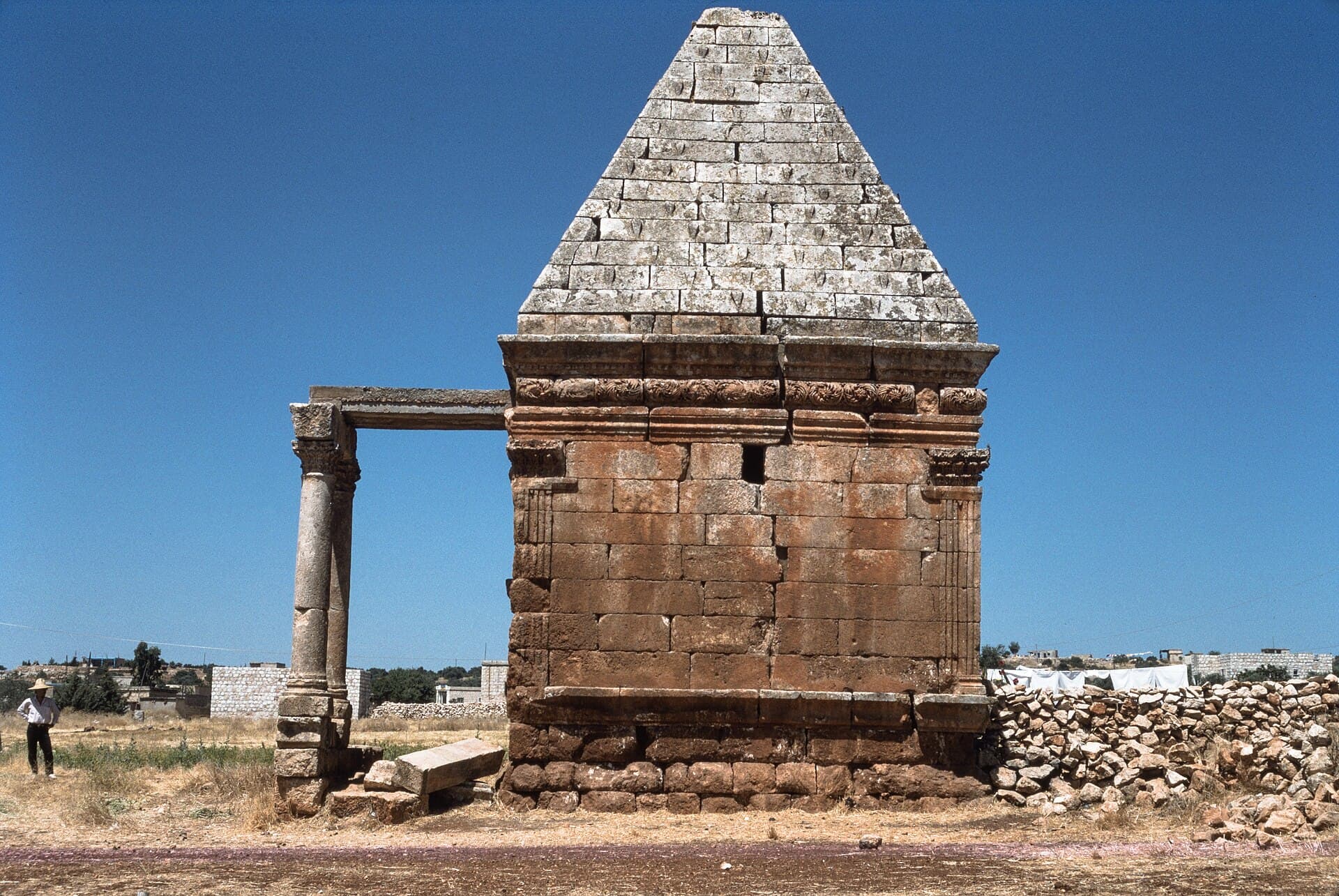
A pyramid-roofed tomb dated 324 on Jebel Zawiya, the earliest securely dated of its kind, and 500 metres north the Qasr al-Banat, still standing three storeys high.
- Opening hours
- Open site, daylight hours
- Entry
- Variable — confirm on arrival
- Duration
- 60 minutes
- Best time
- Morning, while the east front and the porch catch the light
- Period
- Late Roman — Byzantine
- Address
- Jebel Zawiya, north of Maarat al-Numan, Idlib
A small village and two monuments on the eastern edge of Jebel Zawiya, at 550 metres above sea level. The pyramid-roofed tomb at the eastern end of the village is dated by inscription to 324, which makes it the earliest securely dated pyramid tomb on Jebel Zawiya. About 500 metres to the north, alone on a low hill, the Qasr al-Banat, the Maidens’ Palace, still stands three storeys high. The two fit into a single visit.
Two things get confused. North of Idlib, in Harim district, there is another Dana, a town with a four-columned Roman tomb pavilion of the 2nd century; this page is about the village in the south. And the Qasr al-Banat in Raqqa is an Abbasid palace and a different building altogether.
Getting there
From Maarat al-Numan, 2 kilometres on the motorway towards Aleppo, then 2 kilometres west. The village sits on rolling ground among grain fields and olive groves. The same road runs 2 kilometres north-east to Jerada and on to Ruweiha. There is no public transport, so you need a car and driver.
How long it takes
An hour. The tomb is on the edge of the village, and the Qasr al-Banat is a walk away. Add Jerada and Ruweiha and you have half a day.
What you see
The pyramid tomb. It stands on the eastern edge of the village and is visible from a distance: a square chamber of neatly coursed limestone under a steep pyramid roof. Fluted flat pilasters with capitals mark the corners, and just below the fluted cornice runs a frieze of round bosses. The two tombs at Al-Bara and those at Ba’uda are later versions of the same form, from the 6th century. The form is traced back to the Mausoleum at Halicarnassus.
In front of the entrance, on the same continuous platform, there was originally an open porch of four columns. Melchior de Vogüé drew the building complete in the 19th century and showed the mouth of an underground burial chamber inside. In Gertrude Bell’s photograph of March 1905, three of the four columns are standing, with Corinthian capitals whose acanthus leaves look bent by the wind. Today two columns remain, with the architrave above them and three stone beams of the porch ceiling.
The tomb of Olympiane. On the same eastern edge, a canopy tomb on four columns. Around 1900 Butler dated it to the 3rd or 4th century.
The Qasr al-Banat. A very well preserved building, most likely a monastery. Its long south side has a two-storey arcade on thick square piers. A small square prayer room was added to the east end, like the apse of a church. Butler took the building for a khan, a travellers’ inn, with a small chapel attached. Traces of a 6th-century church lie nearby.
Don’t miss
Step under the tomb’s porch and look up: above the architrave on its two columns, three stone beams of the ceiling are still in place. Set beside Bell’s photograph of 1905, this is where you can read what the building has lost in a century.
Tips
- Ask the driver for Dana in the south; northern Dana in Harim district is somewhere else
- Look up at the ceiling under the porch; three stone beams are still in place
- Qasr al-Banat is about 500 metres north of the tomb on a low hill; walk there
- Jerada is 2 kilometres north-east; put it and Ruweiha in the same half day
Transparency
- How this was chosen
- Written by hand; opening hours, entry fee and coordinates are kept as data. A field that is not known for certain is marked as variable rather than guessed.
- Facts checked
- September 2026
- Last updated
- September 15, 2026