The Tetrastyle Roman Tomb at Dana (North)
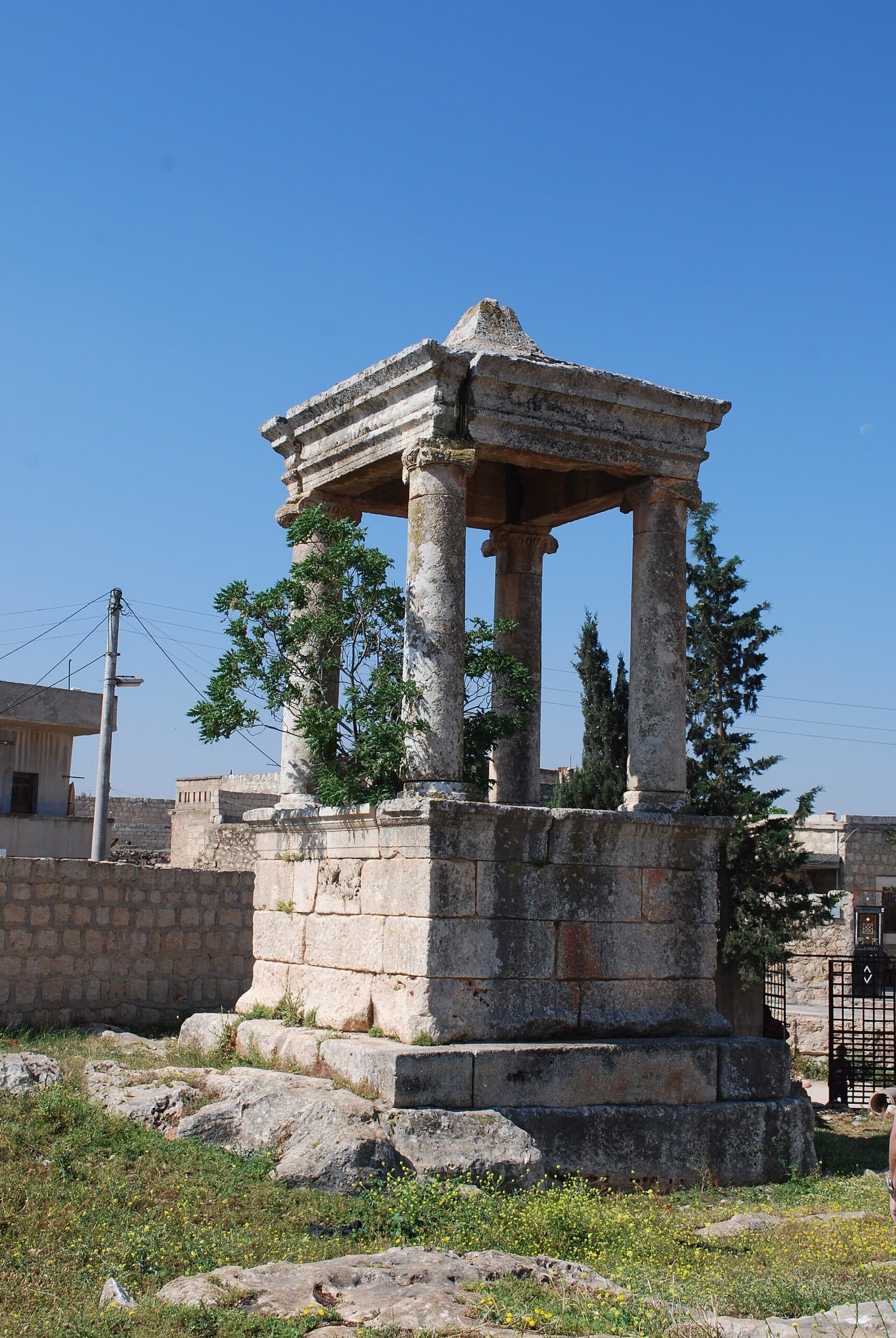
A 2nd-century Roman tomb in northern Dana, Idlib: four Ionic columns under a pyramid roof, one of the best-preserved Roman tomb canopies standing in the region.
- Opening hours
- Open site, daylight hours; condition uncertain, confirm locally
- Entry
- Varies — confirm on site
- Duration
- 30 minutes
- Best time
- Morning or late afternoon, when side light picks out the capitals and the moulding
- Period
- Roman
- Address
- Town centre of Dana, north of Idlib
A small Roman tomb canopy from the 2nd century in the town of Dana, north of Idlib. Four columns with Ionic capitals carry a gently curved pyramid roof; the canopy is the visible part of a burial chamber below ground. It is counted among the best-preserved Roman tomb canopies surviving in the region. The most recent photograph we have dates from 2004 and shows it fully standing; we could not verify its condition today.
Which Dana
There are two places called Dana in Idlib governorate. This monument is in the northern one: the main town of the plain between Jabal Barisha and Jabal Halaqa, at 390 metres. Southern Dana, in Jabal al-Zawiya with its own pyramid-roofed tomb, is a different place with a separate page.
Getting there
The town is about 3 kilometres north of the Aleppo-Bab al-Hawa motorway, 5 kilometres west of Deir Turmanin and about 15 kilometres south of Deir Semaan. The monument stands in the town centre; locally it is also called the Tomb of Daniel and Helena.
How it is built
The columns stand on a podium of four stone courses with two steps. The top course of the podium is carved as a broad fluted moulding. Four architrave blocks form a cornice with several profiles, and the roof rises above it. The only other example of this type in the region is at Barad. The two-column monuments at Sarmada and Refade are a different form.
The town’s lost church
Dana also had a dated church. An inscription on its west wall gave the year 483; Howard Crosby Butler found the lintel in 1899-1900 built into the wall of a new house. The church had three aisles on a broad rectangular plan, with three columns in each row. The only description of it before it was destroyed is the 1840 record by Texier and Pullan.
Older layers of Dana
The town is identified with Adennu, the Aramaean city taken by Shalmaneser III in 853 BC. A paved section of the main Roman road from Aleppo to Antioch survives 2-3 kilometres to the south, near Tell Karame. In the 1220s Yaqut al-Hamawi described a square level space cut into the hillside with a domed tomb in the middle. In the 19th century the English traveller Buckingham wrote that the houses were built of old building stone. The town was once also known for indigo dyeing.
How long it takes
Half an hour to walk around the monument. With Deir Turmanin and Sarmada it makes a half-day trip.
Before you go
Dana was a conflict zone between 2012 and 2024 and became a crowded area of displacement camps; the 2023 earthquake also struck the region. Ask before you go whether the monument is still standing. Unexploded ordnance remains a risk across Idlib governorate. Roads and checkpoints change.
Don’t miss
The top course of the podium. From a distance it looks like a plain row of stone; up close the broad fluted moulding comes into view.
Tips
- Tell the driver northern Dana; southern Dana in Jabal al-Zawiya is a different place
- Look closely at the top course of the podium; the fluted moulding does not show from a distance
- Deir Turmanin is 5 kilometres east; combine it with Sarmada for a half day
- Ask before you go whether the monument still stands and how the roads are
Transparency
- How this was chosen
- Written by hand; opening hours, entry fee and coordinates are kept as data. A field that is not known for certain is marked as variable rather than guessed.
- Facts checked
- September 2026
- Last updated
- September 15, 2026