Darkush, the Town on the Orontes Bend in Idlib
Darkush, 27 km north of Jisr al-Shughur, sits where the Orontes leaves a limestone gorge and turns: a Roman boatbuilder’s inscription, an old bridge, orchards.
- Opening hours
- A town; no fixed hours
- Entry
- Free to walk the town; confirm on site for individual buildings
- Duration
- 120 minutes
- Best time
- A spring or autumn morning
- Period
- Roman — Crusader — Mamluk
- Address
- North of Jisr al-Shughur, Orontes valley, Idlib
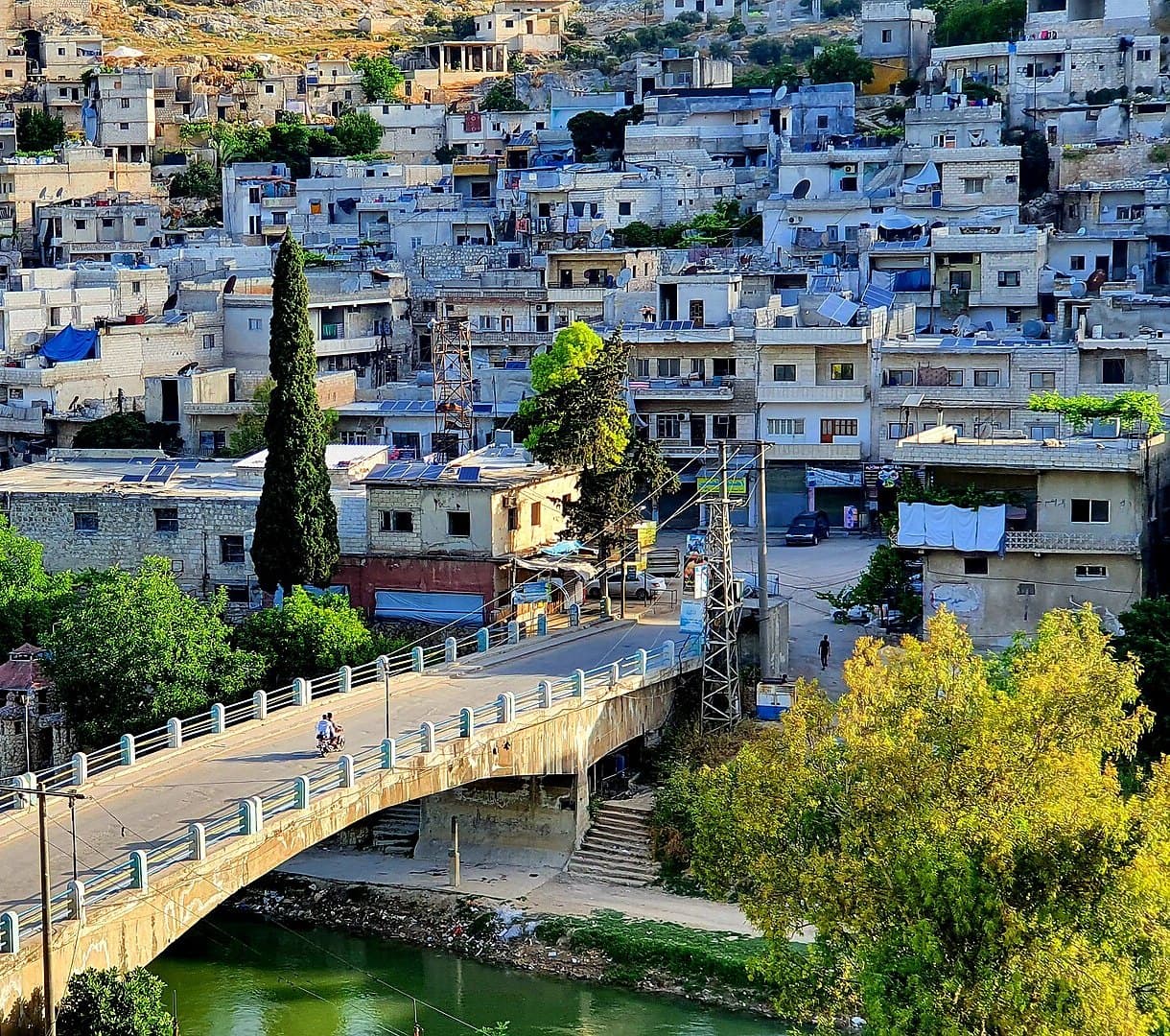
Darkush is a town built where the Orontes makes a wide bend at the end of a limestone gorge. The river turns first west and then north, and the houses climb from the bank up the slope. It lies 27 kilometres north of Jisr al-Shughur, close to the Turkish border, at 150 metres above sea level. There is no single great monument. The town itself is the sight: its river and its layers of history.
Getting there
The road that runs north from Jisr al-Shughur up the Orontes valley passes through Darkush. The Christian village of Al-Yacoubiyah is about 10 kilometres away and fits into the same day. The two location records we have do not agree within our threshold, so we give no map pin.
Traces of Rome
A Roman-period inscription found in the town shows that a shipwright lived here, building riverboats that sailed the Orontes. The river was a transport route at the time. The remains of an ancient bridge also survive. The area most likely became Christian after 322.
The Crusader castle and the 1822 earthquake
In the Middle Ages Darkush belonged to the Principality of Antioch. Saladin took it in 1188, Bohemond VI won it back in 1260, and Baybars captured it in 1267. In the 1220s Yaqut al-Hamawi described it as “a castle in the Awasim district, near Antioch”. Nothing of the Crusader castle is left today. Its stones went into other buildings.
The earthquake of 13 August 1822 destroyed Darkush and the country around it, killing 20 thousand people in the region.
What you see
Arabic sources list caves, a bridge, the site of the castle, a hammam and inscriptions in the town. Olive groves, vineyards and pomegranate orchards cover the surrounding slopes. In the 1960s the French guidebook writer Boulanger counted Darkush among the most beautiful places in the area. The bridge you cross today is modern concrete. Ask in town for the ancient one.
Don’t miss
The bend in the river. The point where the Orontes leaves the gorge and changes course can be seen from the bridge that joins the town. One look from there explains why the boatbuilder of the Roman inscription worked on this bank.
Tips
- Ask in town where the ancient bridge and the Roman inscription are
- Al-Yacoubiyah is about 10 km away; put both in the same day
- Do not go looking for the Crusader castle; its stones were reused long ago
- The town is close to the Turkish border; check current road conditions before you go
Transparency
- How this was chosen
- Written by hand; opening hours, entry fee and coordinates are kept as data. A field that is not known for certain is marked as variable rather than guessed.
- Facts checked
- September 2026
- Last updated
- September 15, 2026