Deir Seta, a Dead City with a Hexagonal Baptistery
About 25 kilometres from Idlib: the only hexagonal baptistery in the Dead Cities, an early 6th-century basilica, and an Islamic cemetery with a gravestone of 1431.
- Opening hours
- Open site, daylight hours
- Entry
- Variable — confirm on arrival
- Duration
- 60 minutes
- Best time
- Spring, while the olive groves are green and before the summer heat
- Period
- Byzantine
- Address
- Deir Seta village, southern end of Jebel Barisha, Idlib
A Byzantine settlement on the eastern edge of Jebel Barisha, at the southern end of the range. Part of the ruins has merged into the houses of today’s Deir Seta, and olive groves surround it. The village has a building found nowhere else in the Dead Cities: a hexagonal baptistery. The North Church beside it dates from the early 6th century. Deir Seta is also unusual because life went on after the Christian village emptied. Its two Islamic cemeteries hold inscriptions from between 1431 and 1530.
Getting there
About 25 kilometres from Idlib, to the north. The ruins sit inside the village and along its edge; asking for the church in the village is enough. There is no public transport, so you hire a car and driver in Idlib. The two churches of Banqusa are about one and a half kilometres west, and the village of Barisha is 7 kilometres north.
How long it takes
An hour. The church and the baptistery stand side by side. Add half an hour if you also walk to the monastery church 500 metres east of the village.
What you see
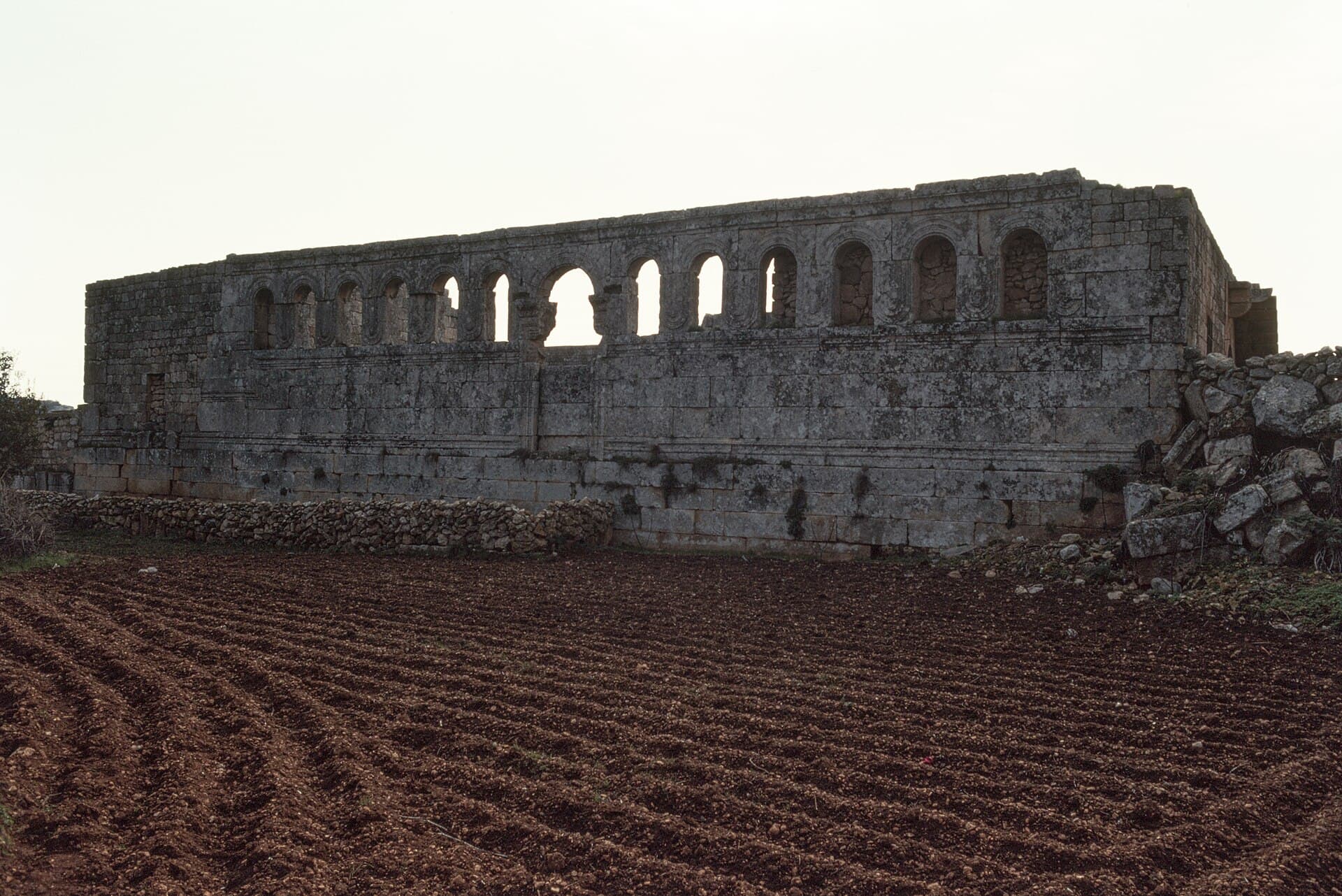
The North Church is a three-aisled basilica. Inside it measures about 32 by 19 metres, with an arcade of seven openings on each side. The side room to the south is a martyrion, a chamber that held a saint’s relics. The ground falls away to the north, so the north side of the building rests on a high terrace. The south and north walls stand up to the roof cornice. The west and east fronts, though, have been spoiled by village houses built against them later. Most of the capitals that Howard Crosby Butler saw are gone.
The carving deserves a closer look. According to the art historian Christine Strube, no building in the region copies the ornament of the Church of Saint Simeon (Qal’at Sim’an) more faithfully.
The baptistery stands in front of the church’s south-east corner. It is nearly 10 metres across and hexagonal in plan. The font was in the centre, ringed by six columns. Melchior de Vogüé, who came here in the 19th century, wrote that the columns carried a central dome.
The monastery church is 500 metres east of the village. It measures 19 by 12 metres and was built before 530.
What happened after the Christian village
Deir Seta was at its height in the 6th century. From the 7th century the Christian population moved away. Unlike most Dead Cities, though, the place was not abandoned. Islamic settlement continued through the Middle Ages, and the two village cemeteries show it with dates.
The west cemetery has a grave inscription of 1431. The east cemetery has inscriptions dated 1469/70 and 1530. One grave there imitates the sarcophagi of the Christian period, down to the acroteria at the corners. A 15th-century mason looked at the old sarcophagi around him and carved their shape again.
How it stands today
The site has been studied since the 19th century: de Vogüé, Butler, Georges Tchalenko, Strube and Jean-Pierre Sodini all worked here. The most detailed publication is Wedad Khoury’s two-volume study, published in Damascus in 1987. The ruins lie inside a living village, some of them against courtyards. We found no verified record of their condition after the war years. Call out before you enter a courtyard, and do not photograph anyone without asking.
Don’t miss
The grave in the east cemetery that copies a sarcophagus. Most visitors see the church and the baptistery and leave. The real story of Deir Seta, though, is this stone, which reused the form of a Byzantine sarcophagus in the 15th century.
Tips
- The baptistery is in front of the church's south-east corner; trace the hexagon on the ground
- The ruins sit among village houses; call out before entering a courtyard
- The monastery church is 500 metres east of the village
- Banqusa is about one and a half kilometres west; put the two in one morning
Transparency
- How this was chosen
- Written by hand; opening hours, entry fee and coordinates are kept as data. A field that is not known for certain is marked as variable rather than guessed.
- Facts checked
- September 2026
- Last updated
- September 15, 2026