Deir Sunbul, a Dead City on Jebel Zawiya
Four kilometres east of Ihsim on Jebel Zawiya: 115 ruined houses, five churches, two-storey mansions, a lamb carved in relief and a 6th-century basilica.
- Opening hours
- Open site, daylight hours
- Entry
- Variable — confirm on arrival
- Duration
- 60 minutes
- Best time
- Spring and autumn, when low light picks out the carvings on the fronts
- Period
- Roman — Byzantine
- Address
- Jebel Zawiya, east of Ihsim, Ariha district, Idlib
A Dead City on Jebel Zawiya, 4 kilometres east of Ihsim. The settlement goes back to the first half of the 2nd century and flourished most in the 6th. Arabic sources count about 115 houses and the remains of five churches; the best preserved is the 6th-century north basilica. What sets it apart is the house fronts: symbols carved on lintels and wall faces, and on one house a lamb in relief.
Getting there
The village belongs to the Ihsim subdistrict of Ariha district. The modern village had 1751 inhabitants at the 2004 census. It lies 4 kilometres east of Ihsim. There is no public transport; hire a car and driver in Ariha or Idlib. A village of the same name exists near Hama, so tell the driver you mean the Deir Sunbul near Ihsim.
How long it takes
An hour, enough for the mansions of the west quarter, the church and the sarcophagus.
What you see
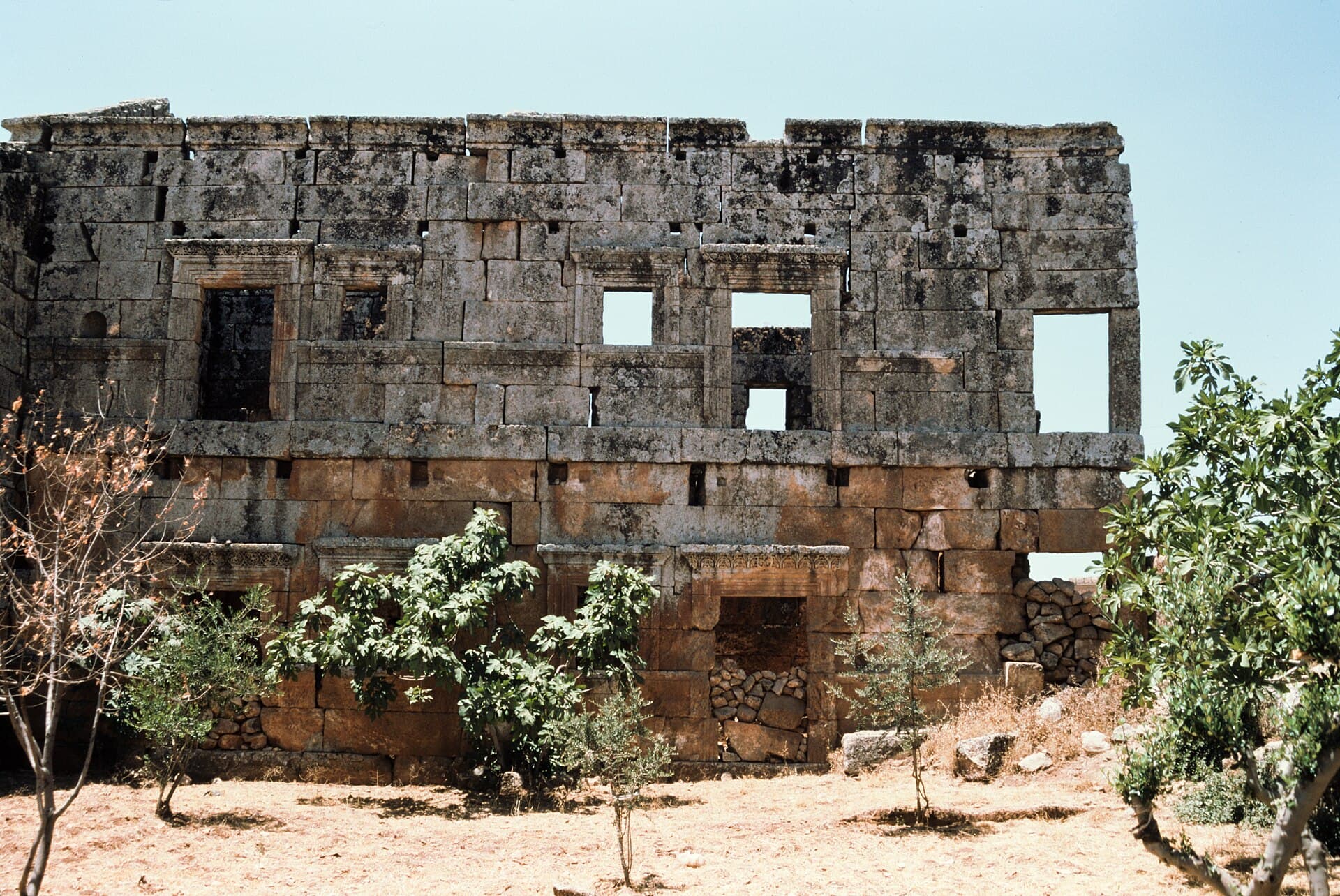
The mansions. The two-storey houses of wealthy families stand in the west quarter. The stones are laid without mortar. Some have colonnaded porticoes and stone balconies in front; every face has windows, and projecting slabs above the doors kept the rain off. Religious symbols and decoration cover the fronts. Ordinary houses stand wall to wall, also two storeys high, with small ground floors. Olive and grape presses have been found in the village, which shows where the wealth came from.
The Dumbarton Oaks archive records the buildings by number. In House 1 the west building still has a two-storey front and its upper-floor doors. The south front of the north building of House 18A carries geometric motifs, a niche and decorated door lintels.
The church. There is a decorated lintel over the central door of the west front, a pilaster at the south-west corner, and column capitals and bases in the nave. A sarcophagus also lies on the site.
History and the present
The region came under Arab rule in 637, fell to the Crusaders in 1098 and was retaken by Nur al-Din Zangi in 1149. The village’s history also lists the earthquakes of 1157, 1408 and 1822. There has been a recent loss too: on 5 October 2017, while the area was under the control of Hayat Tahrir al-Sham, a Byzantine villa of the 5th or 6th century was demolished. Which buildings stand today has to be seen on the ground; we found no building-by-building record from after the demolition.
Don’t miss
The lamb in relief on the south front of the north building of House 18A. It is the motif Christian art calls the Lamb of God, cut into the stone in a simple line, with a small cross above its back. Most visitors look at the front from a distance and move on.
Tips
- It is easily confused with its namesake near Hama; ask the driver for the Deir Sunbul near Ihsim
- Go close to the south front of the north building of House 18A; the carved lamb is there
- Look at the decorated lintel over the central door of the church's west front
- Stay on cleared paths; ask locally about unexploded ordnance from the war in the countryside
Transparency
- How this was chosen
- Written by hand; opening hours, entry fee and coordinates are kept as data. A field that is not known for certain is marked as variable rather than guessed.
- Facts checked
- September 2026
- Last updated
- September 15, 2026