The Great Colonnade at Palmyra
The spine of Palmyra: 1100 metres of columns raised in three phases. What the brackets were for, where the tetrapylon stood, and how long the walk takes.
- Opening hours
- Sunrise to sunset
- Entry
- Variable — check at the entrance
- Duration
- 60 minutes
- Best time
- An hour before sunset, when the stone turns orange
- Period
- Roman
- Address
- Centre of the ancient city, Palmyra, Homs governorate
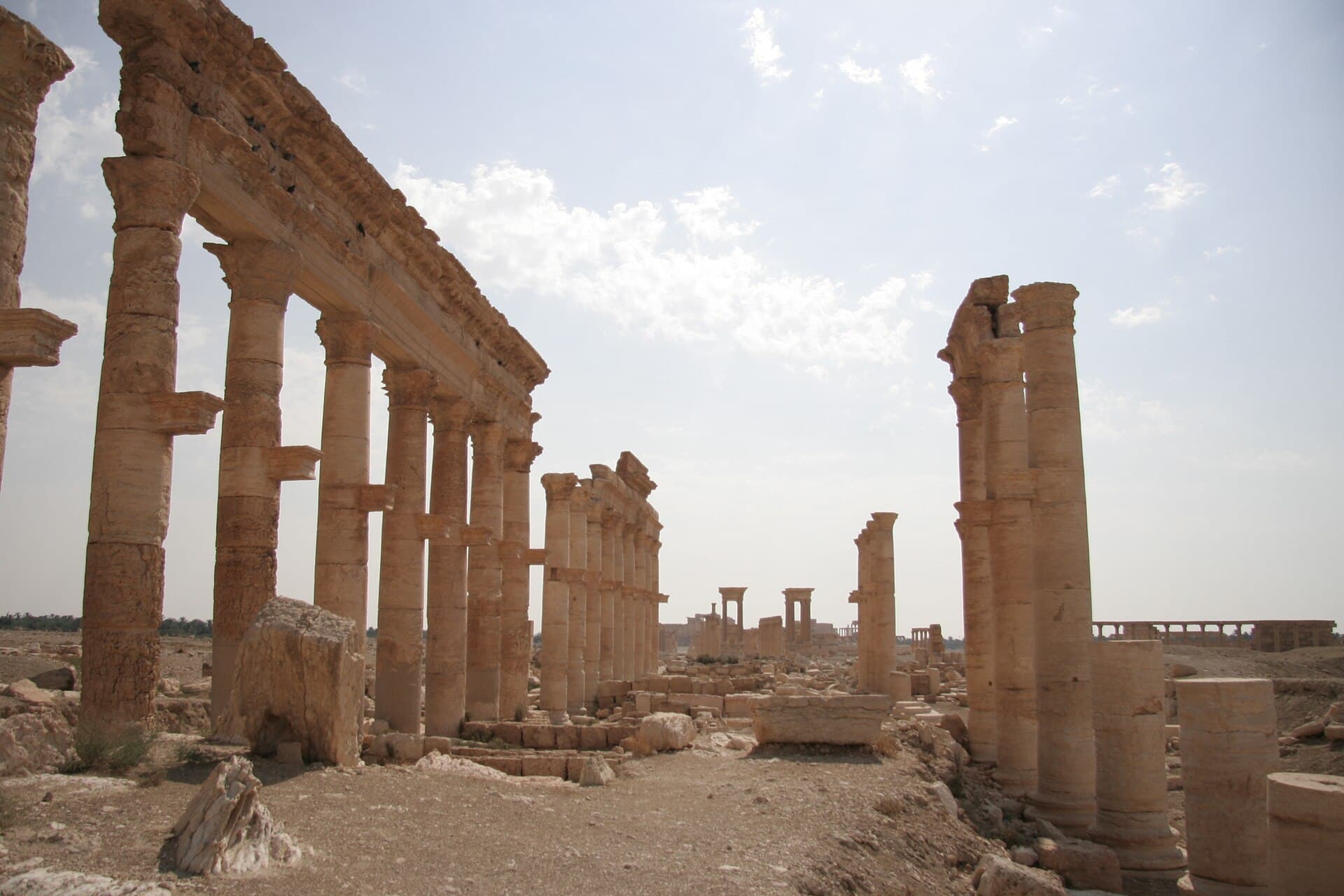
The main street of the ancient city and the most photographed place in Palmyra. Corinthian columns line it for 1100 metres. Most of them are still up. It was not laid out in one go but in three separate phases, and you can tell the three sections apart as you walk.
How the three sections differ
The western section is the oldest: 500 metres long, starting at the West Gate beside the funerary temple. The eastern section came after the entrance to the Temple of Bel was finished, and it is the widest stretch of the street. The middle section was added last, meeting the western colonnade at the tetrapylon and the eastern one at the triumphal arch. So the street is not a straight line. It has two kinks, and the tetrapylon and the arch were put there to hide exactly those kinks.
What the brackets on the columns are
Halfway up each shaft is a stone bracket jutting forward. Bronze statues once stood on them, and the face of the bracket carried the name of whoever paid for the statue: the merchants who funded the street, caravan owners, members of the city council. Some inscriptions are in the Palmyrene alphabet, some in Greek, and some carry both.
How long it takes
Walking from one end to the other takes an hour. The only shade is at the foot of the columns and by midday even that is gone. It is never crowded. Take it at your own pace.
Its condition today
Most of the colonnade came through the war standing. The tetrapylon in the middle of the street was destroyed in 2017. Its four-footed platform is in place; the columns are gone. The triumphal arch was brought down in the same period and its blocks lie beneath it.
Tips
- Look for the brackets halfway up the shafts; they held statues and carry inscriptions
- Start at the west end and walk east so the sun stays behind you
- Find where the tetrapylon stood — that is the point where the street changes direction
Transparency
- How this was chosen
- Written by hand; opening hours, entry fee and coordinates are kept as data. A field that is not known for certain is marked as variable rather than guessed.
- Facts checked
- August 2026
- Last updated
- September 15, 2026