The Agora of Palmyra and the Tariff Court
Where Palmyra’s caravans paid tax: a 71 by 84 metre courtyard with 11 gates, and the court where the tariff of AD 137 was found. What remains and how long to allow.
- Opening hours
- Open site; no set hours in December 2025
- Entry
- Free (December 2025) — check at the entrance
- Duration
- 40 minutes
- Best time
- Morning or late afternoon; the courtyard has no shade
- Period
- Roman
- Address
- West of the theatre, south side of the colonnaded street, Palmyra, Homs governorate
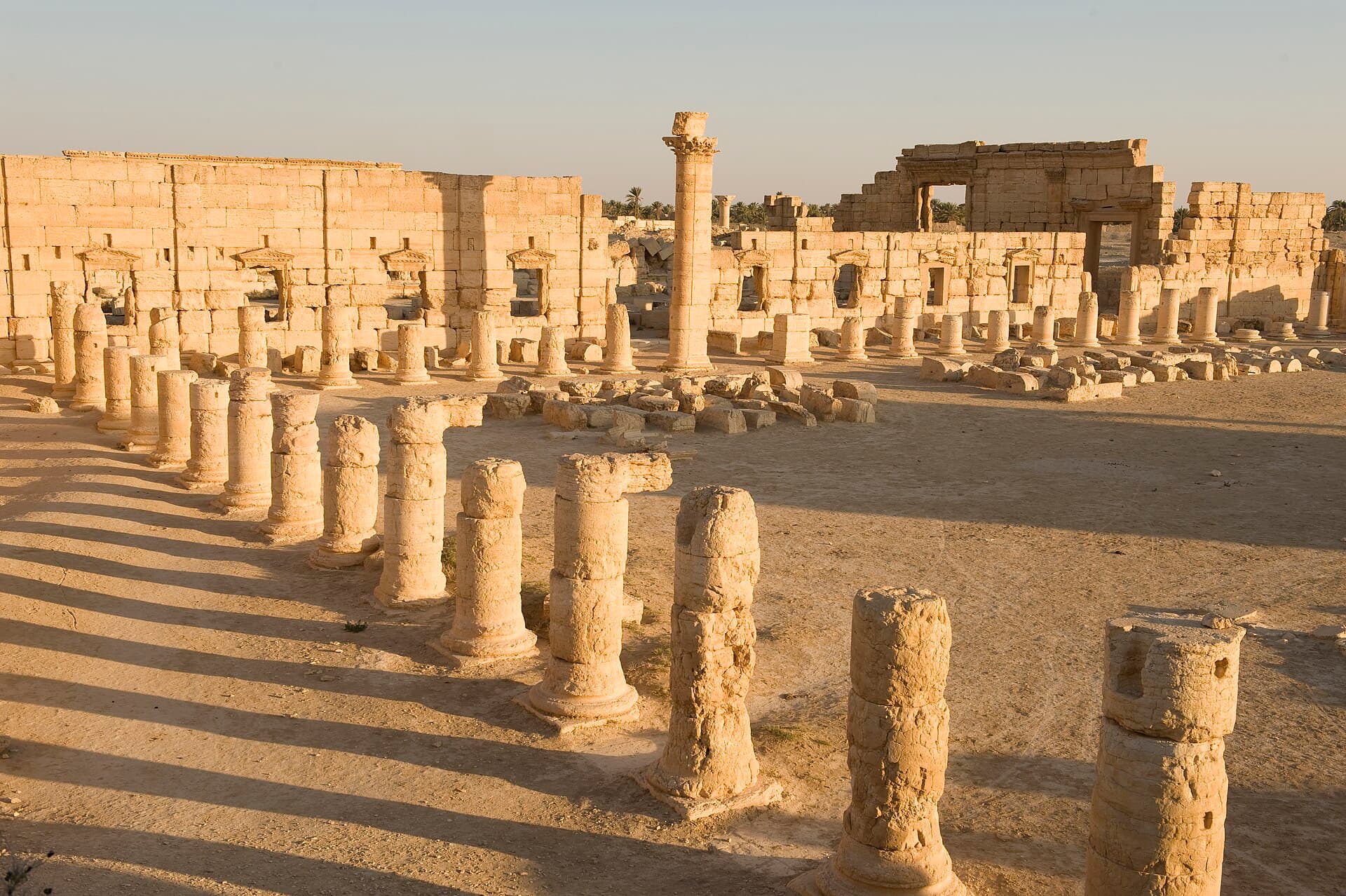
This is where Palmyra’s caravans unloaded and paid their dues. The agora was built in the 2nd century AD: an enclosed courtyard of 71 by 84 metres, lined with porticoes and entered through 11 gates. The Tariff Court beside it, on the south-east, belonged to the same business. The city’s tax law, a long inscription dated AD 137, was found here in 1881. It draws fewer photographers than the theatre or the colonnade. Yet no building shows more plainly how a caravan city worked.
Where it is
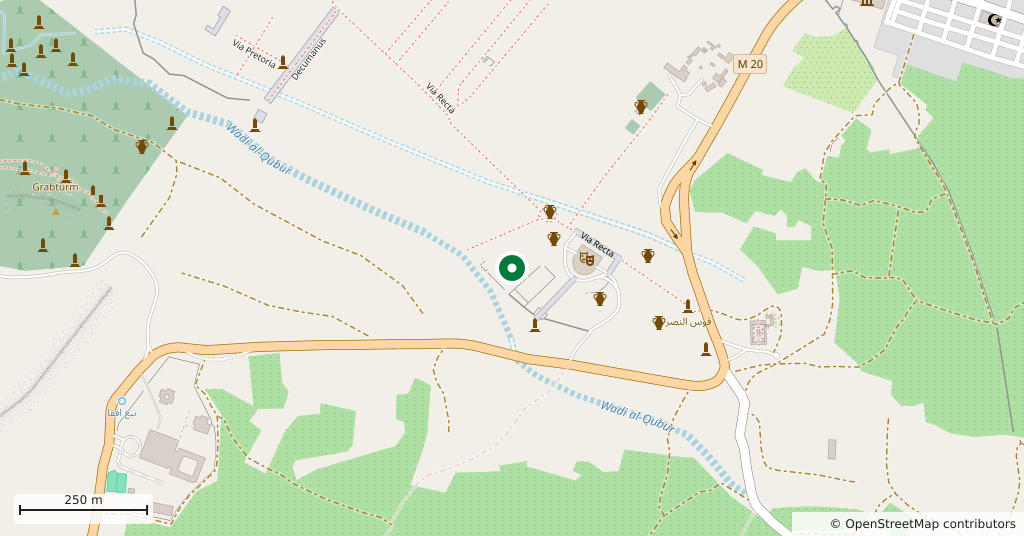
The agora lies west of the theatre, on the south side of the colonnaded street. The layout of the whole site is on the Palmyra ruins page, and the city’s largest sanctuary, the Temple of Bel, has its own page. Transport, permits and closed sectors are covered, with dates, in how to get to Palmyra. As of December 2025 the ruins were open and no entry fee was charged.
What stood in the courtyard
Porticoes ran along all four sides, carrying some 200 columns. On them stood statues of the city’s leading men, and their places were not random. Palmyrene and Roman officials stood in the north-east section, senators in the south-east, army officers in the north-west, and merchants and caravan leaders in the south-west. None of the statues remain. Pre-war photographs show rows of broken column shafts across the courtyard and windows with triangular pediments in the outer walls. The hall in the west corner is a triclinium, a banqueting room.
The Tariff Court and the tax law
In the second courtyard, adjoining the agora on the south-east, caravans paid their taxes. The triple monumental gate in its south-west wall is well preserved. The portico in front of it was partly taken down in the 3rd century, when the Wall of Diocletian was built.
The Palmyra tariff came from this court. The Russian prince Semyon Abamelek-Lazarev found the inscription in 1881. The text, dated AD 137, lists the duties owed on goods entering the city. It is now in the Hermitage Museum in St Petersburg.
Excavation and present state
Henri Seyrig excavated the courtyard in 1939 and 1940. In January 2017 the tetrapylon and the stage front of the theatre at Palmyra were destroyed. In March 2017 the Syrian Directorate-General of Antiquities and Museums reported no new damage at the agora. No later dated source on the building’s condition was found, so its present state is unverified; ask on site which sections can be visited. Mine clearance that began in May 2026 is working in the northern necropolis and the hippodrome, and those areas are closed.
How long it takes
Allow about 40 minutes. That covers the courtyard and the Tariff Court gate. There is no shade in the courtyard, so morning or late afternoon is easier.
What most people miss
Keep the statue plan in mind and walk the four sections one by one. Merchants and caravan leaders were honoured in the same courtyard as senators and officers, and that alone shows how much the caravan trade counted here. The same habit shows on the Great Colonnade, where the brackets halfway up the columns were statue bases too.
Tips
- Walk the four sections separately; where a statue stood showed who was being honoured
- The Tariff Court adjoins the agora on the south-east; see its triple gate as well
- The tariff inscription is not on site but in the Hermitage Museum in St Petersburg
- The northern necropolis and the hippodrome are closed for mine clearance; stay on the paths
Transparency
- How this was chosen
- Written by hand; opening hours, entry fee and coordinates are kept as data. A field that is not known for certain is marked as variable rather than guessed.
- Facts checked
- September 2026
- Last updated
- September 15, 2026