Harran al-Awamid
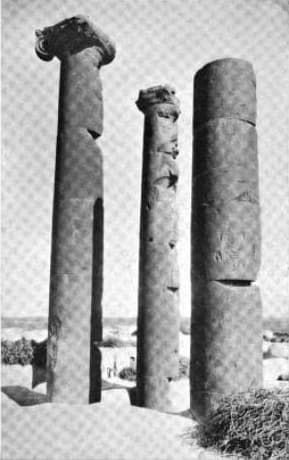
The only Roman structure still standing in the Ghouta: three basalt columns 10 metres high in the middle of a village, Corinthian capitals intact. Free, an hour.
- Opening hours
- An open village, all day; the columns stand between the houses
- Entry
- Free
- Duration
- 60 minutes
- Best time
- Morning or late afternoon; basalt takes a hard light at midday
- Period
- Roman
- Address
- Harran al-Awamid, Eastern Ghouta, southeast of Damascus
A village in Eastern Ghouta, 35 kilometres southeast of Umayyad Square, named after the three basalt columns standing in the middle of it. The columns are about 10 metres high and rest on giant bases. Their capitals are Corinthian, but the three are not in the same condition: in Butler’s photograph from the turn of the twentieth century one capital is in place, one is broken and the third is gone. These three columns are the only Roman structure still standing in the Ghouta.
Getting there
35 kilometres southeast of Damascus, through Eastern Ghouta. Harran al-Awamid is a nahiya centre in the Douma district and a junction for the villages around it, so minibuses run. The columns stand in the middle of the old village; get off in the centre.
How long it takes
An hour. That covers the columns, the pieces of stone scattered around them and the front of the village mosque.
What to see
The three columns are the only part left of a Roman temple dated to the 3rd century AD. The rest of the temple is gone: scattered capitals, bases, jambs and carved fragments lie around, and some of them were set as spolia into the facade of the village mosque. The settlement was prosperous in Roman times and there were other buildings beside the temple. The only measure left today is the columns themselves; working out from a base how large the building was is left to you.
Where the name comes from
Two explanations exist and both are on record. One ties the name to a monk called Hiran who lived in the village — villages nearby follow the same pattern, Qaysa from Deir Qays, Deir al-Salman from Deir Selman. The other ties it to the black basalt harra land that runs from Eastern Ghouta to Jabal al-Arab. The village appears in Yaqut’s Mu’jam al-Buldan, in Ibn Asakir’s History of Damascus and in Ibn Kathir’s al-Bidaya wa’l-Nihaya. Sheikh Hayat ibn Qays al-Ansari al-Harrani came to the village at 30 and stayed until his death; he was buried here in AH 581.
What most people miss
The mosque facade. Some of the carved stones from the temple are there, set into the wall — the clearest case of a building used a second time. It is a five-minute walk from the columns to the facade.
Tips
- The columns are in the middle of the old village and it is not a prepared site; get off in the centre and ask
- Look at the reused stones in the mosque facade, the temple's carving is there
- Scattered bases and capitals lie in the lanes; look down as well as up
- Basalt glares in the midday sun; morning or late afternoon is better for photographs
Transparency
- How this was chosen
- Written by hand; opening hours, entry fee and coordinates are kept as data. A field that is not known for certain is marked as variable rather than guessed.
- Facts checked
- September 2026
- Last updated
- September 15, 2026