Jerada, a Dead City with a Tower on Jebel Zawiya
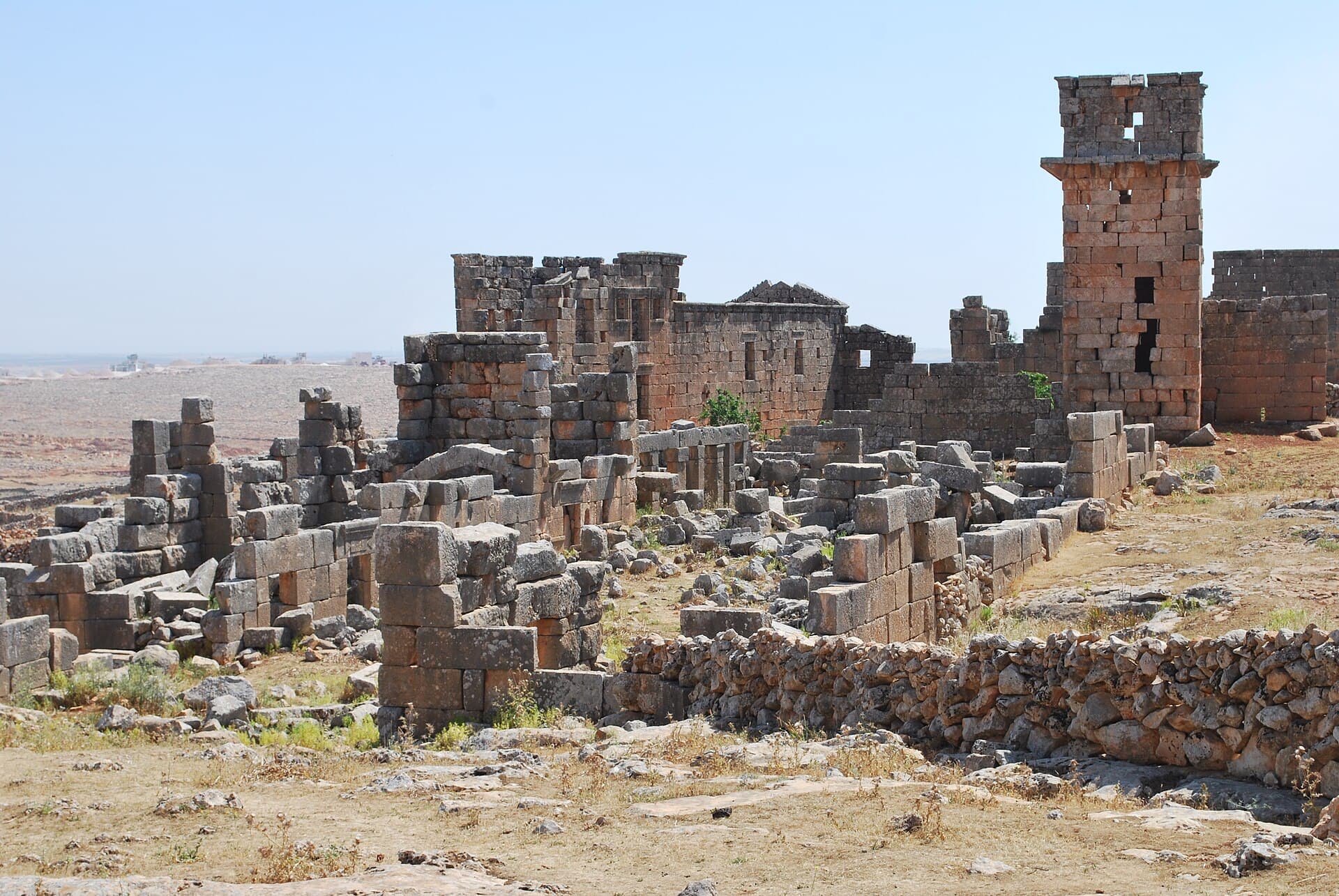
Two kilometres from Ruweiha on Jebel Zawiya: a many-storey tower with its latrine still on the wall, 96 houses and a 5th-century church with rooms against its apse.
- Opening hours
- Open site, daylight hours
- Entry
- Variable — confirm on arrival
- Duration
- 60 minutes
- Best time
- Spring and autumn mornings, before the summer heat
- Period
- Byzantine
- Address
- Jebel Zawiya, west of Babila, north of Maarat al-Numan, Idlib
A Dead City on the eastern edge of Jebel Zawiya, lying along the lower end of the modern village of Jerada and among its houses. The settlement was founded in the 4th century, reached its height in the 5th and 6th centuries and emptied slowly over the centuries that followed. The first thing you see from a distance is its tall stone tower. Closer in are two-storey porticoed mansions and a church whose plan Howard Crosby Butler was the first to publish.
Getting there
From Maarat al-Numan, drive 7 kilometres north on the motorway towards Aleppo and turn west at the village of Babila; the ruins are 3 kilometres further. Ruweiha is 2 kilometres to the north-west and South Dana 2 kilometres to the south-west. There is no public transport, so you need a car and driver. The modern village had 837 inhabitants at the 2004 census; it was probably resettled early in the 20th century.
How long it takes
An hour, enough for the tower, the church and the mansions around them. Ruweiha and South Dana lie on the same road, and all three fit into half a day.
What you see
The towers. There are two free-standing towers. The larger is built of roughly dressed limestone blocks; sources disagree on whether it has five or six storeys. Near the top runs a cornice of flat slabs on stone corbels. Whether it served for watch and defence or as a hermit’s retreat is still debated. The Italian team of the Gruppo Archeologico Romano calls it the prisoner’s tower and describes it as almost intact. The smaller tower has three storeys: a gatekeeper’s room in the middle, an open loggia at the top, and an entrance onto a courtyard.
The houses. Surveys counted 96 houses and 291 rooms. The long sides of the two-storey mansions carry colonnaded porticoes rising through both floors, with capitals derived from the Ionic and Corinthian orders. Window frames are rarely decorated, and the eaves have a wide fluted moulding. Most of the arches that carried the ground-floor ceilings are still in place, and most houses have a high-walled courtyard. One 6th-century house shows how life was divided. The door opens onto the street, and the family quarters stand to the left of the courtyard. Mangers on the ground floor put the animals below and the family above. An outside stair leads up.
The church. A three-aisled columned basilica of the 5th century. Butler published its plan after his expedition of 1899 and 1900, and Georges Tchalenko partly excavated it in 1943 and 1970. The windowless east wall is flat on the outside. There are two doors on the south side and one on the north; the west door opens into a narthex, a porch with an architrave on two columns. A two-storey tower adjoins the narthex. Parts of the north and east walls stand to the eaves, and the two-storey martyrium is there. Five of the twelve capitals survive: one Ionic, the rest Tuscan. North of the church lies a courtyard lined with well-preserved houses and the clergy’s quarters.
Don’t miss
The church apse is semicircular, and the rooms on either side use its curved wall as their inner boundary, a rare arrangement in the region. On one face of the big tower, look for the stone beams that jut out from the wall: that is where the tower’s latrine was.
Tips
- Look for the stone beams jutting from one face of the big tower; the latrine was there
- The ruins sit among the houses of the modern village; ask before walking into a courtyard
- Ruweiha is 2 kilometres north-west and South Dana 2 kilometres south-west; combine all three in half a day
- Stay on cleared paths; ask locally about unexploded ordnance from the war in the countryside
Transparency
- How this was chosen
- Written by hand; opening hours, entry fee and coordinates are kept as data. A field that is not known for certain is marked as variable rather than guessed.
- Facts checked
- September 2026
- Last updated
- September 15, 2026