Kfeir, a Deserted Village near Qalb Lozeh
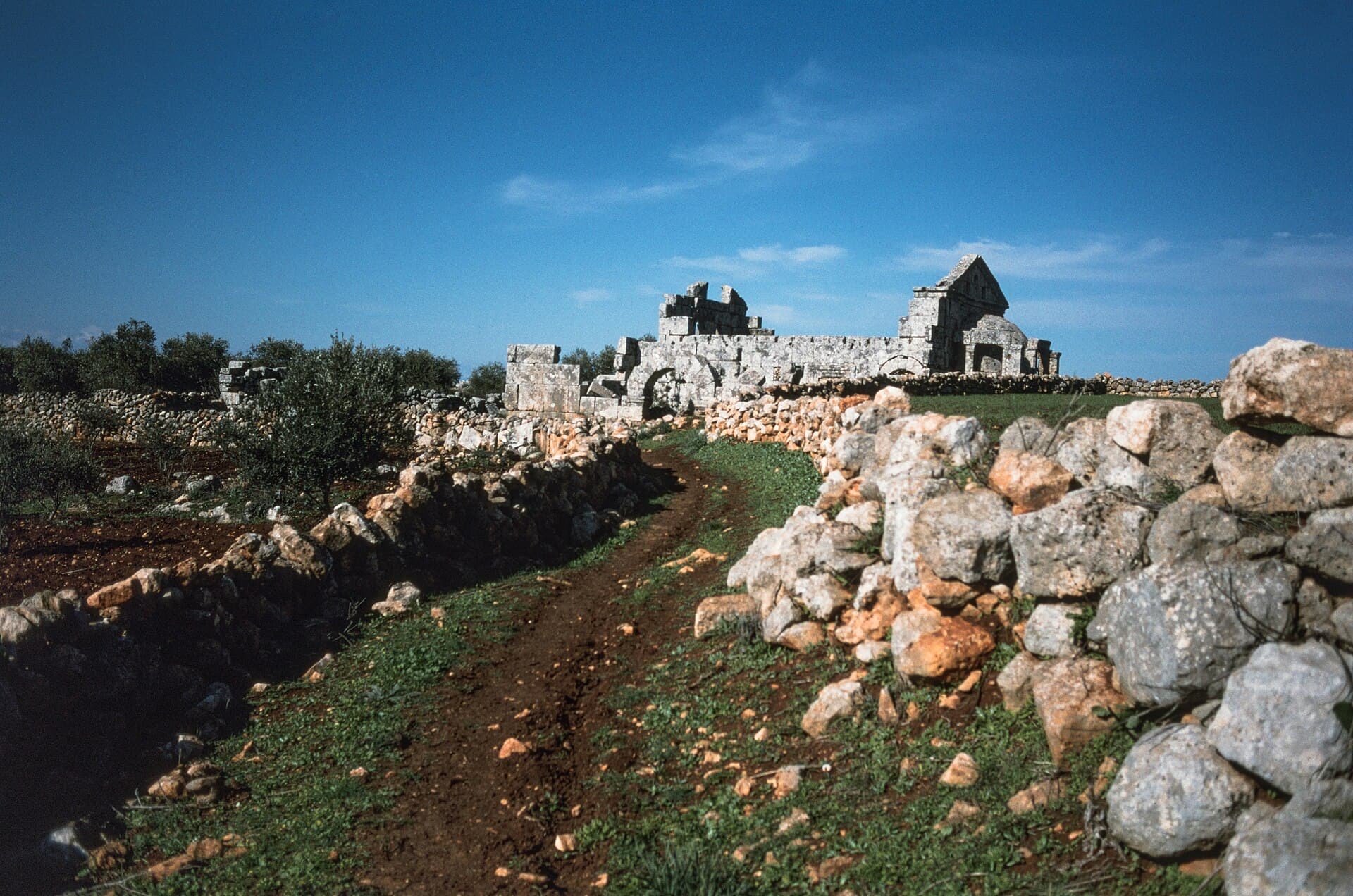
On Jebel al-A’la, about two kilometres from Qalb Lozeh: an empty village with a near-intact chapel and its richly carved arch, old houses and an underground press.
- Opening hours
- Open site, daylight hours
- Entry
- Variable — confirm on arrival
- Duration
- 45 minutes
- Best time
- Spring and autumn, before the summer heat
- Period
- Late Roman — Byzantine
- Address
- Jebel al-A'la, near Qalb Lozeh, Harim, Idlib
An empty village on Jebel al-A’la, about two kilometres from the Church of Qalb Lozeh. Kfeir has houses from different periods, a richly decorated chapel and many presses, one of them cut underground. It is one of three places named in the Jebel al-A’la park of the Ancient Villages of Northern Syria, inscribed by UNESCO in 2011, alongside Qalb Lozeh and Qirqbize. Howard Crosby Butler found the chapel almost perfectly preserved.
The name causes confusion. A village of the same name lies near Jisr al-Shughur, and Kfeir Kila is a separate place too. This page is about the empty village near Qalb Lozeh.
Getting there
North-west of Idlib. You set out from the village of Qalb Lozeh in the Harim district; Kfeir is about two kilometres to the north-west. Qirqbize is the same distance away. There is no public transport; you hire a car and driver in Harim or Idlib. Nothing is signposted. In the Dumbarton Oaks photographs, a dirt track between stone field walls leads up to the chapel.
How long it takes
Forty-five minutes. The chapel, the porticoed building south of it and the tombs are close together. With Qalb Lozeh and Qirqbize it makes a half day.
What you see
The chapel has a single nave. What breaks its ordinary plan are two side openings just in front of the apse. In the south wall an arch opens into a square room; Butler calls it the prothesis, the room where offerings were prepared for the liturgy. Opposite, in the north wall, a door led into a small room that has since collapsed. The two side rooms project outwards and give the building the look of a small transept.
A colonnaded portico ran along the south wall, from the prothesis room to an extension of the west wall. The only entrances are the two doors on the south. The windows are rectangular. Only in the gables does a round-arched window open between two rectangular ones.
Butler singled out the semi-dome of the apse as fine stonecutting. The apse arch carries flat mouldings that spring straight from Corinthian pilaster capitals.
South of the chapel stands a porticoed building of unknown use, and around it lie tombs and ancient terraced fields. The houses date from different periods.
Don’t miss
The prothesis arch. This is where the chapel’s real carving is: late Corinthian pilaster capitals, mouldings with laurel leaves, bead-and-reel and anthemion, and a scalloped frame on the outside. Some archive records call it the diaconicon arch; it is the same arch. Most visitors look at the apse and leave without noticing the side opening.
How it stands today
The descriptions here rest on Butler’s publication, the UNESCO evaluation and photographs in the Dumbarton Oaks archive. We found no verified record of the site’s condition after the war years. Qalb Lozeh is a lived-in village; as you pass through, do not look into courtyards, and ask before taking photographs.
Tips
- The prothesis arch is just in front of the apse, in the south wall
- Ask the driver for the Kfeir near Qalb Lozeh, not its namesake near Jisr al-Shughur
- It fits into the same half day as Qalb Lozeh and Qirqbize
- Qalb Lozeh is a lived-in village; ask before taking photographs as you pass
Transparency
- How this was chosen
- Written by hand; opening hours, entry fee and coordinates are kept as data. A field that is not known for certain is marked as variable rather than guessed.
- Facts checked
- September 2026
- Last updated
- September 15, 2026