Khan Shaykhun
The first Idlib town on the road from Hama: a 14th-century Mamluk khan that gave it its name, the Takiyya Mosque and a mound with layers from the 20th century BC.
- Opening hours
- The town at any hour
- Entry
- Free; there is no ticketed site
- Duration
- 60 minutes
- Best time
- Spring; there is no shade on the mound
- Period
- Bronze Age — Mamluk — Ottoman
- Address
- Aleppo–Damascus motorway, Maarat al-Numan district, Idlib
A town on the Aleppo–Damascus motorway, 350 metres above sea level, and the first place in Idlib for travellers coming north from Hama. Hama is about 35 kilometres away, Idlib 70. The name is said to come from a 14th-century khan, a merchants’ inn built around a courtyard. Next to the khan stands the Takiyya Mosque, and above the town rises a mound excavated in 1930, with layers going back to the 20th century BC.
The khan and the name
The khan is said to have been built by the Mamluk emir Sayf al-Din Shaykhu al-Umari, who died in 1357. This is not certain. What is certain is that the town grew up around the khan, and that the old khan still stands in the town centre.
Who built the Takiyya Mosque
The Takiyya Mosque next to the khan, and its pavilion, were built by Abu al-Huda al-Sayyadi. A native of Khan Shaykhun, he belonged to the inner circle of Sultan Abdulhamid II.
What the mound held
The mound above the town is 200-250 metres long and 18-24 metres high. Comte du Mesnil du Buisson excavated it in 1930. Settlement begins in the 20th century BC. In the Bronze and Iron Ages the top was levelled and walled towns were built one over another. The second of these, the town of around 700 BC, has been identified with Ashkhani of the Assyrian sources. The site was abandoned around 300 BC. It has also been suggested that in the Late Bronze Age this was Ugulzat, capital of the kingdom of Nuhashshe.
Beehive houses and embroidery
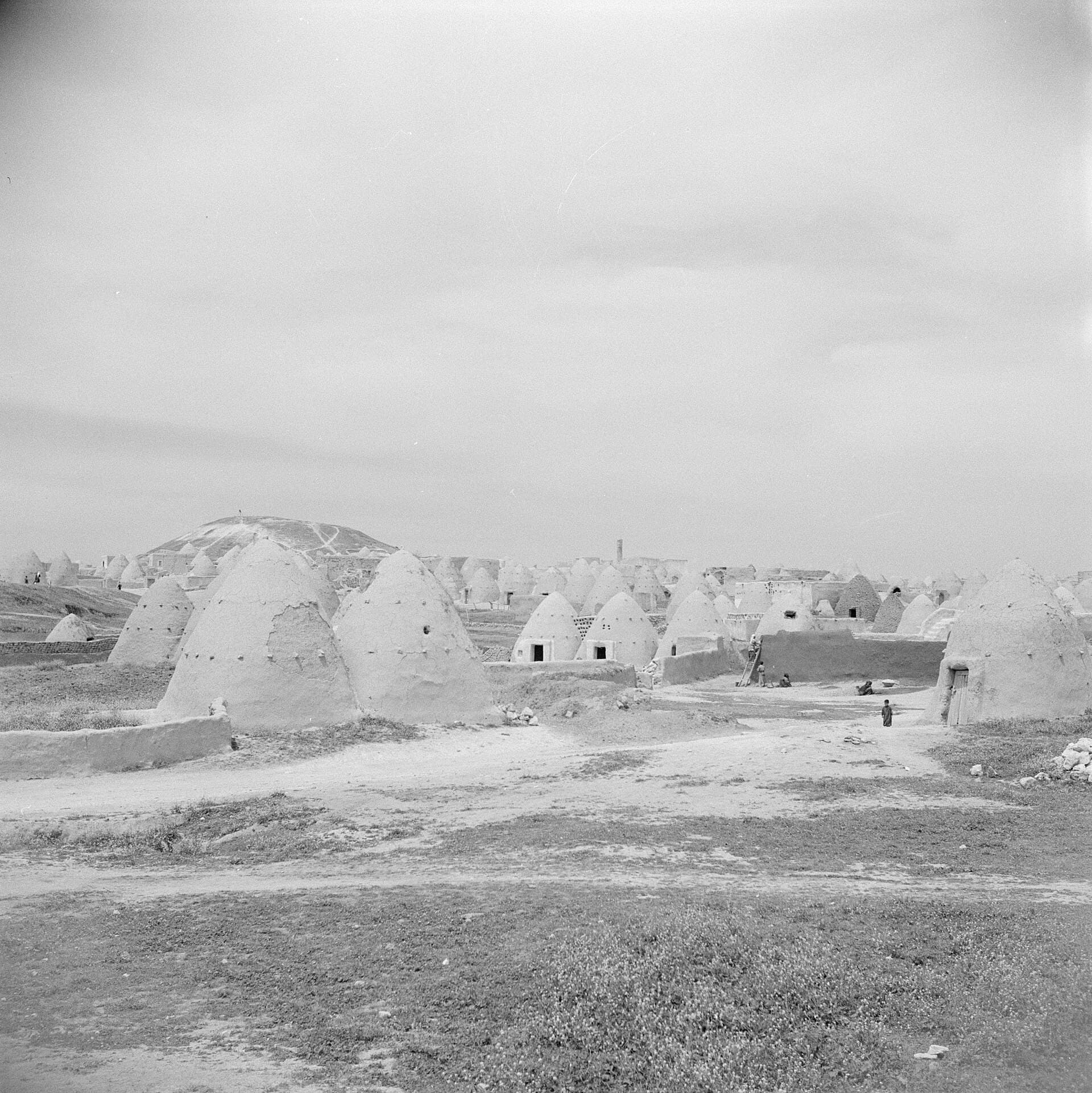
Khan Shaykhun was known for its beehive houses, domed and built of mud brick. Photographs taken in 1950 show rows of domes on the flat ground, with the mound behind them. Along with Saraqib and Maarat al-Numan, the town was also known for embroidery on black cotton cloth.
Recent history
On 4 April 2017 the town was hit by a chemical attack. That attack is how the name Khan Shaykhun entered the international record.
Getting there
About 35 kilometres north of Hama on the motorway. Kafr Tab is 3 kilometres west and Maarat al-Numan 25 kilometres north. Roads and checkpoints change; check the current situation before you set out.
How long it takes
An hour for the khan, the Takiyya Mosque and the mound.
Don’t miss
The mound. Most people passing through stay on the motorway, yet the hill rising behind the domes in the 1950 photograph holds 4000 years of the town’s past.
Tips
- The old khan is in the town centre, with the Takiyya Mosque right beside it
- There is no shade on the mound; avoid climbing it at midday in summer
- Maarat al-Numan is 25 kilometres north and fits into the same day
- Roads and checkpoints change; ask before you set out
Transparency
- How this was chosen
- Written by hand; opening hours, entry fee and coordinates are kept as data. A field that is not known for certain is marked as variable rather than guessed.
- Facts checked
- September 2026
- Last updated
- September 15, 2026