Mausoleum of Amat al-Latif, Damascus
A small domed tomb in Salihiyya, Damascus, for Amat al-Latif: Hanbali scholar, author, founder of madrasas and adviser to Saladin’s sister Rabi’a Khatun.
- Opening hours
- Variable — current status not verified; seen from outside
- Entry
- Variable — confirm on site; the dome is visible from the street
- Duration
- 15 minutes
- Best time
- Morning, before the street stalls go up and the front is clear
- Period
- Ayyubid
- Address
- Southern part of the street of madrasas, Salihiyya, Damascus
A small domed tomb squeezed between apartment blocks in the southern part of the street of madrasas in Salihiyya, the quarter on the slopes above Damascus. The woman buried here led a life much larger than the building: a Hanbali scholar, the author of two known books, the founder of more than one madrasa, and adviser to Rabi’a Khatun, the sister of Saladin. Her name was Amat al-Latif bint al-Nasih.
Who was Amat al-Latif
Her father, Nasih al-Din Abd al-Rahman, came from a family of scholars known in Damascus as “Ibn al-Hanbali” — the Hanbali school being one of the four schools of Sunni law. He was a Hanbali shaykh and fought beside Saladin at Hattin. Arabic Wikipedia traces the family to Sa’d ibn Ubada, a companion of the Prophet. Amat al-Latif entered Rabi’a Khatun’s service and became the adviser whose word she followed. Sources say Rabi’a Khatun built her Hanbali madrasa on the slope of Mount Qasioun under her influence; that is the Al-Sahiba Madrasa, which has its own page on this site.
Prison, marriage, fortune
When Rabi’a Khatun died in 1245, Amat al-Latif lost her protector. Her property was seized and she spent three years imprisoned in a fortress. After her release, in 1249, she married al-Ashraf Musa, the emir of Homs. He was twenty; English Wikipedia says she was at least forty. She went with him to Homs, Tall Bashir and al-Rahba. In Damascus she founded another school of hadith near the al-Afram Mosque, with her own name and her father’s carved on the threshold of one of its doors. Two of her books are known by title: al-Tasdid fi Shahadat al-Tawhid and Birr al-Walidayn. At her death she left jewels worth six hundred thousand silver dirhams and a large number of endowments.
The year of her death and the name of the tomb
The sources part ways on two points. Arabic Wikipedia puts her death in 653 AH, that is 1255; English Wikipedia says 1253. Her burial place also goes by two names. The Arabic source places her in the tomb of the Banu al-Shirazi near the school of hadith, where her ancestors lay. The Commons caption, based on Ross Burns’s guide, calls the building the Turba Amat al-Latif outright and says the wife of an emir of Homs, a descendant of a Hanbali shaykh, is buried here. The two are very likely the same building, but we found no source that proves it.
What to see
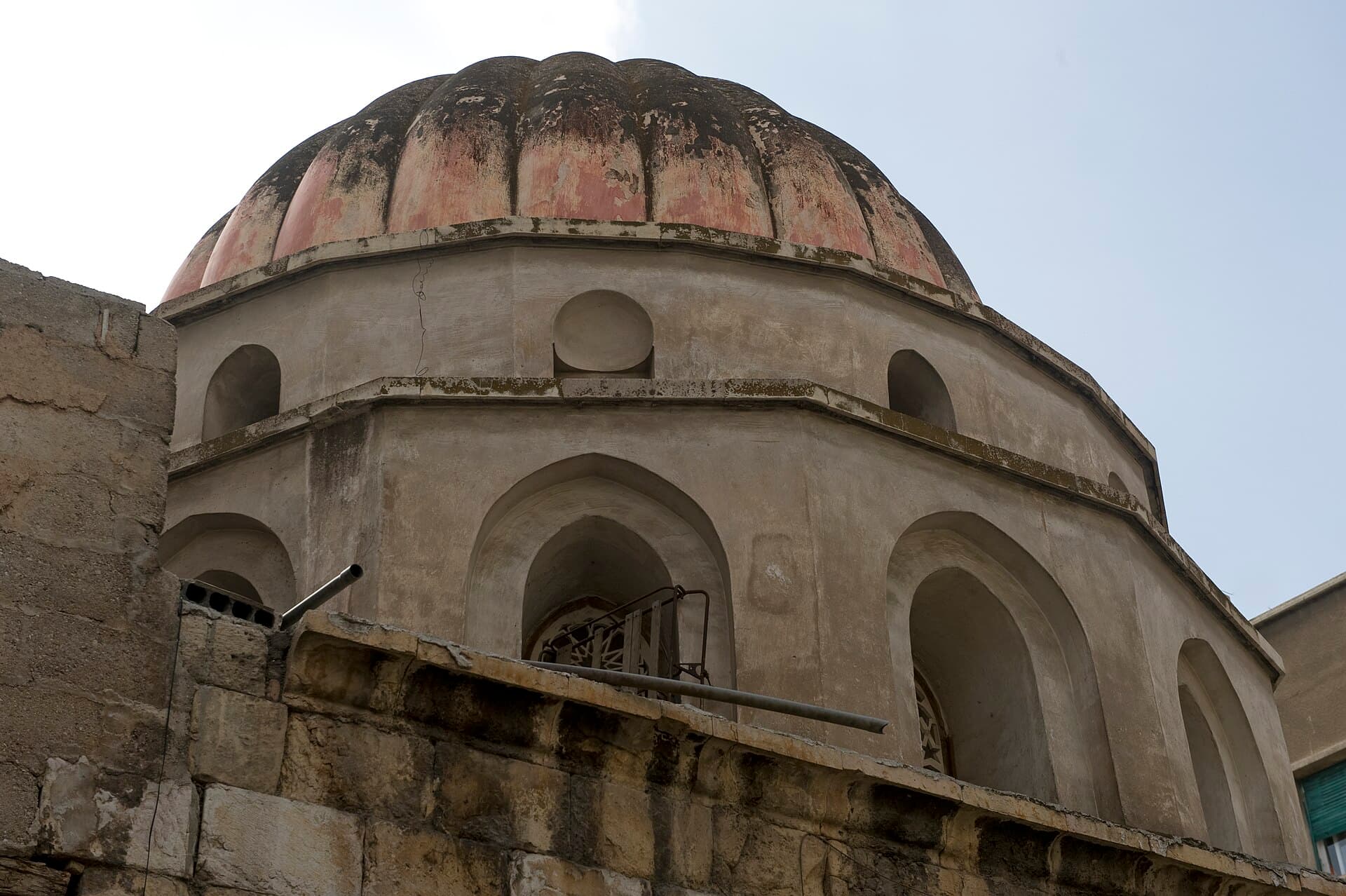
The building is read from outside. The lower half of the street front is large dressed stone, the upper half rendered. In the stone wall there is a window blocked up with masonry, a small door with an iron grille and a barred window. The dome rests on a two-tier drum: deep arched niches below, small round and arched windows above. The dome itself is ribbed, and faded traces of old red paint remain on its surface. From the lower street at the back, the dome stands out more clearly between the apartment balconies.
Getting there and how long it takes
In the southern part of the street of madrasas, within a few dozen metres of the Tomb of Kuchkun al-Mansuri and the Qubbat Rayhan. Fifteen minutes is enough for the building itself; it works well as a stop on a walk that heads south from the Al-Sahiba Madrasa. The most recent dated record we have is a set of photographs from 2010. No source shows whether the tomb can be entered today, so ask on the spot.
Don’t miss
The link between the Al-Sahiba’s doorway and this dome. Rabi’a Khatun built the Al-Sahiba; the woman in this tomb was her adviser and is said to have had a hand in founding it. Walk the two stops together and a circle of women who founded and ran institutions in Ayyubid Damascus comes into view. Seen on their own, both are quiet buildings.
Tips
- Go down to the lower street at the back to see the dome; from the front you only see wall and the top of the drum
- Stop at the Al-Sahiba Madrasa first; this tomb's story ties back to its founder
- The blocked window and iron door on the front are useful landmarks when asking for the building
Transparency
- How this was chosen
- Written by hand; opening hours, entry fee and coordinates are kept as data. A field that is not known for certain is marked as variable rather than guessed.
- Facts checked
- September 2026
- Last updated
- September 15, 2026