Graves of the Ottoman Aviators, Damascus
Three Ottoman airmen killed in 1914 lie in the courtyard of Saladin’s tomb in Damascus: Fethi, Sadık and Nuri. The graves are just north of the Umayyad Mosque.
- Opening hours
- Same as the Mausoleum of Saladin — check on site
- Entry
- Varies — check on site
- Duration
- 15 minutes
- Best time
- Morning, straight after visiting the Umayyad Mosque
- Period
- Ottoman (1914)
- Address
- Courtyard of the Mausoleum of Saladin, north of the Umayyad Mosque, Old City, Damascus
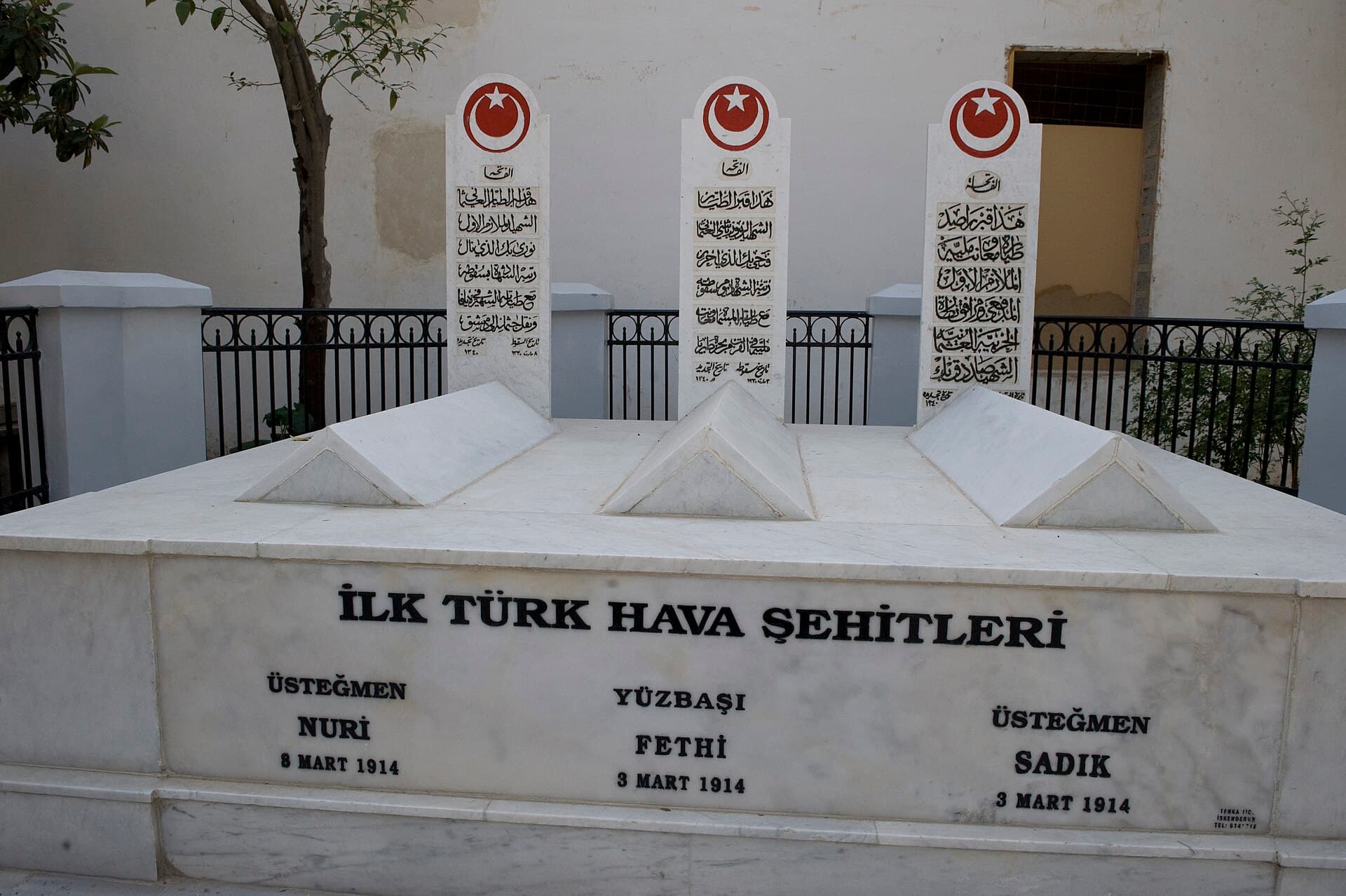
There are five graves in the outer courtyard of the Mausoleum of Saladin, and three of them belong to Ottoman airmen: Captain Fethi Bey, Lieutenant Sadık Bey and Lieutenant Nuri Bey. All three died in early 1914 while trying to fly from Istanbul to Cairo. The stone in front of their marble tombs reads “İlk Türk Hava Şehitleri” — the first Turkish air martyrs — and Turkish visitors to Damascus make a point of stopping here.
Getting there
Leave the Umayyad Mosque by the north door and within a few steps you are in the courtyard of the Mausoleum of Saladin. The graves are in this courtyard, on a raised marble platform behind iron railings. No recent source describes their current condition; this description rests on photographs from 2009.
The story of the flight
Fethi Bey and Sadık Bey set out from Istanbul in a Blériot XI named “Muavenet-i Milliye”. The route ran through Konya, Ulukışla, Adana, Homs and Damascus to Cairo. They landed in Damascus, were seen off with a ceremony and took off again. On 27 February 1914 the plane came down near Lake Tiberias and both men were killed. The plan had been to send their bodies to Istanbul, but the people of Damascus asked for them to be buried in the city.
Nuri Bey, flying a second aircraft on the same expedition, got as far as Jaffa. His plane crashed after taking off from there, and he died on 11 March 1914. His body was brought to Damascus and buried beside his two comrades.
Traces in Turkey
In 1916 the Aviation Martyrs’ Monument went up for the same three men in the Fatih district of Istanbul, designed by the architect Vedat Tek. In 1934 the town of Meğri, in Muğla province, took the name Fethiye in memory of Fethi Bey. The airman who gave Fethiye its name is buried here, in Damascus.
The other graves in the courtyard
The other two of the five belong to the Syrian politician Abdul Rahman Shahbandar (1940) and to Yasin al-Hashimi, a former prime minister of Iraq (1937). Saladin’s own cenotaph is in the domed room beside the courtyard.
Do not miss
Look at the three headstones behind the platform: each is topped with a crescent and star, with an inscription in Arabic script below. The Latin-lettered stone in front, however, gives two different dates: “3 Mart 1914” (3 March) for Fethi and Sadık, and “8 Mart 1914” (8 March) for Nuri. The sources say Fethi and Sadık died on 27 February and Nuri on 11 March; neither date on the stone matches the sources exactly.
Tips
- Leave the Umayyad Mosque by the north door; the graves are in the courtyard of Saladin's tomb
- The front stone gives 3 March for Fethi and Sadık and 8 March for Nuri; neither matches the death dates in the sources
- Look closely at the crescent and star and the Arabic-script inscriptions on the headstones
- This is a burial site: do not climb onto the platform, look from outside the railings
Transparency
- How this was chosen
- Written by hand; opening hours, entry fee and coordinates are kept as data. A field that is not known for certain is marked as variable rather than guessed.
- Facts checked
- September 2026
- Last updated
- September 15, 2026