Qasr al-Hayr al-Sharqi
An Umayyad palace in open steppe: two walled enclosures built for Caliph Hisham in 728, decorative towers, a bathhouse, and water piped in from far away.
- Opening hours
- Open site, daylight hours
- Entry
- Variable — confirm at the entrance
- Duration
- 90 minutes
- Best time
- Autumn and spring; there is no shade on the steppe in summer
- Period
- Umayyad
- Address
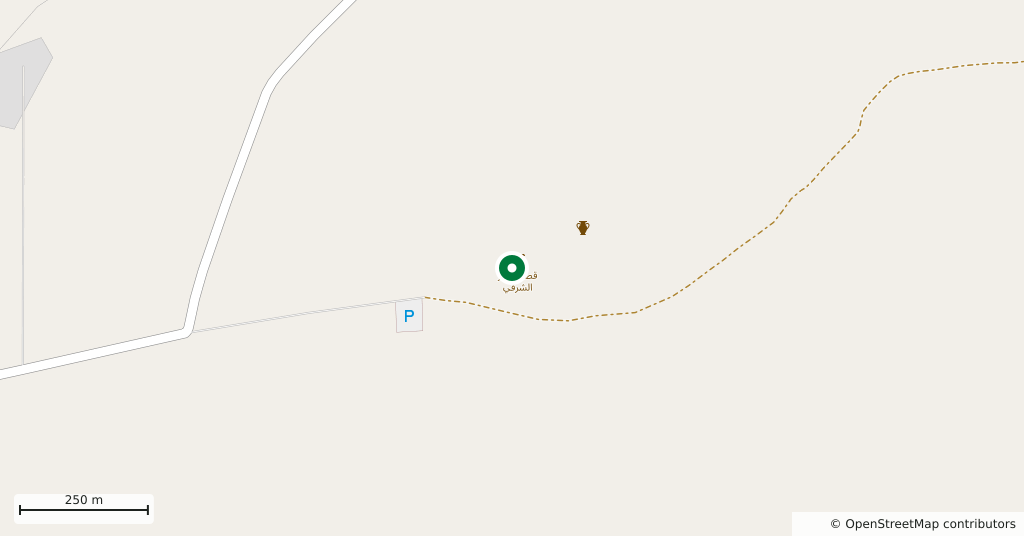
- Badiya steppe, 28 km from al-Sukhnah, 115 km north-east of Palmyra, Homs governorate
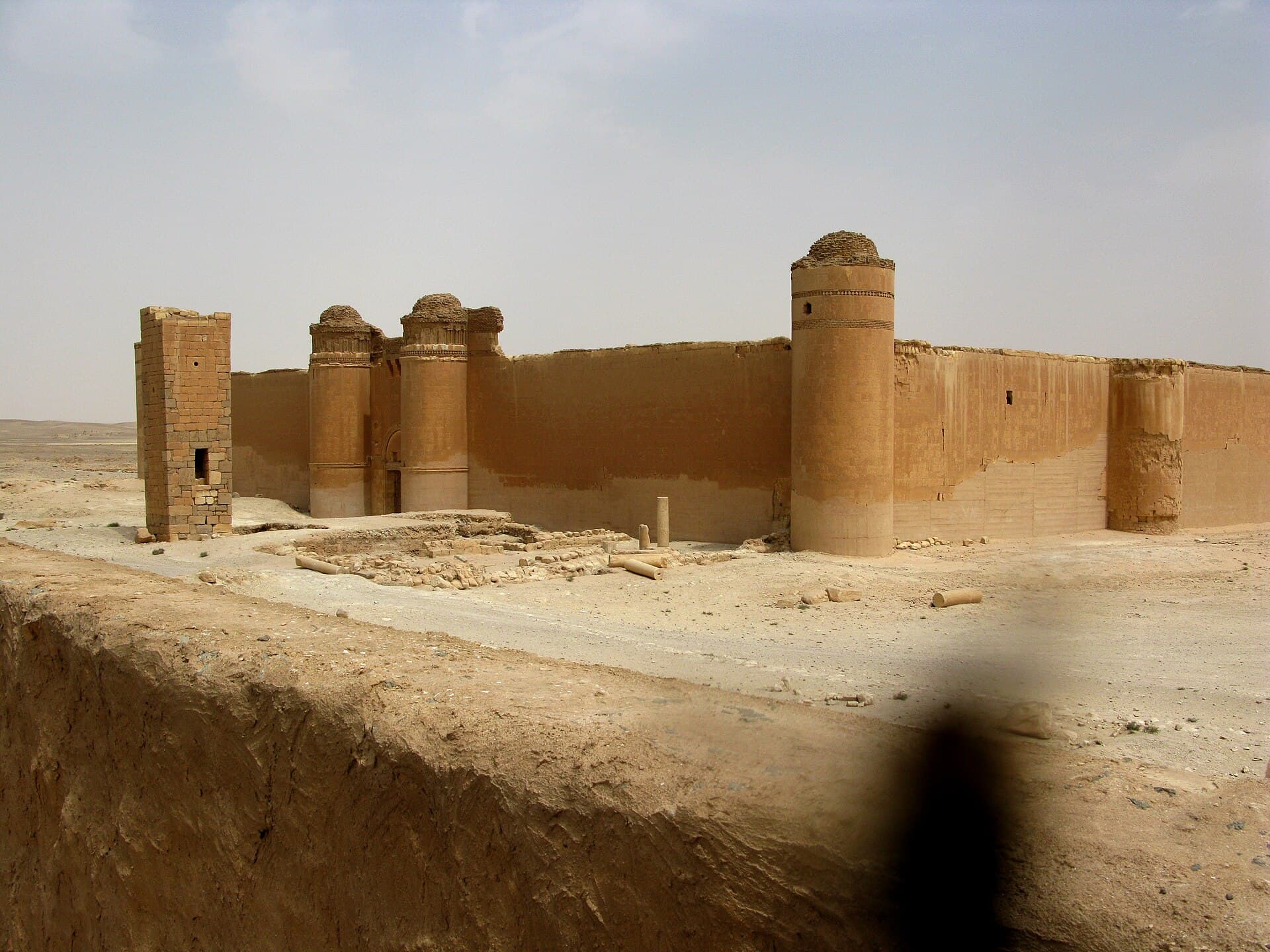
Two large rectangular enclosures stand in the middle of the Syrian steppe, tens of kilometres from the nearest town. Qasr al-Hayr al-Sharqi was built for the Umayyad caliph Hisham ibn Abd al-Malik in 728, and is counted the twin of Qasr al-Hayr al-Gharbi, which he had built a year earlier. The hayr in the name means a walled hunting and grazing ground: this is not a fortress but an estate and hunting compound set down in the desert.
Getting there
115 km north-east of Palmyra and 28 km from the town of al-Sukhnah. The road crosses open steppe with no fuel or water along the way, so travel with a driver who knows the route and a full tank. The site is entirely exposed, with no shade.
What to see
The complex has three parts: a small enclosure, a large enclosure, and an outer wall around both. The walls are built of fine-grained limestone with an amber tint, banded near the top with brick and stucco decoration. Inside the large enclosure, ranges of rooms, arches and column drums are still standing, and a mosque, a wide bathhouse and a reception hall can be made out. Traces of the old olive groves remain around it.
What not to miss
Look closely at the towers: round, ornamental and without a single arrow slit. They were never built for defence but stand as an architectural gesture, and that one detail explains why this is not a castle. The second detail is water: the compound was fed through a canal about 5700 metres long from a Byzantine building further out.
History and the present
The site was abandoned outright at the start of the 14th century and never built over again, which is why it preserves an early Islamic settlement plan intact. Oleg Grabar excavated here across six seasons between 1964 and 1971. Some of the decorated fragments are in the National Museum of Damascus, and the gate has been reconstructed in the Deir ez-Zor Museum. The site was added to the UNESCO tentative list in 1999. Armed groups took it in 2013 and it was looted and vandalised, the visitors’ house broken into; it was retaken in August 2017. The walls stand, but maintenance lapsed and the edges of the excavation trenches are loose.
Tips
- The towers have no arrow slits; up close it is clear this was never a defensive building
- There is no fuel or water on the road; take both before you leave
- There is no shade at all, so go early and avoid the middle of the day
- The edges of the excavation trenches are loose; keep away from them
Transparency
- How this was chosen
- Written by hand; opening hours, entry fee and coordinates are kept as data. A field that is not known for certain is marked as variable rather than guessed.
- Facts checked
- August 2026
- Last updated
- September 15, 2026