Tell Afis, Ancient Hazrek near Ebla
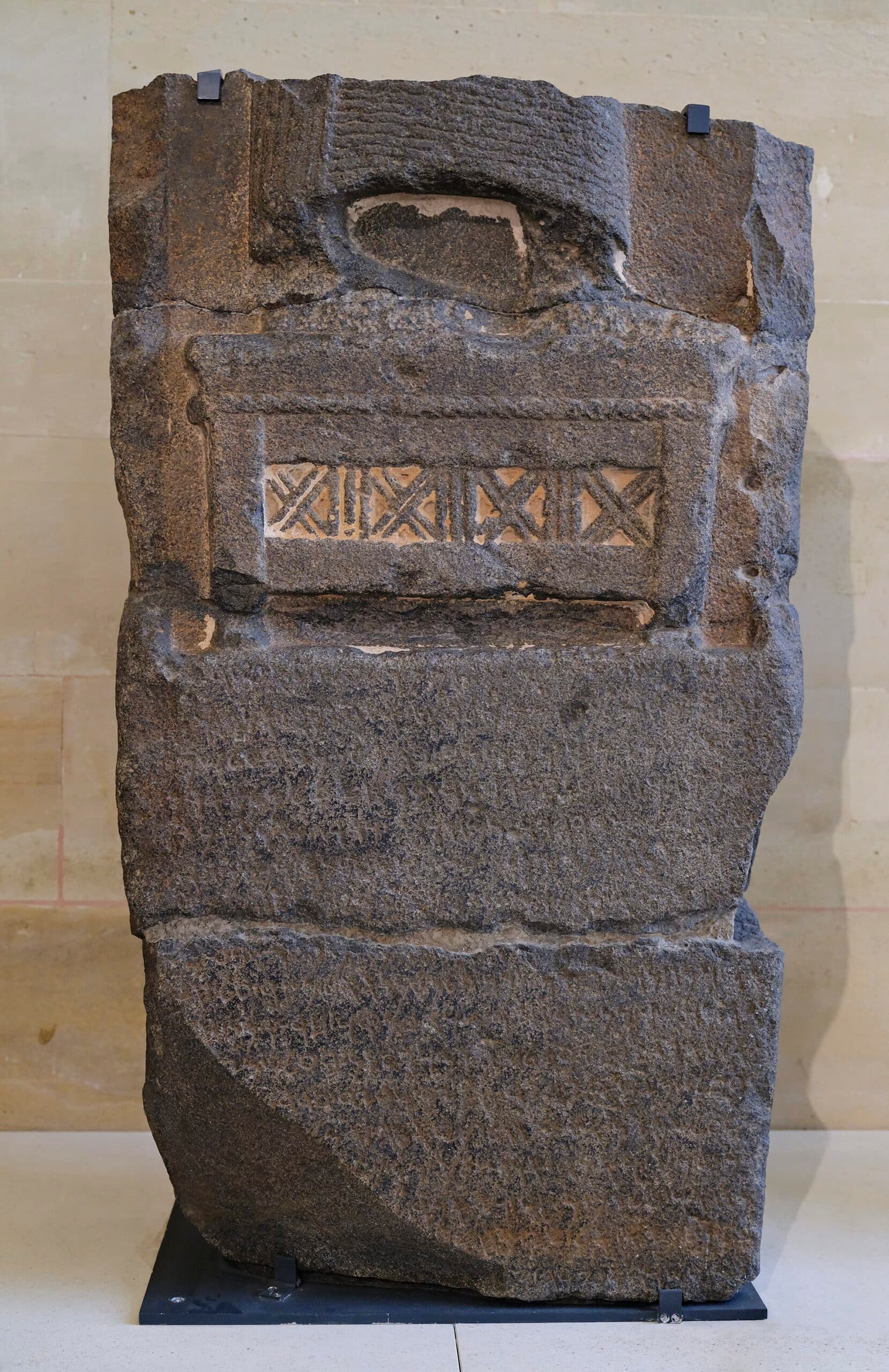
A 28-hectare mound 11 km north of Ebla: biblical Hadrach, capital of King Zakkur, whose Aramaic stele was found on its acropolis in 1903 and is now in the Louvre.
- Opening hours
- Open site, daylight hours
- Entry
- Variable — confirm on arrival
- Duration
- 60 minutes
- Best time
- A spring morning; there is no shade on the mound
- Period
- Late Chalcolithic — Iron Age
- Address
- Beside the village of Afis, Saraqib subdistrict, Idlib
A 28-hectare mound rising from the plain 11 kilometres north of Ebla, in the Saraqib subdistrict. It measures roughly 570 by 500 metres: a broad lower town, with the acropolis on its northern edge. This is ancient Hazrek, Hatarikka in Assyrian records and Hadrach in the Bible. People lived here layer on layer from 4000 BC to 600 BC, and the mound’s best-known find, the Zakkur Stele, is now in the Louvre.
Getting there
About 50 kilometres south-west of Aleppo, beside the village of Afis. It fits into the same trip as Ebla. There is no verified information on signs or a guard at the site; asking in the village is the quickest way. Roads and checkpoints change, so check the current situation before you set out.
How long it takes
An hour. That is enough to climb the acropolis and trace the edge of the lower town by eye. With Ebla it makes a half day.
What the Zakkur Stele says
In 1903 the French consul Henri Pognon found a basalt stele on top of the acropolis. Its Aramaic text dates to around 785 BC. Zakkur, king of Hama and Luhuti, dedicated it to the gods Iluwer and Baalshamin. Hazrek was the capital of his kingdom at the time. The stele is in the Louvre today, numbered AO 8185.
What the layers hold
In the Late Chalcolithic, between 4000 and 3200 BC, a megalithic stone wall and ditch ran around the foot of the acropolis, and the settlers kept sheep and pigs. In the Early Bronze Age a pottery workshop worked on the north side and a food-processing area on the south. In the Middle Bronze Age, between 1820 and 1628 BC, the mound was controlled by Yamhad, the kingdom centred on Aleppo.
The Mitanni arrived in the 15th century BC, and the Hittites under Suppiluliuma I around 1350 BC, when the region was known as Nuhashshe. Seals from the reign of Hattusili III and nine cuneiform tablets come from this phase. Two of the tablets are in Hittite.
In the Iron Age a temple with several building phases rose on the west side of the acropolis. Over the mud-brick temples of Iron I, tripartite stone temples measuring 38×32 metres were built. A potsherd with the letters LWR was linked to El-we, the god of Hazrek. Tiglath-Pileser III in 738 BC and Sargon II in 720 BC brought down the kingdom of Hama. The Late Iron Age wall around the lower town was built in haste and without foundations; it is more than 5 metres wide.
Who excavated it
William F. Albright collected surface finds in 1932. Paolo Matthiae dug here in 1970, 1972 and 1978. From 1986 to 2010 a team from the universities of Rome, Pisa and Bologna worked under Stefania Mazzoni and Serena Maria Cecchini. During the civil war a camp was set up on the mound and the site was damaged. We found no verified record of the surface as it is today.
Don’t miss
The view from the northern edge of the acropolis over the lower town. Only from there do the 28 hectares make sense. The hill where the stele was found was the citadel of a royal capital. Part of the finds from the excavations is in the Idlib Museum.
Tips
- Ebla is 11 kilometres south; both fit into the same half day
- The Zakkur Stele is not here but in the Louvre in Paris
- There is no shade on the mound; bring a hat and water
- Part of the finds is in the Idlib Museum, which fits into the same day
Transparency
- How this was chosen
- Written by hand; opening hours, entry fee and coordinates are kept as data. A field that is not known for certain is marked as variable rather than guessed.
- Facts checked
- September 2026
- Last updated
- September 15, 2026