Tell Shihab and Its Falls
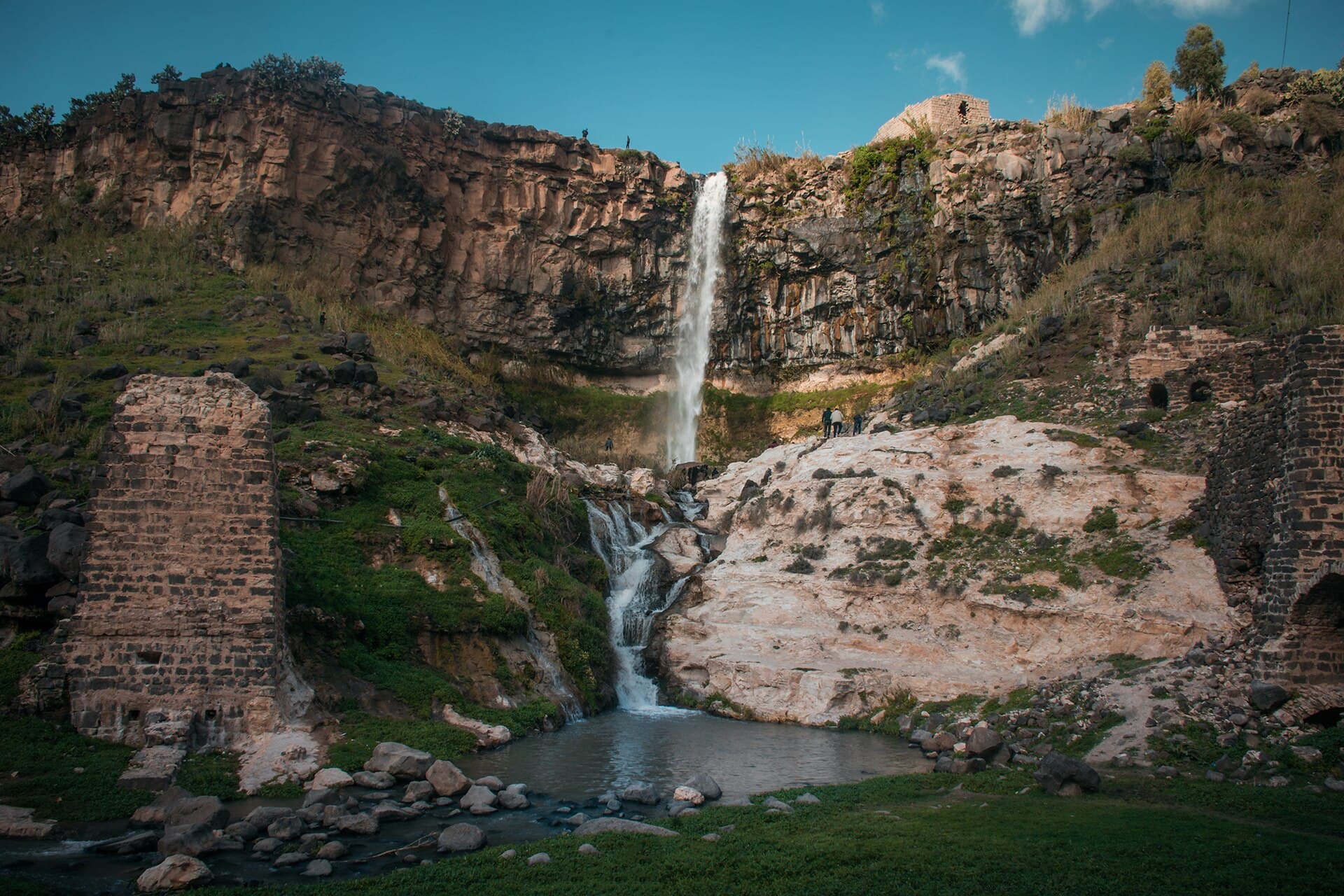
A town north-west of Daraa on the spur where two wadis meet. A waterfall drops over a basalt lip here, and a stele of Seti I was found in a house wall.
- Opening hours
- Open ground, daylight hours
- Entry
- Free
- Duration
- 50 minutes
- Best time
- Late winter and spring; the fall runs strong after rain
- Period
- Bronze Age — Ottoman
- Address
- Tell Shihab, north-west of Daraa, on the Jordanian border
A town north-west of Daraa, right on the Jordanian border. It sits on the spur formed where Wadi al-Meddan meets Wadi Tell Shihab, and the line those two wadis draw is the border itself. It is one of the lowest-lying settlements in the Hauran, a little over 300 metres. Because of the wadis around it there is an abundance unusual for this region: water runs here through the summer.
Getting there
Take the road running north-west out of Daraa. The town is close to the border strip, and rules for the military zone can change, so ask about local conditions before setting out.
What to see
Below the town the wadi drops over a basalt lip into a narrow pool. Stone ruins stand on both sides of the fall. They are the remains of works that once ran on the water, and they are older than they look at a glance from the far bank. Wheat above the rock, green below it. Two faces of the Hauran in one frame.
What not to miss
The archaeological record of the town. Tell Shihab is one of the places identified with the ancient city of Yeno’am. A stele showing the pharaoh Seti I with Amun-Ra and Mut was found here, built into the wall of a local house, its lower part missing. Wilhelm Max Müller argued that the stone did not commemorate a victory but declared the loyalty of the man who set it up. William Foxwell Albright collected Bronze Age pottery on the site in 1925.
The name
George Adam Smith wrote that the name is purely Arabic and translates as the mound of the warrior. Given that the town is built on a mound, the name is describing the ground itself.
Tips
- You are near a border strip; check local conditions before going
- The path down to the foot of the fall is slippery when wet, keep to the edge
- Do not look for the stele, it is not on site; knowing the record is enough
Transparency
- How this was chosen
- Written by hand; opening hours, entry fee and coordinates are kept as data. A field that is not known for certain is marked as variable rather than guessed.
- Facts checked
- September 2026
- Last updated
- September 15, 2026