Tomb of Abu al-Ala al-Maarri, Maarat al-Numan
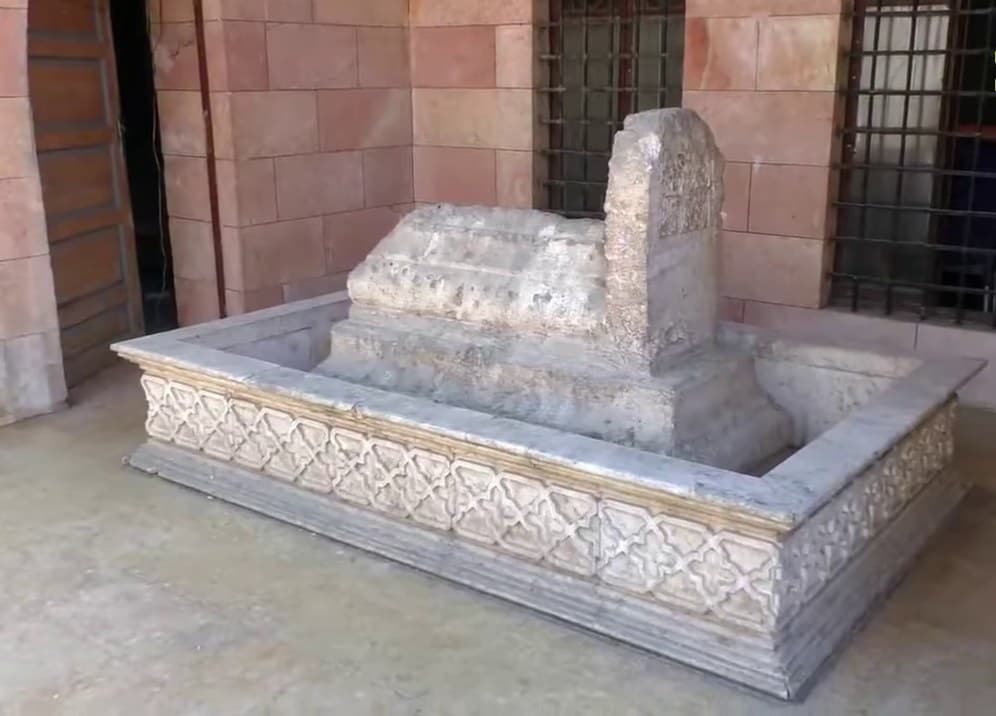
The poet al-Maarri lies in Maarat al-Numan, in a plain grave inside the courtyard of a cultural centre built around it in 1939. What to see and what to check.
- Opening hours
- No fixed hours known — ask in town
- Entry
- Variable — confirm on arrival
- Duration
- 30 minutes
- Best time
- Morning, so the walk can include the museum and the Great Mosque
- Period
- 11th century (burial) — 1939 (cultural centre)
- Address
- Old cultural centre building, central Maarat al-Numan, Idlib
Abu al-Ala al-Maarri, one of the most debated poets in Arabic literature, is buried in Maarat al-Numan, the town where he died in 1057. His grave today is plain and undecorated. It sits inside a north-facing iwan — a vaulted hall open on one side — in the courtyard of the Arab Cultural Centre, which was built around the tomb in 1939. There is no grand mausoleum; the visit is short and fits into one walk with the town’s museum and Great Mosque.
Where the grave is and how to find it
The grave is in the centre of town, inside the old cultural centre building. The centre moved to a new building in 2008, and since then the one holding the grave has been known as the “old cultural centre”. That name helps when you ask the way. Abu al-Ala Street in the town is also named after the poet. We could not find two sources that agree on the building’s exact position, so we give no map pin.
What you see in the courtyard
The entrance is a gateway with columns and arches, and behind it lies an open courtyard. The grave stands inside the northern iwan, beside the Alaiyya library and two cypress trees. The tomb chamber measures about three metres by three, and its dome rises to roughly four metres. The grave itself is 125 centimetres long and 75 centimetres wide. Two upright stones stand on it, carved in Kufic, the angular early Arabic script.
Before 1939 the place looked different. A small mosque and a little courtyard stood in front of the grave, with fig and pomegranate trees and a well. The cultural centre was founded on 28 October 1939. It enclosed the grave on all four sides and gave the site its present layout.
A date that does not fit
One of the upright stones carries a date that does not match the poet’s death in the year 449 of the Hijra. Muhammad Salim al-Jundi, who wrote a history of Maarat al-Numan, links that date to the making of the stone. In his view the original headstone may have been broken by people who considered the poet a heretic, and the present stone was set up later.
The epitaph
Al-Maarri chose the line for his own grave: “This is the wrong my father did to me; I did it to no one.” It is often quoted as the shortest summary of his pessimism. He held that bringing a child into the world was a wrong done to that child.
What happened to the statue
The town had a statue of al-Maarri by the sculptor Fathi Muhammad, dated 1944. The Nusra Front destroyed it in 2013. There is no recent, verified report on the condition of the grave and the building, so visiting arrangements need to be confirmed locally.
Don’t miss
The Kufic script on the two stones. Most visitors look for the epitaph and glance at the grave. The stone with the mismatched date is the only physical clue that the grave may once have been broken.
Tips
- Ask for the “old cultural centre”; the centre itself moved to another building in 2008
- One of the two stones on the grave carries a date that does not fit his death; look closely
- The museum and the Great Mosque are in the town centre; all three fit into half a day
- The building's present condition is not verified; check before you set out
Transparency
- How this was chosen
- Written by hand; opening hours, entry fee and coordinates are kept as data. A field that is not known for certain is marked as variable rather than guessed.
- Facts checked
- September 2026
- Last updated
- September 15, 2026