Tomb of Umar ibn Abd al-Aziz, Deir Sharqi
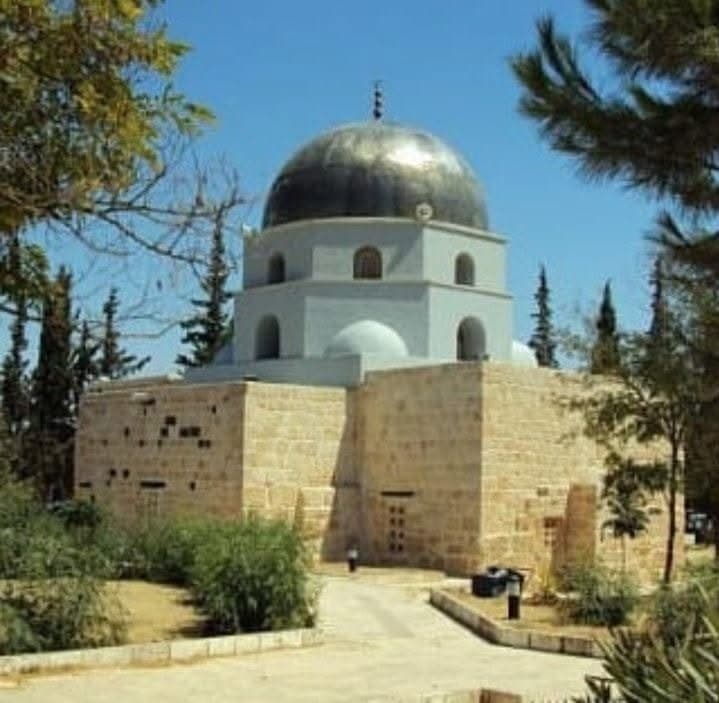
The Umayyad caliph Umar II was buried in 720 at Deir Sharqi, 5 km from Maarat al-Numan: a Mamluk building, a dome added in the 1990s and three graves inside.
- Opening hours
- No fixed hours known — ask in the village
- Entry
- Variable — confirm on arrival
- Duration
- 30 minutes
- Best time
- Morning, so it can share the day with the Maarat al-Numan Museum
- Period
- Umayyad (burial) — Mamluk (building)
- Address
- Deir Sharqi village, south-east of Maarat al-Numan, Idlib
The Umayyad caliph Umar ibn Abd al-Aziz, often called Umar II, is buried in the village of Deir Sharqi, about 5 kilometres south-east of Maarat al-Numan. Beside him lie his wife Fatima bint Abd al-Malik and an ascetic who settled in the village in the 12th century. The building over the graves is Mamluk; the dome and the park around it were added in the 1990s. This is a place of visit rather than an archaeological site: it takes little time and fits easily into the same day as the museum in Maarat al-Numan.
Getting there
Take the road south-east from Maarat al-Numan to Deir Sharqi. The village’s historical name is Dayr al-Naqira, and older sources also call it Dayr Sim’an. That name misleads: it has nothing to do with the Monastery of Saint Simeon west of Aleppo. People in the village point the way to anyone who asks for the tomb. We do not have two sources that agree on the building’s exact position, so we give no map pin.
Who is buried here
Umar died in the year 101 of the Hijra, 720 AD, aged 38. His caliphate lasted 29 months, and he is remembered above all for his justice. His wife Fatima bint Abd al-Malik is buried in the same building. The third grave belongs to Abu Zakariya Yahya ibn al-Mansur al-Maghribi, an ascetic who withdrew to the village in the 12th century and was visited by Saladin.
Why beside a monastery
Tradition says the site was a monastery where a monk named Sim’an lived in the 5th century. While Umar was governor of Khanasir, his mother’s family held land in this area and he came here often; his friendship with the monk continued after he became caliph. The monk wanted to give him the plot for his grave. Umar refused the gift and paid for the land. Saladin visited the tomb in the year 584 of the Hijra, 1188 AD.
The building and its restoration
The present building is Mamluk, and the date of its construction is unknown. It was neglected for a long time. Around 1970 the headstone bearing Umar’s name was kept in the house of the village headman until restoration could be finished. The researcher Kamil Shehadeh, curator of the Maarat al-Numan Museum, identified the site. In the 1990s the Ministry of Antiquities and Museums restored the building, roofed the courtyard with a dome and laid out a park around it. The village also has a Byzantine church dated 361 where a mosaic was found.
Damage in 2020 and the 2026 reopening
Government forces took Deir Sharqi at the end of January 2020. On 28 January the state agency SANA published photos of the tomb burned out and blamed opposition groups; opposition media blamed pro-government forces. A video that circulated in May 2020 showed the three graves dug open. On 5 June the Syrian Ministry of Awqaf said the grave and the body had not been touched, while the walls showed signs of vandalism.
Under an agreement with the Awqaf ministry, the Ankara-based Kalem Foundation began work in April 2025 to repair the tomb and build a complex beside it. The complex holds a mosque, the tomb, a Quran school and a garden. The Idlib Awqaf directorate and the Kalem Foundation opened it for prayer and visits at a ceremony on 10 February 2026. Visiting hours should be confirmed in the village.
Don’t miss
The third grave. Most visitors look at the caliph’s cenotaph and leave; few know that the ascetic Saladin came to see lies in the same building.
Tips
- This is a shrine; clothing that covers shoulders and knees is appropriate
- The museum and the Great Mosque in Maarat al-Numan are 5 kilometres away and fit into the same half day
- Asking for 'Dayr Sim'an' can be confused with the monastery near Aleppo; ask for Deir Sharqi
- The tomb and its new complex reopened in February 2026; confirm visiting hours before you set out
Transparency
- How this was chosen
- Written by hand; opening hours, entry fee and coordinates are kept as data. A field that is not known for certain is marked as variable rather than guessed.
- Facts checked
- September 2026
- Last updated
- September 15, 2026