Turba al-Takritiyya, Salihiyya
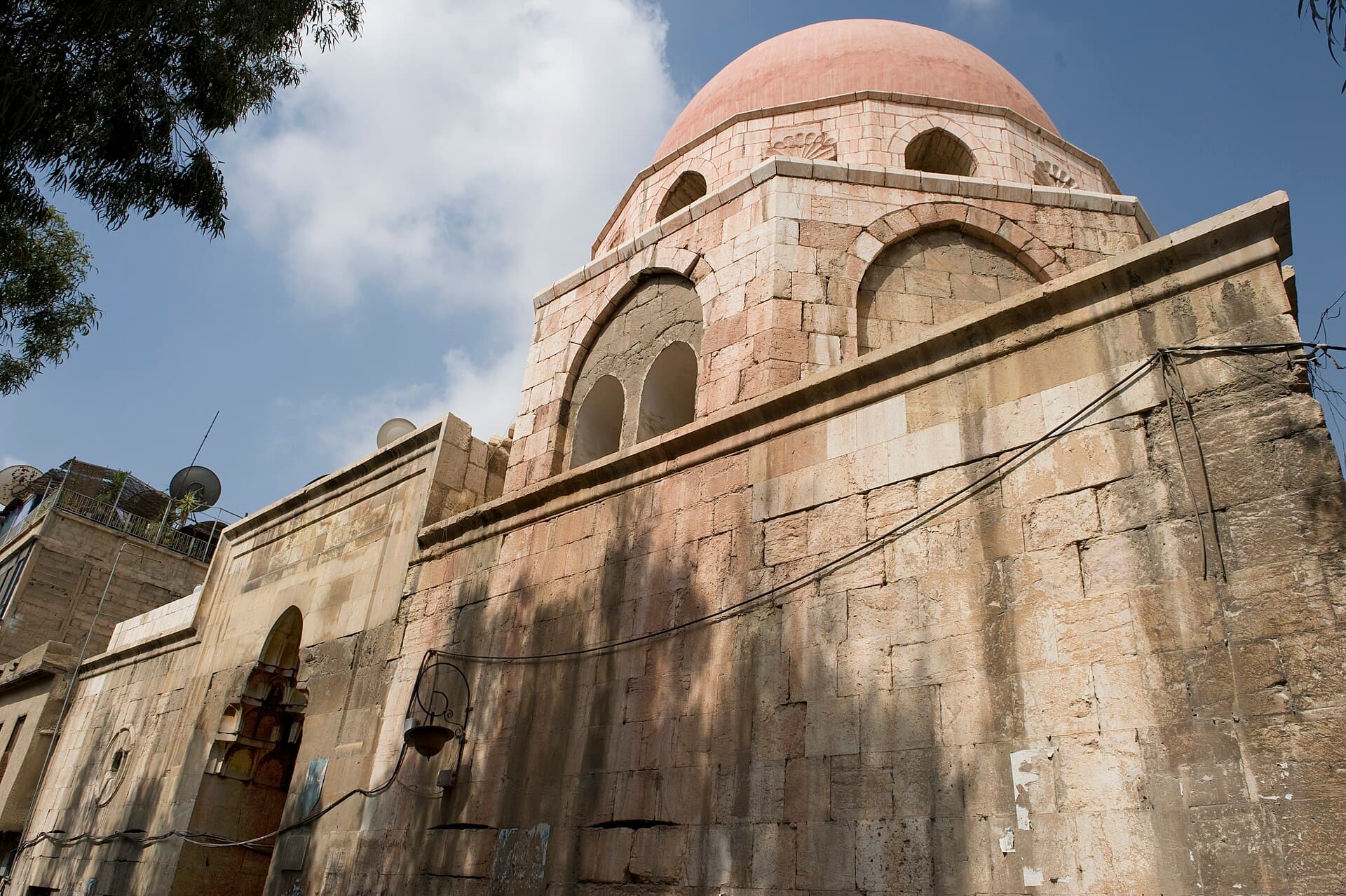
A Mamluk tomb on the street of madrasas in Salihiyya, Damascus, built for Taqi al-Din al-Takriti, an official of Sultan Qalawun. Neglected, but still standing.
- Opening hours
- Variable — neglected building seen from the street; ask on site about the interior
- Entry
- Variable — confirm on site; portal and dome are visible from the street
- Duration
- 15 minutes
- Best time
- Towards midday, when light reaches inside the portal niche
- Period
- Mamluk
- Address
- Street of madrasas, beside the Al-Atabakiyya Madrasa, Salihiyya, Damascus
A stone tomb on the street of madrasas in Salihiyya, the quarter on the slopes above Damascus. The Commons caption, based on Ross Burns’s guide, says it was built for Taqi al-Din al-Takriti, a senior official under Qalawun, the Mamluk sultan — the Mamluks being the slave-soldier dynasty that ruled Egypt and Syria after the Ayyubids. Taqi al-Din died in 1299. The building is also known as the Madrasa Tabutluk. Most madrasas on the street are Ayyubid; this tomb marks the point where the row passes into the Mamluk period.
Getting there
On the street of madrasas, opposite the Dar al-Hadith al-Ashrafiyya al-Barraniyya and beside the minaret of the Al-Atabakiyya Madrasa. One photo on Commons shows all three in a single frame: the school of hadith on the left, the Takritiyya in the middle, the Atabakiyya’s minaret on the right. Find the Atabakiyya’s door and this tomb is a few dozen paces away. The Dar al-Hadith al-Ashrafiyya page on this site covers a different building beside the citadel; the neighbour here is the Barraniyya in Salihiyya.
What to see
Two sides of the building can be read from the street. The long side wall is large dressed stone, with a round oculus window and a pointed arched niche. At the corner a drum sits on the heavy stone body. Paired arched windows open in its faces, with small scallop-shell carvings above them. A smooth dome painted a tile red covers the drum. The finest work is the portal: the top of its tall niche is filled with honeycomb-like mukarnas cells and small shell-ribbed half-domes. The doorway beneath the niche is plain and dark, and the wall around it carries traces of posters.
What state it is in today
The Arabic Wikipedia entry on the street of madrasas notes that while most of its colleges became houses or mosques, some were left as neglected remains, and gives the Takritiyya as an example. In photographs from 2008 the building stands, with its dome, drum and portal in place. We found no newer record of its condition. Whether the interior can be entered is not known, so this page treats it as a stop seen from the street.
How long it takes
Fifteen minutes. It is not a place to travel to on its own. On the same street walk as the Atabakiyya, the Murshidiyya and the Jaharkasiyya, it is a few minutes spent in front of the portal looking up.
Don’t miss
The top of the portal niche. From the foot of the door it looks like a dark hollow; step back two paces and the shell-ribbed half-domes between the mukarnas cells come into focus. The shell motif you see in the hood of the Ayyubid Al-Sahiba on the same street turns up again here, on the door of a Mamluk tomb.
Tips
- Look at the portal from two paces back; the mukarnas at the top of the niche cannot be seen from the foot of the door
- Walk to the corner of the building to see the dome; from the long side only stone wall shows
- Do not confuse the school of hadith opposite with the Ashrafiyya beside the citadel; this one is the Barraniyya in Salihiyya
Transparency
- How this was chosen
- Written by hand; opening hours, entry fee and coordinates are kept as data. A field that is not known for certain is marked as variable rather than guessed.
- Facts checked
- September 2026
- Last updated
- September 15, 2026