The Al-Abed Building, Damascus
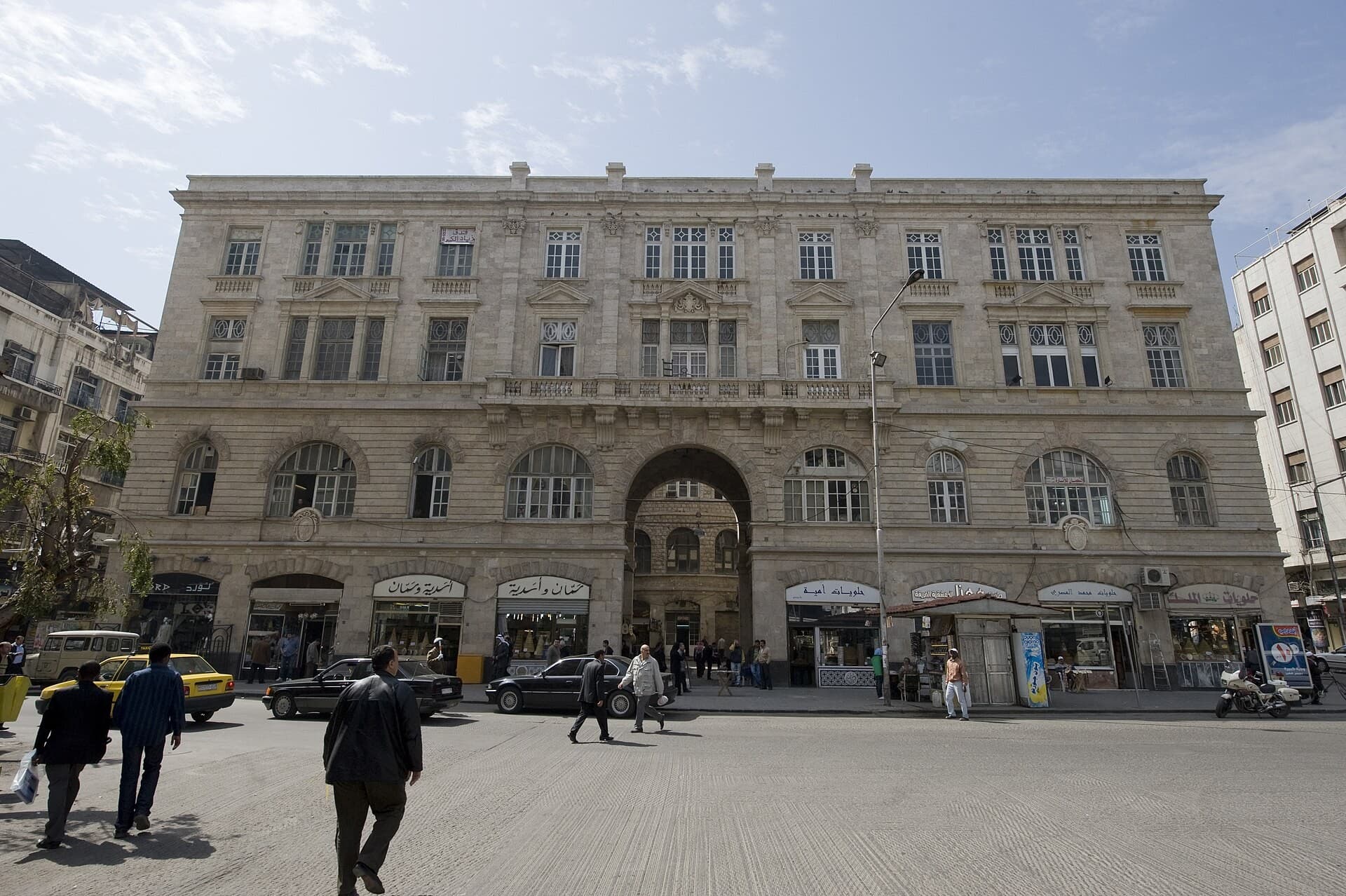
The best-known front on Marjeh Square was built as a hotel between 1906 and 1910. The Syrian General Congress met inside it in 1919. It is not open today.
- Opening hours
- The ground-floor shops keep daytime hours; there is no visitor entry to the building
- Entry
- Free to look at from the square; no entry to the building
- Duration
- 20 minutes
- Best time
- Before noon, while the front takes direct light
- Period
- Late Ottoman
- Address
- Eastern side of Marjeh Square, Damascus
A four-storey stone building on Marjeh Square with an arched passage through its middle. It was among the first buildings in Damascus to take up a European manner, and it is the face of the square that appears in most photographs of it. Designed as a hotel, it was never a hotel: it became a war hospital, then a parliament, then a headquarters, then government offices. Shops fill the ground floor now, with flats and newspaper bureaus above.
Getting there
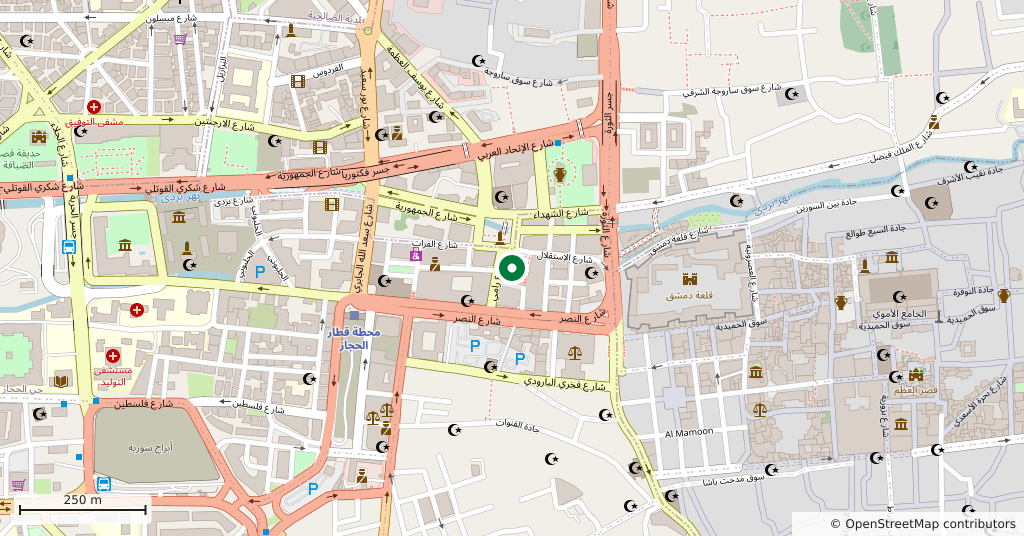
Come out of the Al-Hamidiyah Souq onto An-Nasr Street and walk west. When you reach Marjeh Square, the long stone front on the eastern side is this one. Stand at the foot of the telegraph column and the building sits squarely opposite. The Grand Serail is on the southern edge of the same square, and the courthouse is five minutes east.
Can you go inside
You can go into the shops on the ground floor; into the building itself, no. The upper floors are working offices and homes, and there is no visitor tour. The arched passage in the middle is public and opens onto the courtyard — it is the only point from which the inside shows, reached between a shoe shop and a sweet shop.
Who built it
Ahmad Izzat al-Abid, chief secretary to Sultan Abdulhamid II, had it built between 1906 and 1910 on the old palace plot he bought from Husayn Nazim Pasha. Ahmad Izzat was the father of Muhammad Ali al-Abid, the first president of Syria. The work was carried out by the Spanish architect Fernando de Aranda, who also designed the Hijaz station. The foundations rest on wooden piles treated with tar and lysol and driven into the water of the Barada.
What happened here
In the First World War the Ottoman army requisitioned the building and used it as a military hospital. In 1919 the Syrian General Congress — the first parliament of Greater Syria — met here. In 1920 General Gouraud, entering Damascus, made it his headquarters. It housed the assembly until the new parliament building was finished, which means the first sessions of modern Syria were held inside these walls.
Do not miss
The central axis of the front: the pediment at the top, the band of balconies under it, and at street level the wide arch opening into the courtyard. All three line up, and that alignment is what says the building was drawn as a hotel. Step one pace into the passage and look up.
Tips
- Stand at the base of the telegraph column; the front sits squarely opposite
- Step into the arched passage in the middle; the courtyard and upper floor show from there
- The Grand Serail and the telegraph column are the same stop; the souq is five minutes back
Transparency
- How this was chosen
- Written by hand; opening hours, entry fee and coordinates are kept as data. A field that is not known for certain is marked as variable rather than guessed.
- Facts checked
- September 2026
- Last updated
- September 15, 2026