The Al-Atabakiyya Madrasa
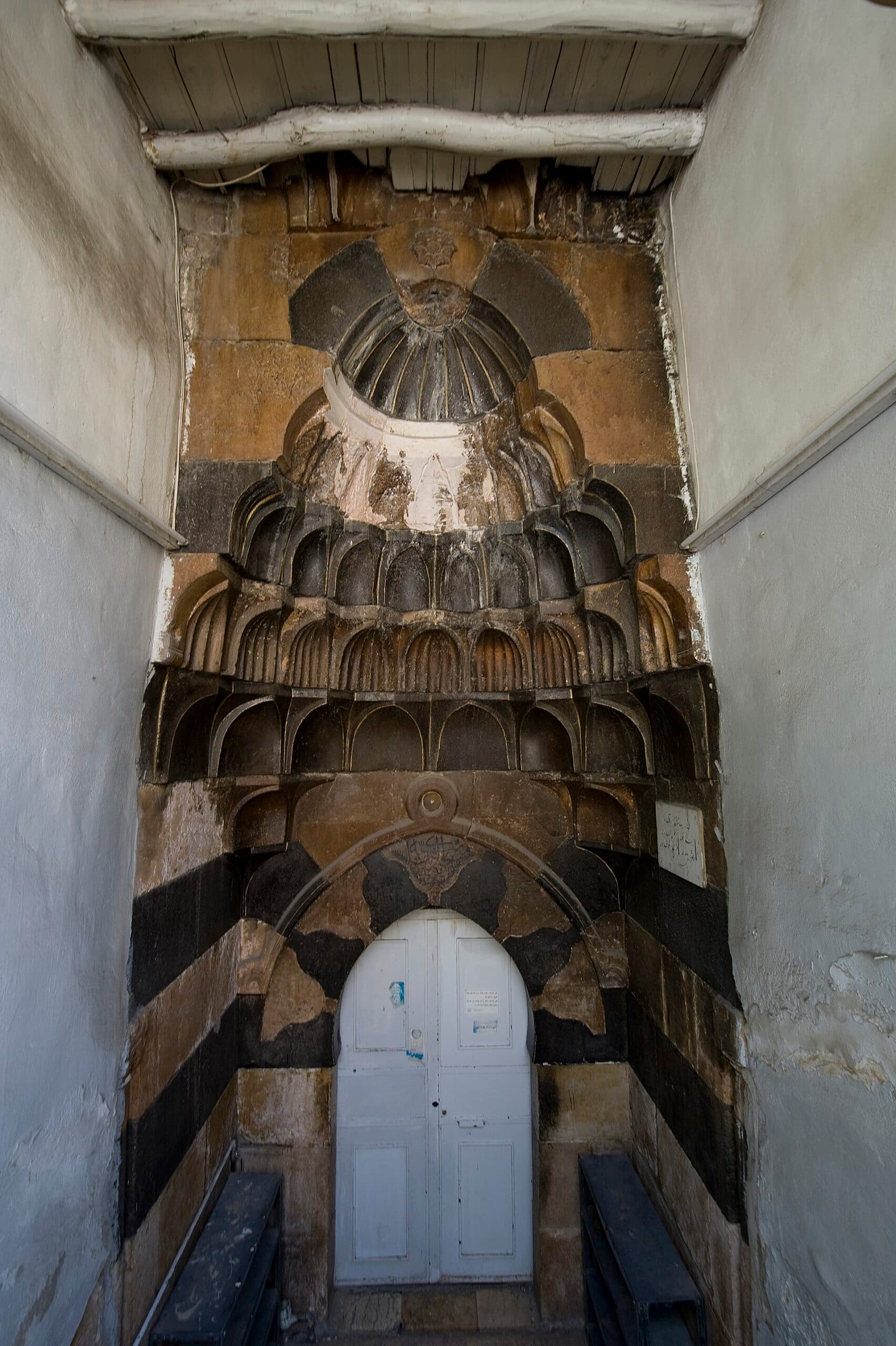
The most worked doorway on the street of madrasas in Salihiyya: a muqarnas hood, a striped stone frame, and two records that disagree about its founder.
- Opening hours
- Variable — seen from the street, the interior is not regularly open
- Entry
- Free — the facade is visible from the street
- Duration
- 15 minutes
- Best time
- Towards midday, when light reaches into the door recess
- Period
- Zengid — Ayyubid
- Address
- Salihiyya, the street of madrasas (Jaddat Hayy al-Madaris), Damascus
It stands on the street of madrasas in Salihiyya, outside the line of the old walls. The finely carved muqarnas hood over the door is what tells this building apart at a glance, and courses of black and white stone frame the door recess. Its square minaret was added later.
Who built it
There are two answers, and both come from a source. The Arabic Wikipedia entry names the founder as Sayf al-Din Ghazi, son of the Zengid ruler Imad al-Din Zengi, and gives the date 1140 (540 AH). The Commons records, which follow Ross Burns’s guide to Damascus, put the building under Turkan Khatun (d. 1242), daughter of a ruler of Mosul and grand-niece of Nur al-Din. That is a hundred years apart. No source in hand settles it, so both stand here. What is certain is the Zengid circle, and that this street was largely founded by women.
What to see
The recess is narrow and tall, so you look up without going in. A small fluted half-dome closes the top of the hood, and rows of muqarnas cells step down below it, some of them carved inside with stars and rosettes. The sides of the recess and the arch over the door are laid in alternating black basalt and pale limestone. The wooden door comes from a later repair and its paint is new. The shaft of the square minaret reads better from the far end of the street.
How long it takes
Fifteen minutes, at the door. This is not a museum open to visitors; what you see from the street is the whole of it. Walked with the Sahibiyya, the Murshidiyya and the Jaharkasiyya, the four fit into one morning.
Don’t miss
The neighbours right beside the door. Dar al-Hadith al-Ashrafiyya al-Barraniyya and the Takritiyya tomb are twenty or thirty paces away on the same side of the same street. The street takes its name from that crowding: founding a madrasa in Ayyubid Damascus was a land grab as much as an act of charity, and here three buildings share one frontage.
Tips
- The inside of the hood stays in shadow; the muqarnas cells only separate when the sun is straight over the street
- Frame the minaret from the far end of the street, the shaft is invisible from the door
- The Takritiyya tomb next door is neglected but thirty paces away, on the same walk
Transparency
- How this was chosen
- Written by hand; opening hours, entry fee and coordinates are kept as data. A field that is not known for certain is marked as variable rather than guessed.
- Facts checked
- September 2026
- Last updated
- September 15, 2026