Al-Bara
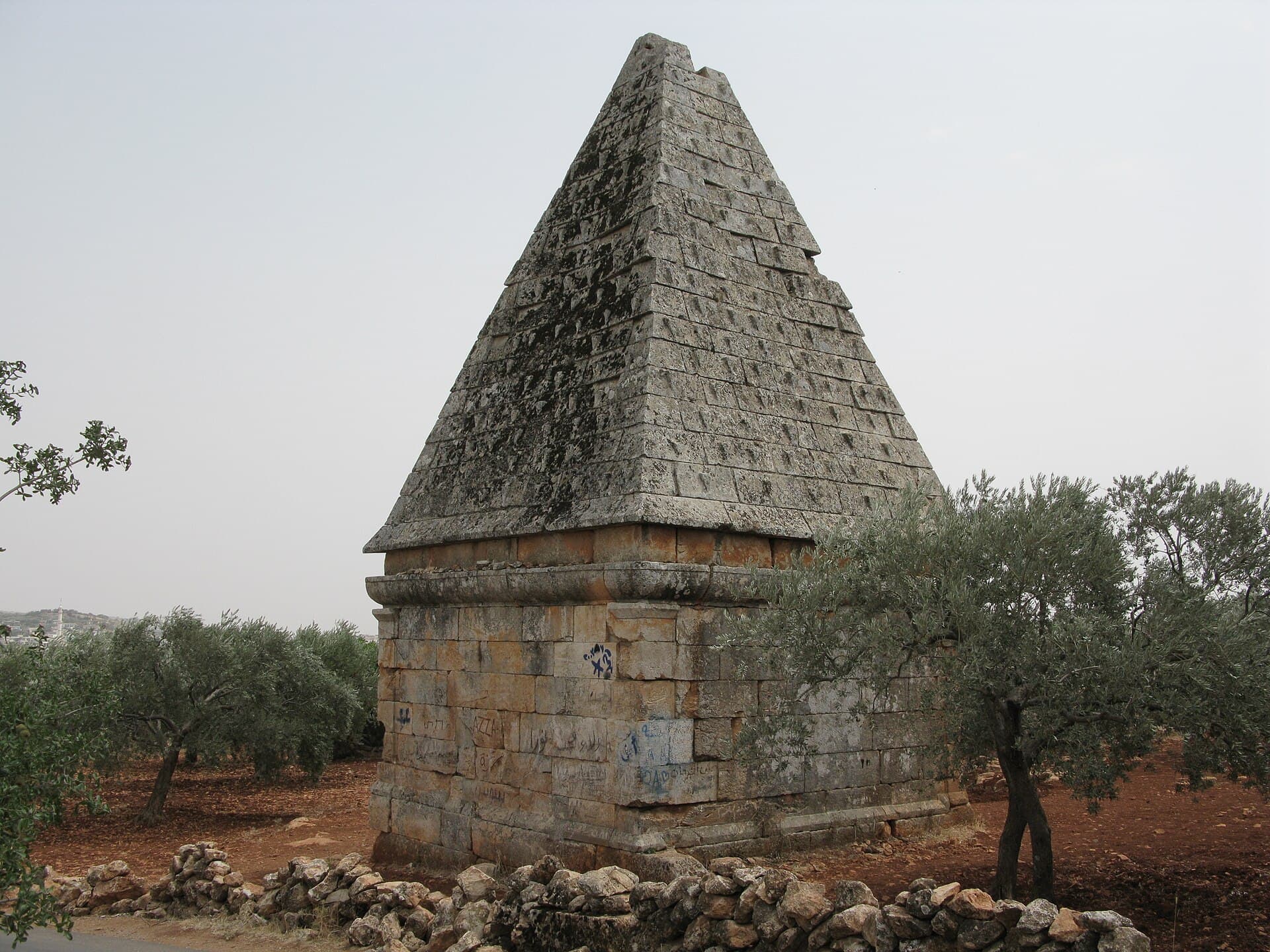
The largest of the Dead Cities. Two pyramid-roofed tombs, churches and olive presses on an industrial scale, with a working village standing inside the ruins.
- Opening hours
- Open site; the ruins lie inside the village and its olive groves
- Entry
- Variable — check at the entrance
- Duration
- 90 minutes
- Best time
- Spring morning; there is shade in the groves and the tombs take side light
- Period
- Byzantine — 4th to 6th century
- Address
- Jebel Zawiya, village of al-Bara, Idlib
The most extensive of the Dead Cities, and the only one still lived in: the modern village of al-Bara was built on top of the ancient town, among the olive groves. So you do not enter this site through a gate. You walk between olive trees, and out of the dry-stone walls come a tomb, an apse, a press stone. The two best known buildings still standing are pyramid-roofed mausolea: dressed limestone, sharply pitched, out in the middle of a field.
Getting there
41 kilometres south of Idlib, in the Jebel Zawiya hills, about an hour and a quarter by car. Serjilla is 7 kilometres away and the two fit into the same half day. There is no public transport; you hire a car and driver, and the driver needs to know where the tombs are, because nothing here is signposted.
How long it takes
An hour and a half. The two pyramid tombs stand two hundred metres apart with olive grove in between. If you want the churches and the monastery as well, allow three hours, and take someone who knows the ground.
What to see
Two pyramid-roofed tombs, and the remains of five churches and three monasteries, of which Deir Sobat is in the best condition. The town was founded in the 4th century and was at its fullest in the 6th; most of what stands belongs to those two centuries. Crusaders took it in 1098 and it became the seat of a bishopric under Antioch. It was abandoned after an earthquake at the end of the 12th century.
What most people miss
The olive presses. Olive oil is what made al-Bara rich, and the presses here are on an industrial scale: stone basins, weight stones, cisterns. Olives still grow on the same slope today, and that continuity is the liveliest thing on the site — more so than the tombs.
Tips
- Take a driver or guide who knows the ground; nothing is signposted
- The olive groves are private property; ask before walking in among the trees
- You can go inside the larger tomb, where the sarcophagi are still in place
- Serjilla is 7 kilometres away; put the two in the same day
Transparency
- How this was chosen
- Written by hand; opening hours, entry fee and coordinates are kept as data. A field that is not known for certain is marked as variable rather than guessed.
- Facts checked
- August 2026
- Last updated
- September 15, 2026