The Al-Hamawi Mosque
An Ottoman mosque of 968/1560 below the north-east side of the Aleppo Citadel, with its own school, fountain and tomb around it. Entry is free, at prayer times.
- Opening hours
- Prayer times; otherwise varies — confirm at the door
- Entry
- Free
- Duration
- 20 minutes
- Best time
- Morning, on the same walk around the citadel
- Period
- Ottoman
- Address
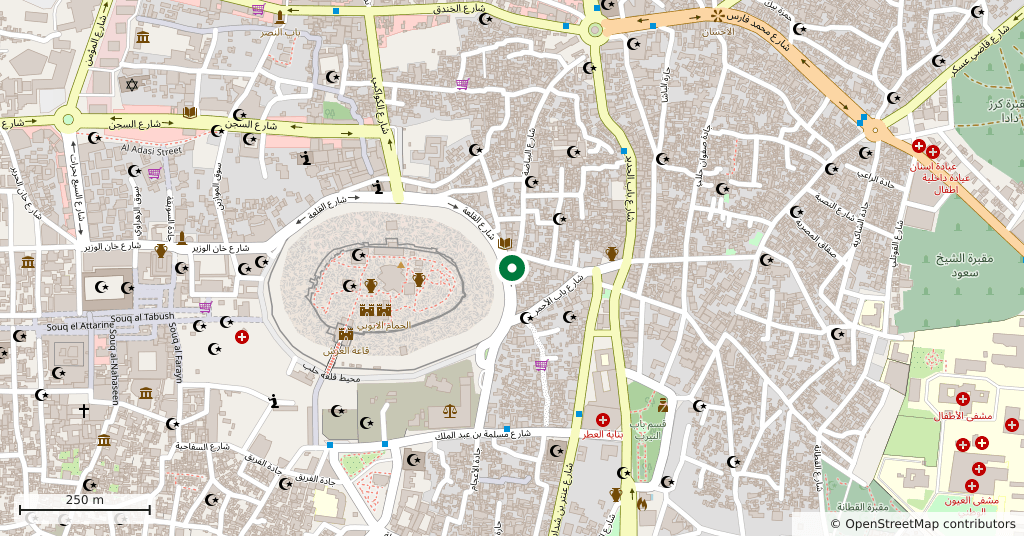
- Bayada quarter, north-east of the citadel, Old City, Aleppo
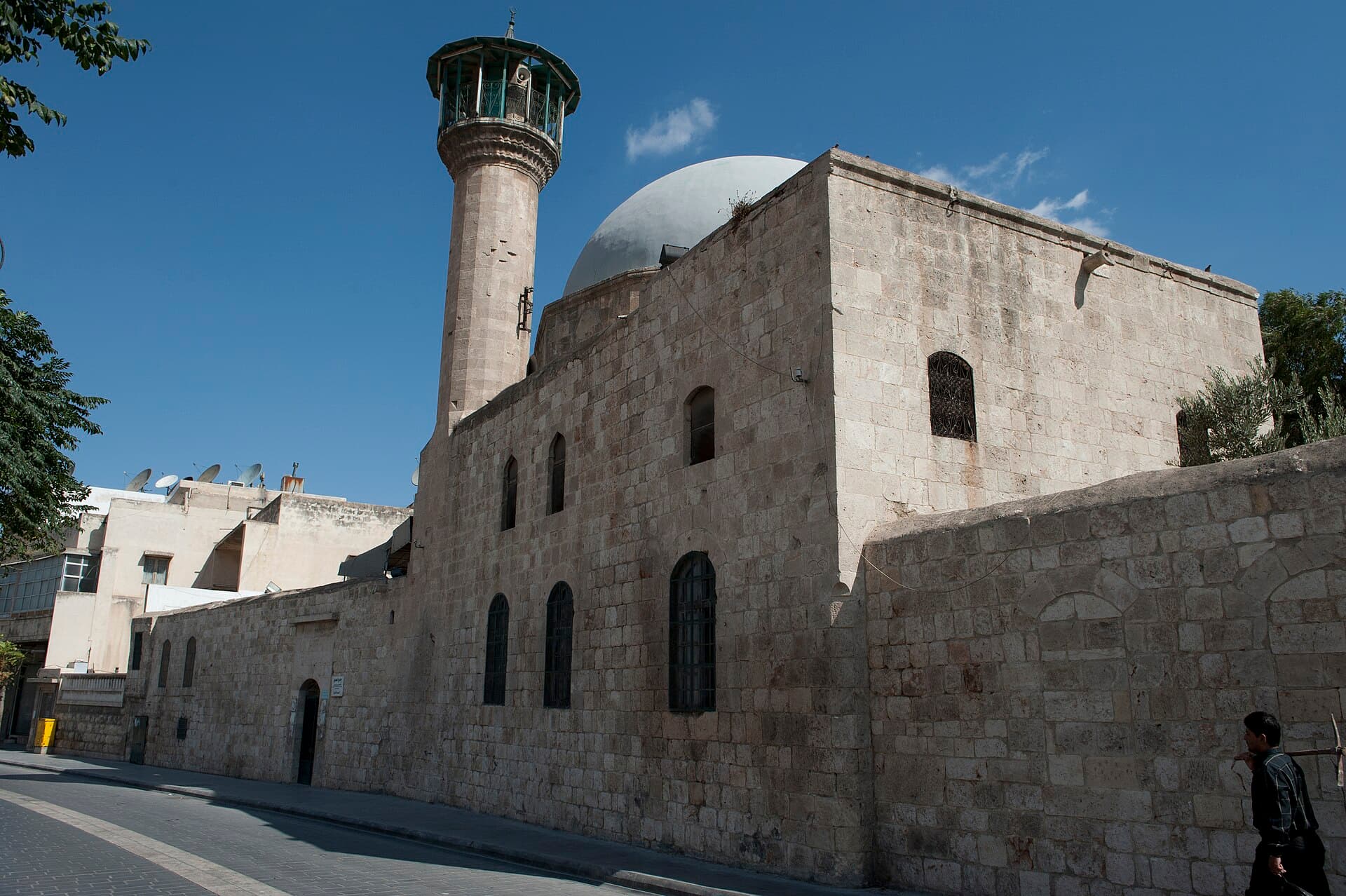
An Ottoman neighbourhood mosque at the north-east foot of the Aleppo Citadel, facing the castle. Hajj Muhammad ibn Dawud al-Nuri al-Maghribi built it in 968/1560. The name comes from Hasan ibn Abd al-Rahman al-Hamawi, who restored and enlarged it in 1183/1769. It does not stand alone: it is the centre of a small endowment — a waqf — with a school opposite, a public fountain to the south and a tomb west of the fountain. Photographs from 2019 and 2020 show the mosque standing.
Getting there
From the citadel square, take the road that rings the castle and walk north-east; the minaret shows from this promenade. The mosque is on the main street of the Bayada quarter, right next to Hammam al-Bayada. The Al-Sarawi Mosque, in the same quarter, is a few minutes on foot.
How long it takes
Twenty minutes. The façade and minaret read from the street, and the school, fountain and tomb are all close around the mosque.
What to see
The long wall on the street is cut stone, with arched, iron-barred windows along its upper row. Blind arches are set into the lower wall beside it. The plastered dome rises behind the wall. The minaret has a round stone shaft and a screened balcony. Hasan al-Hamawi added the minaret in the 1769 restoration; lightning struck it in 1292/1875.
Inside is a wide courtyard. On its north side runs a broad raised platform, partly built over a bakery that belonged to the endowment, with two rooms at its east end. Around 1285 in the Hijri calendar the ablutions area was moved in front of the door, at the top of the steps. The first founder, Muhammad al-Nuri, is buried on the east side.
The endowment around it
The Hamawi family’s charity reaches beyond the mosque. The Hamawi school opposite was also founded in 968, and Hasan al-Hamawi restored it too. The Hamawi fountain to the south carries carved plant motifs, and the Hamawi tomb stands to its west. A soap workshop nearby paid into the same endowment. The quarter takes its name from a trade: in Arabic a bayyad is the craftsman who tins copper pots.
Do not miss
The plant carving on the fountain. Visitors who stop in front of the mosque and look only at the minaret leave without seeing this small building to the south, or the tomb beyond it.
Where things stand
Photographs dated December 2019 and November 2020 show the mosque standing. We found no dated record of the state of the interior, the school or the fountain today; ask in the quarter whether the door is open.
Tips
- The minaret is visible from the promenade around the citadel, which makes the mosque easy to find
- Hammam al-Bayada is right next door and the Al-Sarawi Mosque a few minutes away; treat the three as one stop
- The fountain is south of the mosque and the tomb west of the fountain; look at both
- The door may be locked outside prayer times; ask in the quarter
Transparency
- How this was chosen
- Written by hand; opening hours, entry fee and coordinates are kept as data. A field that is not known for certain is marked as variable rather than guessed.
- Facts checked
- September 2026
- Last updated
- September 15, 2026