Al-Muallaq Mosque
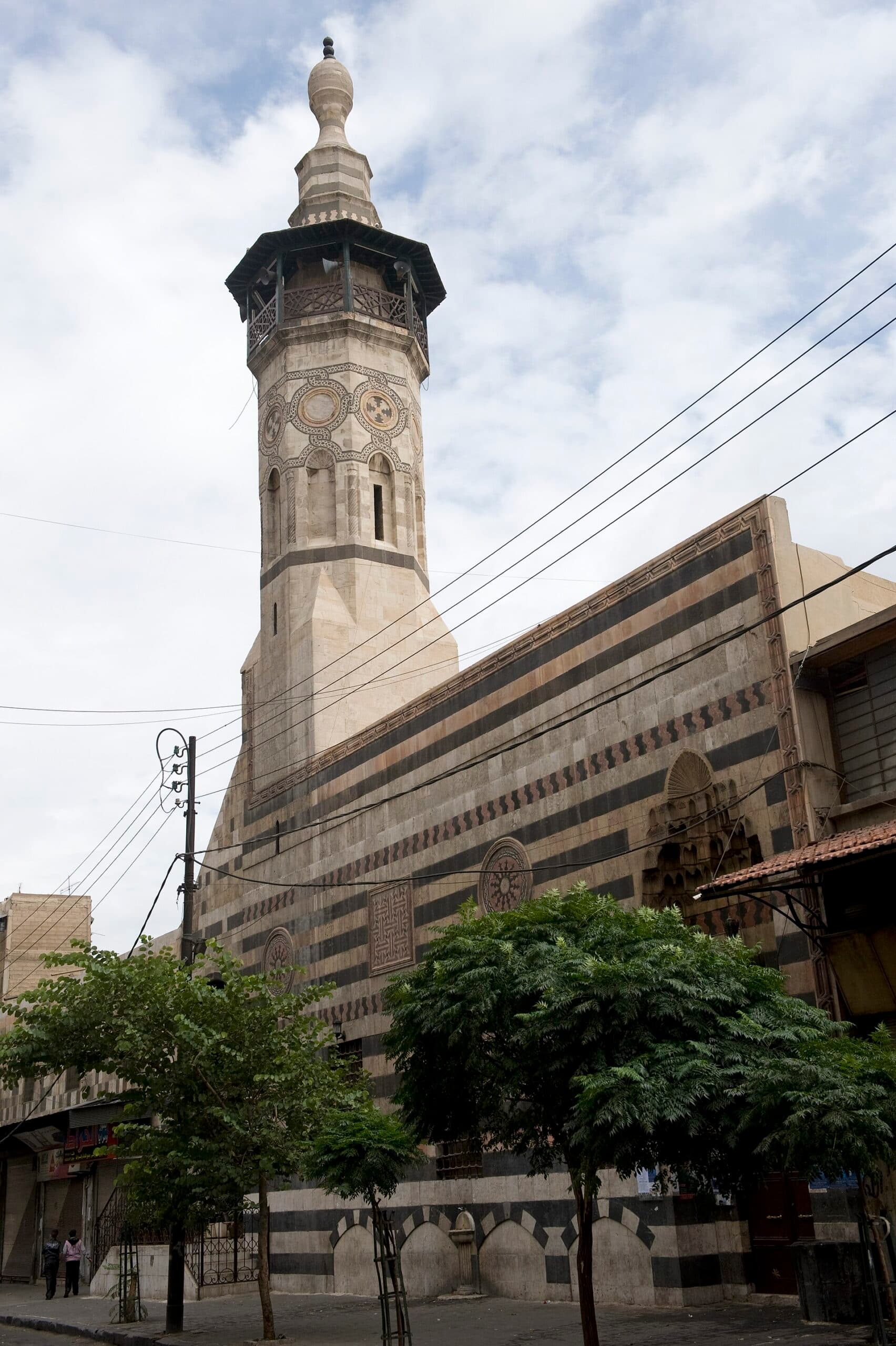
A Mamluk mosque of 1458 on the bank of the Barada: banded black-and-white stone, a stair up to the door, and a minaret rebuilt Cairo-style after lightning.
- Opening hours
- Open around prayer times
- Entry
- Free
- Duration
- 25 minutes
- Best time
- Afternoon, when the sun is on the banded facade
- Period
- Mamluk
- Address
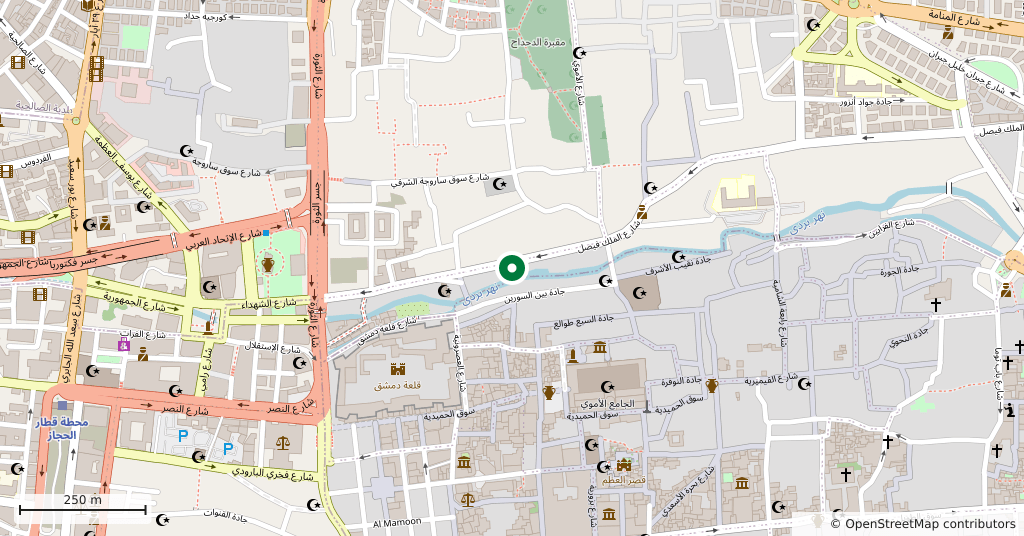
- Between Bab al-Faraj and Bab al-Faradis, al-Amara al-Barraniyya, Damascus
The name means the hanging mosque. It is called that because it sits slightly above the ground and stands right on the bank of the Barada. The Mamluk emir Bardbak al-Ashrafi built it in 1458, and in the city it also carries his name, the Bardbak Mosque. Its site is outside the wall: between Bab al-Faraj and Bab al-Faradis, in the district known as al-Amara al-Barraniyya.
Getting there
Leave the old city at Bab al-Faradis, north of the Umayyad Mosque, then turn west along the line of the river. The mosque faces the street and its minaret is visible from a distance; its banded flank reads as a separate surface among the shops around it. Ten minutes on foot from the centre of the old city.
What to see
The facade is ablaq: courses of black basalt alternating with pale limestone. Panels of Kufic script and round stone rosettes are set into the wall, and the hood over the door is carved with muqarnas. Inside there is a courtyard, a pool and an iwan, and a second doorway. The windows look towards the Barada — the mosque once opened directly onto the water.
The break in the minaret
In 1648 lightning struck the head of the minaret and brought the top down. The governor of Damascus of the day paid for the repair, but the minaret was not put back as it had been; the upper section was raised in the manner of the Mamluk minarets of Cairo. The building was worked on again in 1910. The minaret you see carries the work of three separate centuries.
Don’t miss
The stone stair at the entrance. This is where the mosque gets its name; you climb a few steps up from street level, and once you are in the courtyard the noise of the road stays below you.
Tips
- The muqarnas carving over the door can be seen from the street
- The upper minaret is not in the same style as its shaft; look for the join
- It fits into the same walk as Bab al-Faradis and the Tawba Mosque
Transparency
- How this was chosen
- Written by hand; opening hours, entry fee and coordinates are kept as data. A field that is not known for certain is marked as variable rather than guessed.
- Facts checked
- September 2026
- Last updated
- September 15, 2026