The Al-Naqshabandi Mosque
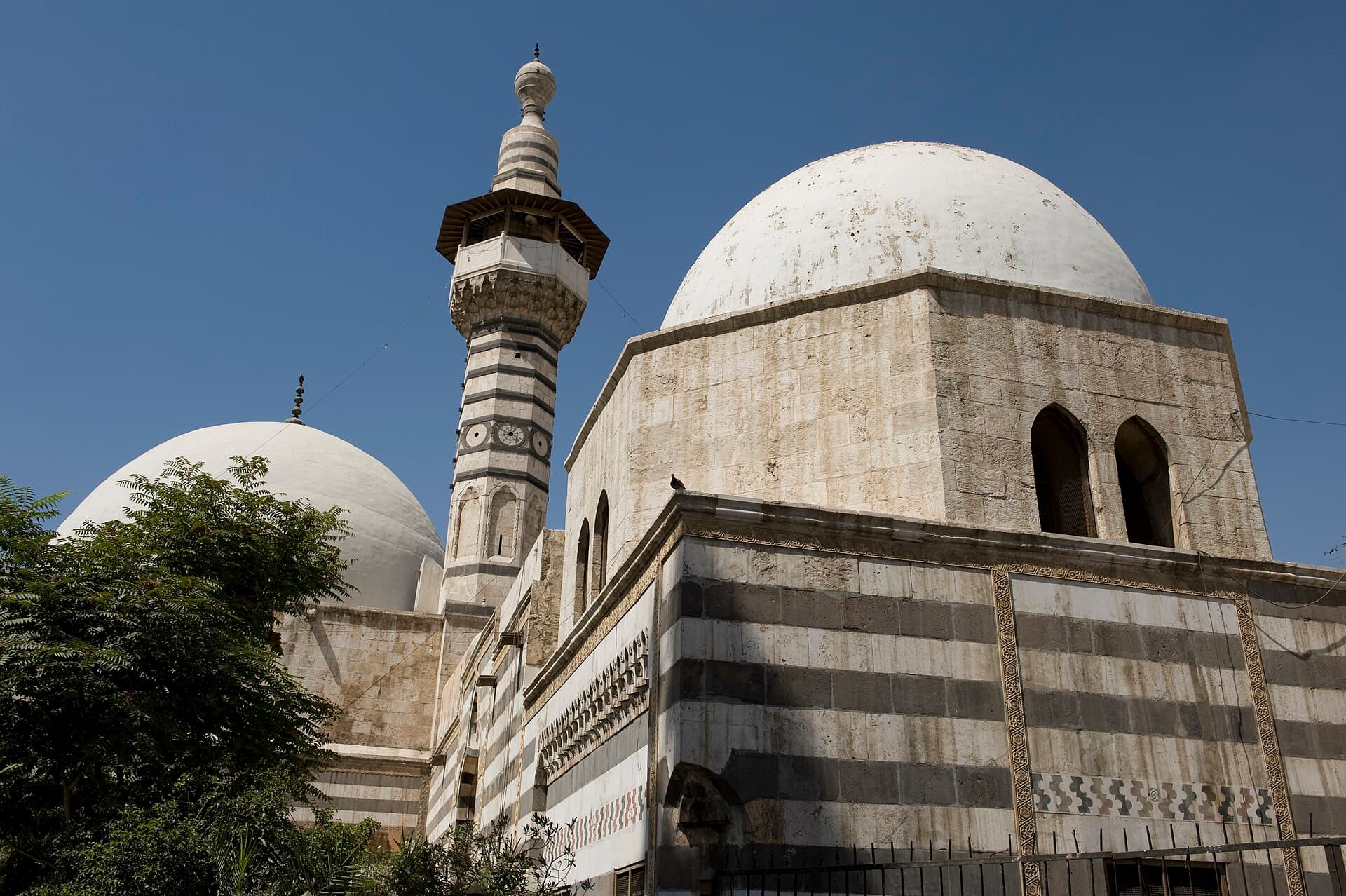
Murad Pasha, governor of Damascus, built this Ottoman mosque in 1568: banded black-and-white walls, domed cells around the courtyard, a hexagonal minaret.
- Opening hours
- Open around prayer times; variable otherwise
- Entry
- Free
- Duration
- 30 minutes
- Best time
- Late morning, before the arcade shadow cuts the courtyard in two
- Period
- Ottoman
- Address
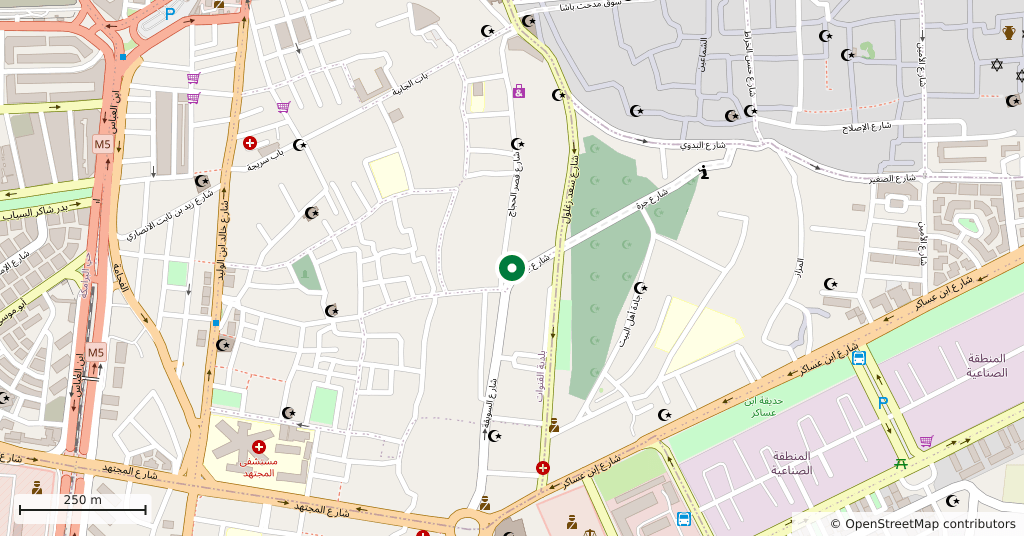
- Suwayqa, near Bab al-Jabiya, Al-Midan, Damascus
Murad Pasha, the Ottoman governor of Damascus, built it in 1568. It later became a centre for the Naqshbandi Sufi order, and picked up the second name it is usually known by today. This was one of the first large buildings in Damascus put up in the Ottoman manner: courses of black and white stone, a lead-covered dome, domed cells running round the courtyard. It stands at the north end of the Midan quarter, where the pilgrim caravan once formed up.
Getting there
Leave the Al-Hamidiyah Souq by its western gate and walk south along the street that follows the outside of the old wall. Past the Darwishiyah and Sibaiyah mosques the road bends south-west, and the mosque is right on that bend, on your right. A quarter of an hour on foot from the souq. Bab al-Jabiya is the nearest of the old gates.
What to see
An ablution fountain sits in the middle of the courtyard, with an arcade around it and domed cells behind the arcade. Those cells were bedrooms for the students who lodged here. Qashani tile panels are set into the walls, and the prayer hall is rectangular under a single dome. Murad Pasha’s tomb chamber occupies one corner.
The first Ottoman building on the road to Mecca
Under Ottoman rule the pilgrim caravan assembled in Damascus. Close to thirty thousand pilgrims gathered each year west of the old wall and set out on a journey to Mecca that took five weeks. This mosque was the first building in Ottoman style along that road, and its complex included a hostel for poor pilgrims. The whole thing was set at an angle to the street for a plain reason: so it could be seen from a distance.
What most people miss
The Kufic inscription over the main gate gives the date of construction and the name of the patron. Most visitors walk under it without looking up. Look at the minaret too. Its hexagonal shaft is the one element that follows the local tradition; everything else here came from Istanbul.
Tips
- Read the Kufic inscription over the main gate before you step inside
- The domed cells around the courtyard were student rooms, not storerooms
- The hexagonal minaret is the only local element; compare it with the dome
- Murad Pasha's tomb is in the corner of the courtyard and has its own door
Transparency
- How this was chosen
- Written by hand; opening hours, entry fee and coordinates are kept as data. A field that is not known for certain is marked as variable rather than guessed.
- Facts checked
- September 2026
- Last updated
- September 15, 2026