The Al-Sabuniyya Madrasa
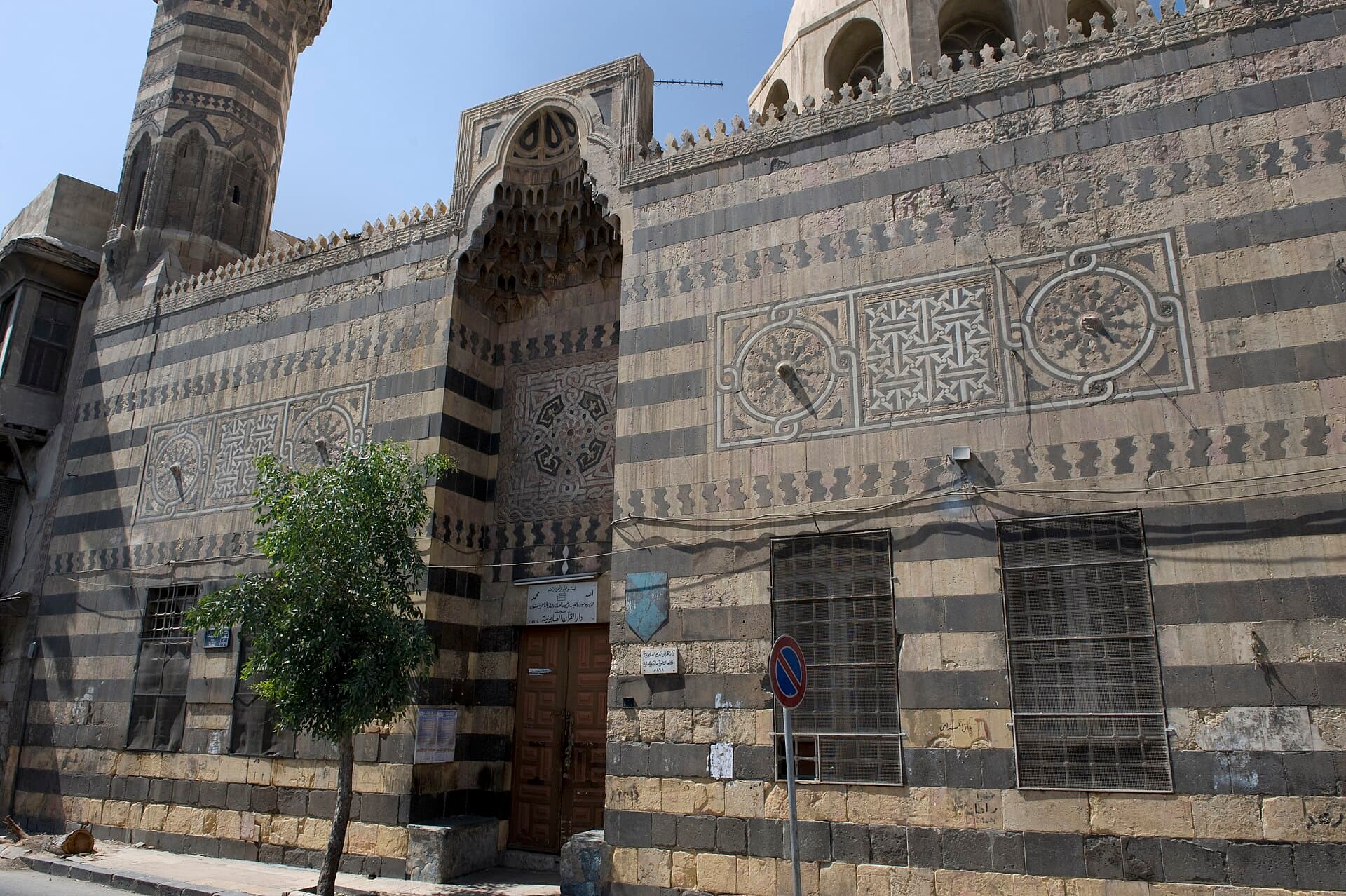
A Mamluk madrasa facing the Bab al-Saghir cemetery: striped stone, a muqarnas portal and an octagonal minaret, the best worked front outside the walls.
- Opening hours
- Rarely open — finding it shut is normal, the facade is there at any hour
- Entry
- Free — the facade is visible from the street
- Duration
- 20 minutes
- Best time
- Morning, while the front takes direct light
- Period
- Mamluk
- Address
- Al al-Bayt Street, opposite the Bab al-Saghir cemetery, Damascus
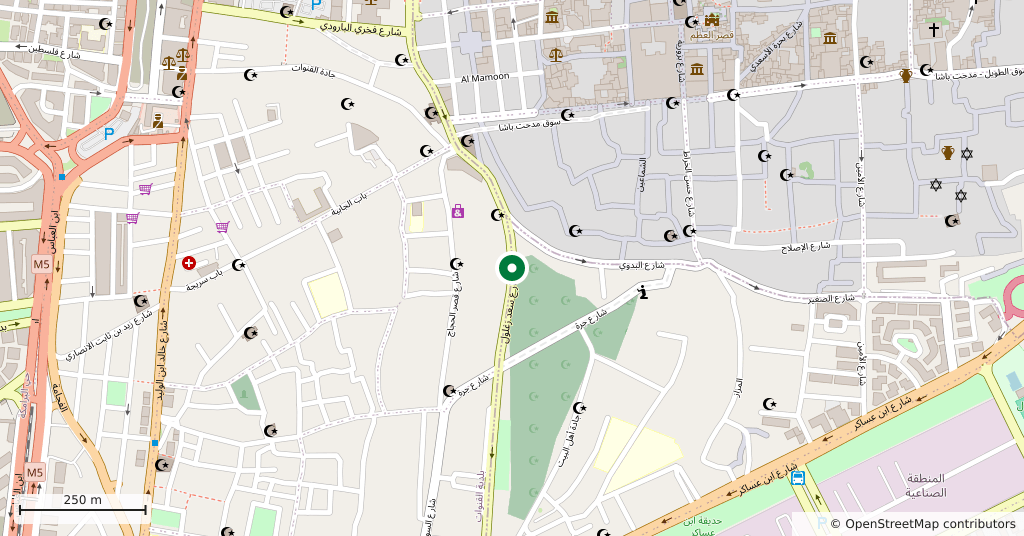
South-west of Bab al-Jabiya, outside the walls, on Al al-Bayt Street and directly opposite the Bab al-Saghir cemetery. It was founded between 1459 and 1464 by a wealthy merchant, Shihab al-Din Ahmad Ibn al-Sabuni, and set up as a funerary endowment.
Getting there
Come out of the gate of the Bab al-Saghir cemetery, turn onto Al al-Bayt Street, and the facade is in front of you. From inside the walls it is a walk south-west from Bab al-Jabiya. The street carries traffic and the pavement is narrow, so you cross to the cemetery side to take the front in as a whole.
What to see
The front is dressed stone laid in alternating black and white courses, with large geometric roundels cut into the white above. The portal recess is deep, closed by a muqarnas crown that narrows as it comes down, and the panel at the back of the recess is coloured marble inlay framed by interlacing bands. The plan is rectangular and Mamluk: a courtyard, a large western iwan with a mihrab facing south on the axis of the entrance, and a smaller southern iwan. The octagonal minaret carries striped stone and blind niches, and its balcony rests on muqarnas corbels. Inside the dome the plant ornament survives.
How long it takes
Twenty minutes, in front of the facade. The building stands and its decoration is intact, but it is rarely open; finding it shut is normal, and most of what there is to see at this stop is outside anyway. Combined with a visit to the Bab al-Saghir cemetery it costs no extra time.
Don’t miss
The panel at the back of the portal. Most visitors look at the muqarnas overhead and walk on. The real work is in the marble below: bands of black, white and reddish stone pass through one another and knot, and a raised plaited border runs around the edge of the panel. Come here after seeing the bare striped wall of the Qilijiyah and you see where the same idea got to in two hundred years.
Tips
- Cross to the cemetery side to take the whole front in; the pavement is narrow and the minaret will not fit in the frame
- Look at the marble inlay panel below the portal, that is where the work is
- Combine it with the Bab al-Saghir cemetery, the two face each other across the street
Transparency
- How this was chosen
- Written by hand; opening hours, entry fee and coordinates are kept as data. A field that is not known for certain is marked as variable rather than guessed.
- Facts checked
- September 2026
- Last updated
- September 15, 2026