The Al-Shamiyah al-Kubra Madrasa
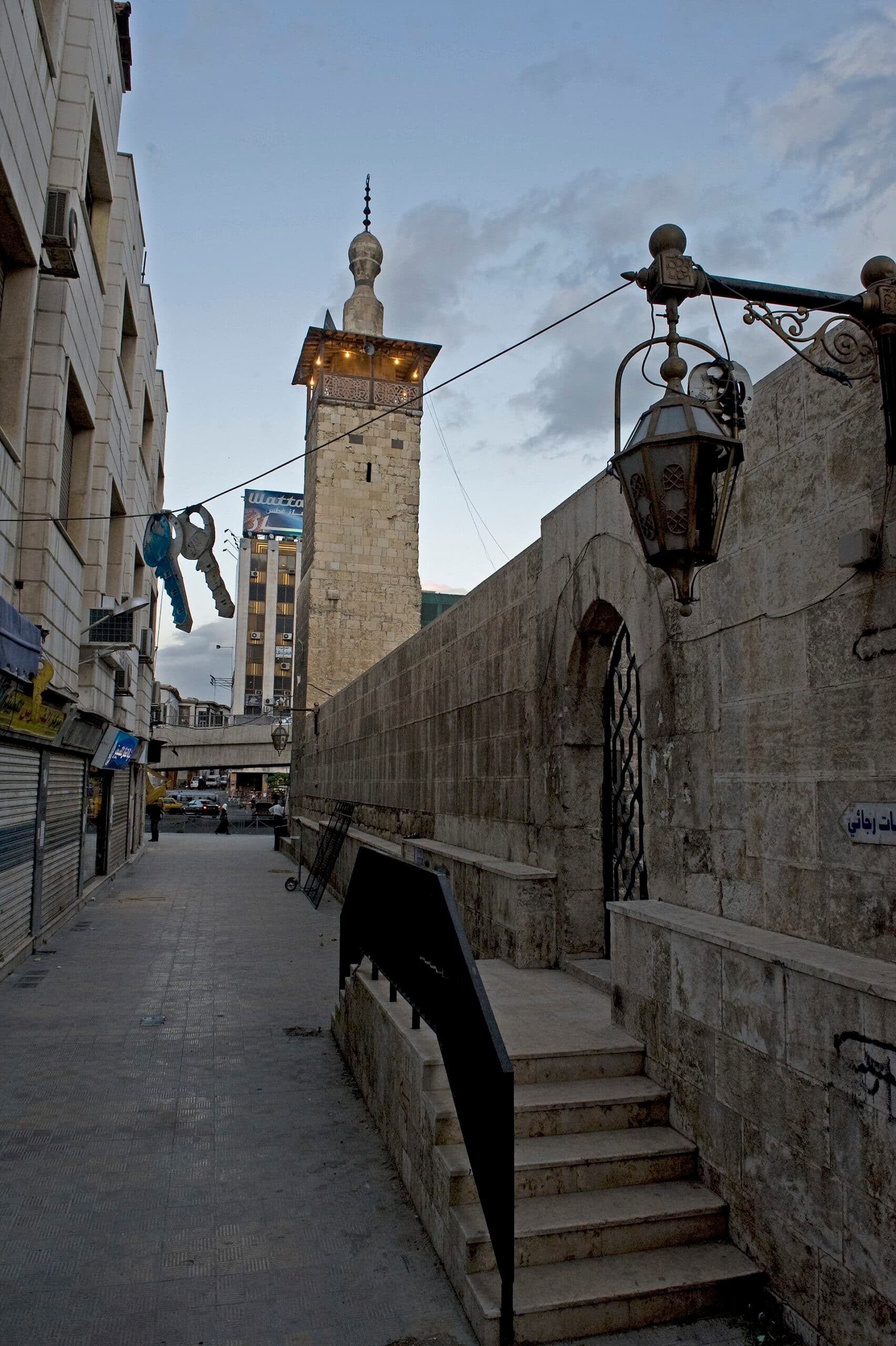
The complex Saladin’s sister Sitt al-Sham founded in Souq Saruja: a wide courtyard, a plain Ayyubid stone minaret, and a tomb chamber holding three graves.
- Opening hours
- Open at prayer times — ask about access outside them
- Entry
- Free
- Duration
- 30 minutes
- Best time
- Afternoon, once the courtyard falls into shade
- Period
- Ayyubid
- Address
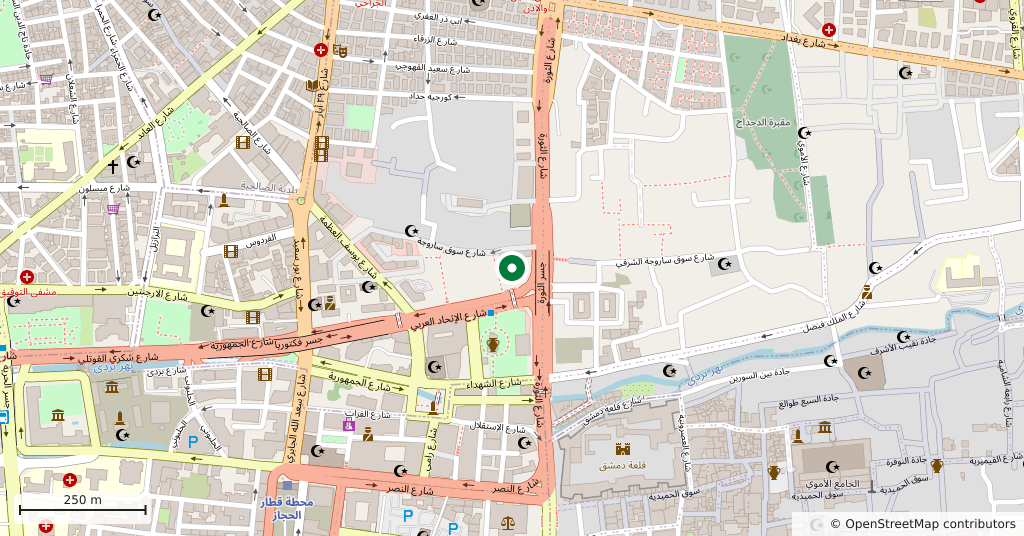
- Souq Saruja, corner of Thawra and Shukri al-Quwatli streets, Damascus
In Souq Saruja, about 200 metres north-west of the old city. Fatima Khatun, daughter of Najm al-Din Ayyub and sister of Saladin, founded it between 1187 and 1191. Her charity earned her the name Sitt al-Sham, the Lady of Damascus; the name passed to the quarter, and the building is now called the Sitt al-Sham Mosque.
Getting there
On the corner of the road that runs from Thawra Street up to the Victoria Bridge, where Shukri al-Quwatli Street meets it. Everything around it is modern: tower blocks, signage, traffic. Take the stone minaret as your marker — it shows from the end of the street and looks like nothing else near it.
What to see
The courtyard is rectangular and wide, with a stone basin at its centre. A portico on stone piers runs in front of the prayer hall. In the eastern corner rises a large, undecorated Ayyubid stone minaret, carrying a square wooden balcony under a wooden canopy, with a bulbous finial at the top. The tomb chamber holds three graves: Sitt al-Sham, her son Husam al-Din who was killed at Hattin, and her husband and cousin Nasir al-Din Muhammad ibn Shirkuh. The body of her elder brother Shams al-Dawla Turanshah was also brought here from Alexandria.
How long it takes
Half an hour. The building works as a mosque, so it is open at prayer times; whether women may enter and sit in the courtyard depends on the arrangement of the day. With the garden beside it this counts as a place to sit, and in the midday heat it is one of the few patches of shade in Souq Saruja.
Don’t miss
One condition of its endowment was that its teacher should hold no chair at any other madrasa. Scholars of the period commonly held several posts at once, and Sitt al-Sham forbade it outright. This was among the most heavily endowed colleges in Damascus, and Ibn al-Salah gave the first lessons in it. Shams al-Din al-A’raj and Shams al-Din al-Maqdisi taught from the same chair after him.
Tips
- Take the minaret as your marker; among the modern blocks the building is otherwise hard to pick out
- Ask for the tomb chamber — the three graves are together and its door is not always open
- If you arrive at prayer time, wait in the courtyard; the portico empties once the congregation leaves
Transparency
- How this was chosen
- Written by hand; opening hours, entry fee and coordinates are kept as data. A field that is not known for certain is marked as variable rather than guessed.
- Facts checked
- September 2026
- Last updated
- September 15, 2026