Bab Kisan
The southeast gate of Old Damascus, Saturn’s gate in the Roman wall. Since 1939 the gate itself is the front of a church. How to find it and what to see.
- Opening hours
- The outside of the gate can be seen all day; chapel hours vary, check at the door
- Entry
- Free from the street; check at the door for the chapel
- Duration
- 30 minutes
- Best time
- Morning — the façade looks southeast and takes the light head-on then
- Period
- Roman · Mamluk rebuilding · 18th century
- Address
- End of Ibn Asakir Street, Amin quarter, southeast corner of the Old City, Damascus
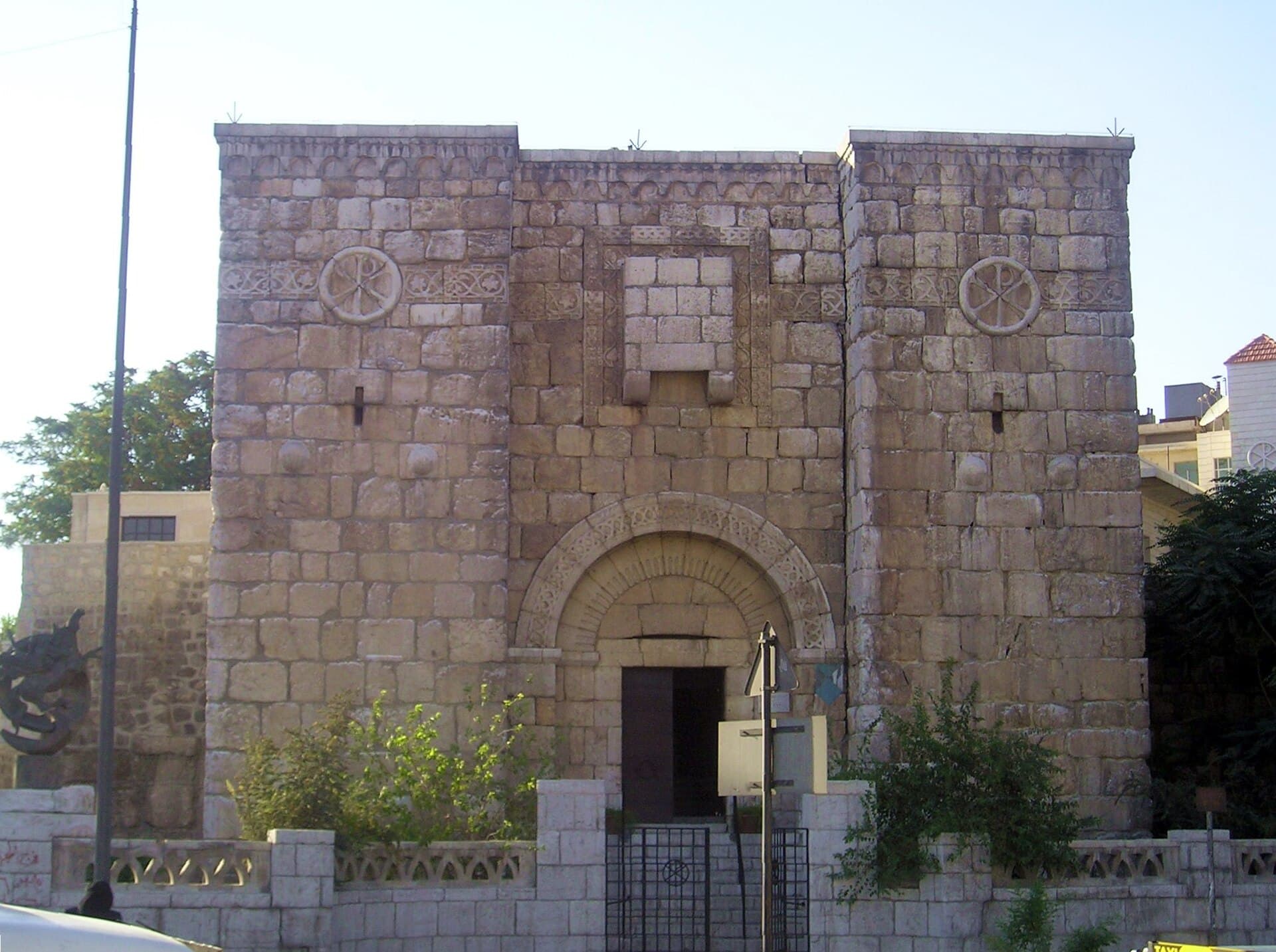
The gate at the southeast corner of Old Damascus, and the only one of the seven ancient gates that now stands as the front of a church. Walk under the arch and you are not in a street but inside the Chapel of Saint Paul. The gate takes its name from Kisan, a slave who became known during a conquest under the Caliph Muawiya. The Romans called it the gate of Saturn: each gate in their wall was dedicated to a planet, with Bab Sharqi given to the Sun and Bab Touma to Venus.
Getting there
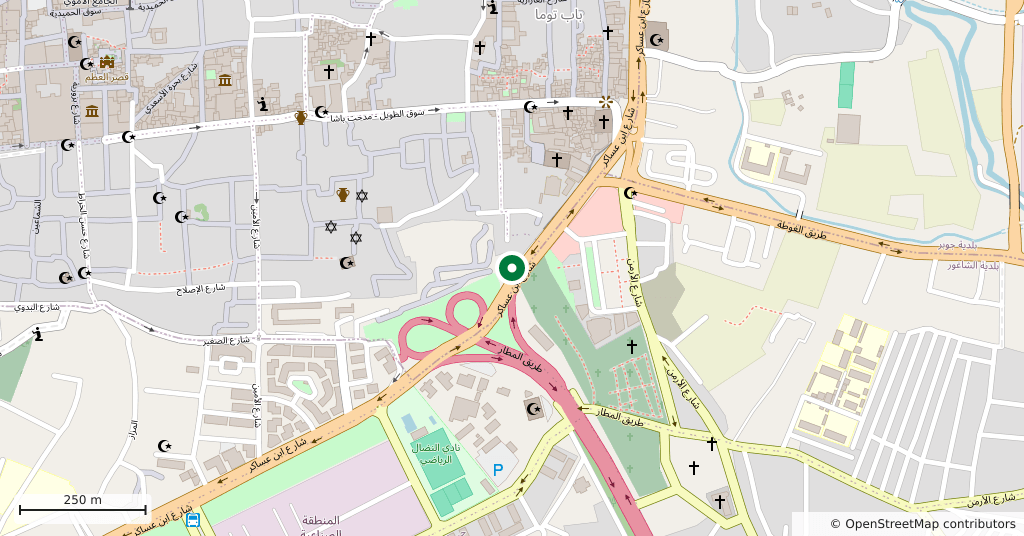
Walk south from Bab Sharqi along the eastern wall: 375 metres as the crow flies, about 400 metres and 5 minutes through the lanes. From the Chapel of Saint Ananias it is 650 metres in the same direction. The gate faces outward, onto the end of Ibn Asakir Street — so you see it from outside the walls, from the opposite pavement, not from within the old city.
How long it takes
Half an hour. Ten minutes of that is spent outside reading the façade, the rest is the chapel inside. The gate faces a busy junction and traffic moves through it, so take your time crossing.
What to see
The façade reads in three stages. In the middle, a round-arched doorway, its arch stones cut with rolled mouldings. Directly above the arch, a window opening blocked up with masonry. Higher still, each of the two flanking blocks carries a carved stone roundel holding a Chi-Rho. Those are the first two Greek letters of the name of Christ, and one of the oldest Christian symbols. Inside, the chapel is plain; a sequence of icons along the wall tells the life of Paul in order, painted for the visit of Pope John Paul II in 2001.
The story attached to it
In Acts 9 and the second letter to the Corinthians 11, Paul has to leave Damascus at night. The gates are watched, so he is let down from a window in the wall in a basket. Tradition puts that spot here, and it is why the chapel was founded on this site in 1939, with stones of the gate built into it. The other end of the story is 650 metres north at the Chapel of Saint Ananias, where Paul recovered his sight and was baptised. The escape belongs here.
Do not miss
The blocked window above the arch. Most visitors look at the arch and the roundels and go straight in. That sealed opening is what the basket story points to — the Dutch archivist who photographed the gate in 1950 wrote the same note under his own frame. The stonework you see is not Roman itself: the gate was rebuilt more than once over the centuries, worked on in the Mamluk period and again in the 18th century.
Tips
- The gate faces outward: to see the façade, step outside the old city to the opposite pavement
- The chapel is a place of worship — cover shoulders and knees, no photographs during a service
- The stone roundels on the two flanking blocks carry the Chi-Rho, visible with the naked eye
- The Chapel of Saint Ananias is 650 metres north and holds the other end of the same story — walk the two together
Transparency
- How this was chosen
- Written by hand; opening hours, entry fee and coordinates are kept as data. A field that is not known for certain is marked as variable rather than guessed.
- Facts checked
- August 2026
- Last updated
- September 15, 2026