The Baghdad Gate
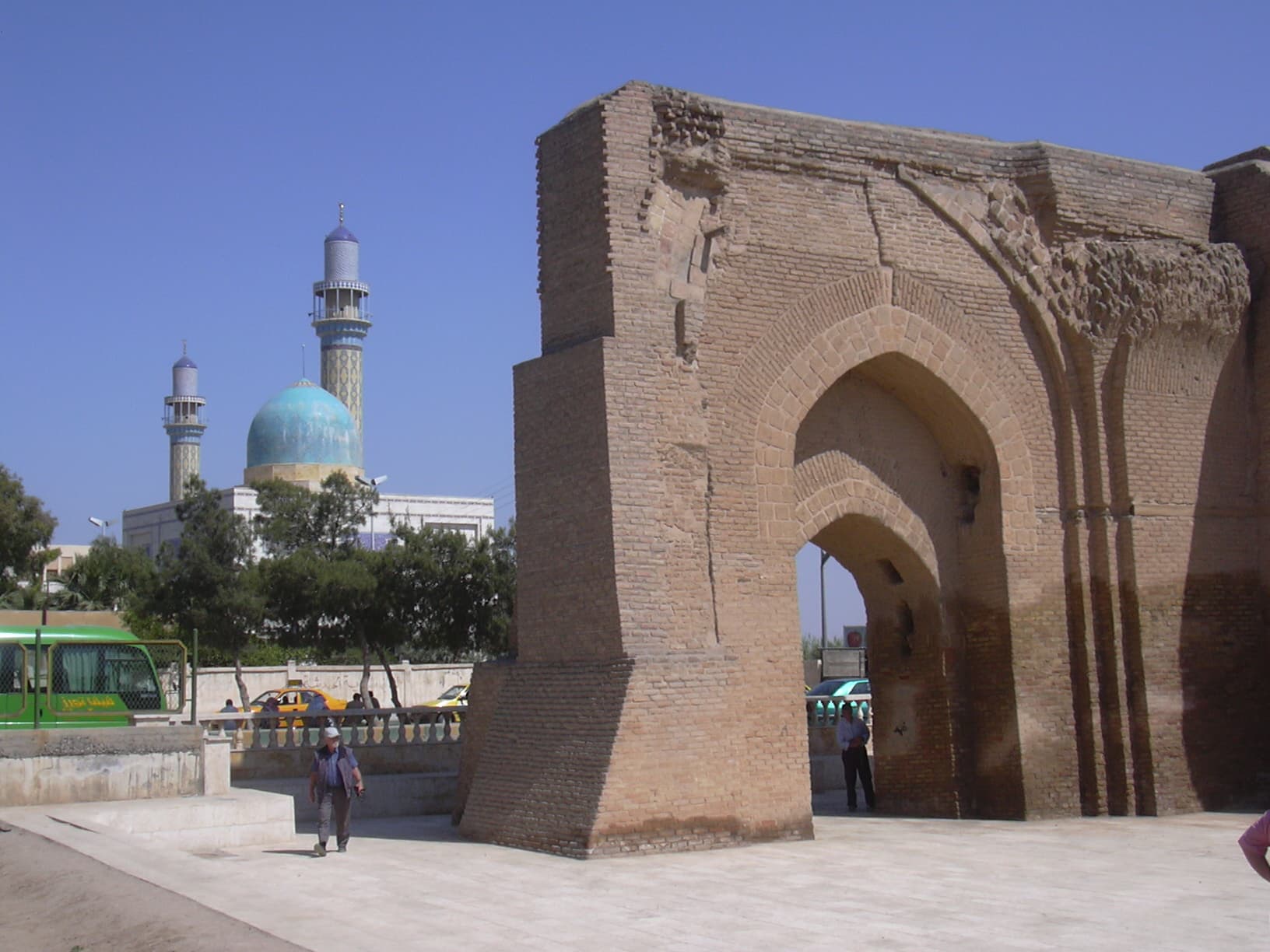
A brick gate standing on its own at the south-east end of Raqqa’s wall. Its broken arch, its two-tier frieze of niches, and the chance its name is wrong.
- Opening hours
- Open ground, daylight hours
- Entry
- Free
- Duration
- 20 minutes
- Best time
- Morning; the front faces east and the frieze only reads at that hour
- Period
- On the Abbasid wall line; the structure itself probably 11th–12th century
- Address
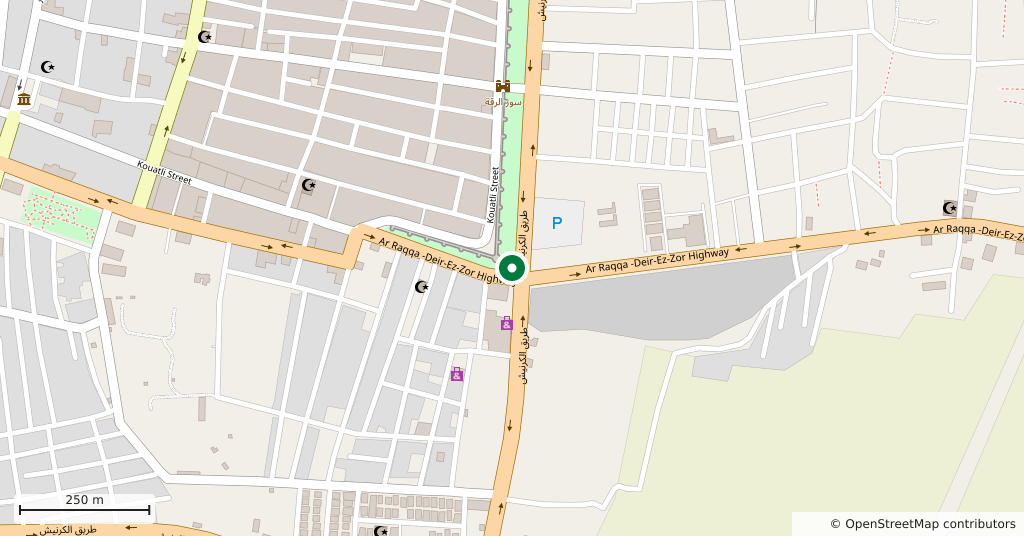
- South-eastern end of the al-Rafiqa wall, Raqqa
The most photographed structure in Raqqa is a gate. It stands alone at the south-eastern end of the Abbasid wall, built in kiln-fired brick. The front is about eight metres wide and five metres high; a broken arch sits over the central opening, with a decorative niche on either side. The upper half does the real work: a wide frieze of niches in two tiers, the lower ones under semicircular arches and the upper ones under trefoil arches. No other gate in Syria plays with brick across a surface like this.
Getting there
At the south-eastern corner of the wall line, east of the city centre. The Uways al-Qarani Mosque stood right beside it — a modern mosque built over the shrine of the companion of Muhammad regarded as Raqqa’s patron saint, and it was blown up in 2014. The ground around the gate is flat and open, and you can drive up to it.
How long it takes
Twenty minutes. The structure is a single piece; you do not go inside, you walk around it. Seeing the front needs morning light, because by the afternoon the gate is in its own shadow.
What to see
Inside, the opening leads through a recess about a metre deep into a passage; the recess once carried a dome. The brickwork is restored in places: the Abbasid walls and this gate were taken into conservation in the 1980s, and new brick went in then. The wall line runs north from either side of the gate, with its towers in a row.
What not to miss
The name is probably wrong. The German archaeologist Herzfeld assigned the gate to Harun al-Rashid’s time. The British scholar Creswell gave it to al-Mansur’s building of 772. Then John Warren, a British architectural historian, read the development of the four-centred arch and placed the gate after the 11th century. The dating accepted today is closer to Warren’s, which makes the gate the work not of the caliph who founded Baghdad but of three centuries later. The name “Baghdad Gate” was most likely given by the new residents who settled around the Ottoman post in the 19th century. When the traveller Edward Shaw saw the city in 1873, he found nothing inside the old walls but black tents.
Tips
- Look at the front from an angle, not head on: the depth of the niches only shows in raking light
- Go in the morning; by the afternoon the gate sits in its own shadow
- Follow the wall line north from here — Qasr al-Banat is about four hundred metres on
- Rubble and dug ground make the footing uneven in places; keep to the marked path
Transparency
- How this was chosen
- Written by hand; opening hours, entry fee and coordinates are kept as data. A field that is not known for certain is marked as variable rather than guessed.
- Facts checked
- September 2026
- Last updated
- September 15, 2026