The Raqqa Museum
The regional museum, housed in an Ottoman government building of 1861. What happened to its collection, what is left of it, and what to ask before you go.
- Opening hours
- Variable — confirm in Raqqa before you go
- Entry
- Variable — confirm at the entrance
- Duration
- 60 minutes
- Best time
- Morning, so the three ruins inside the wall fit into the same day
- Period
- Building 1861 · museum founded 1981
- Address
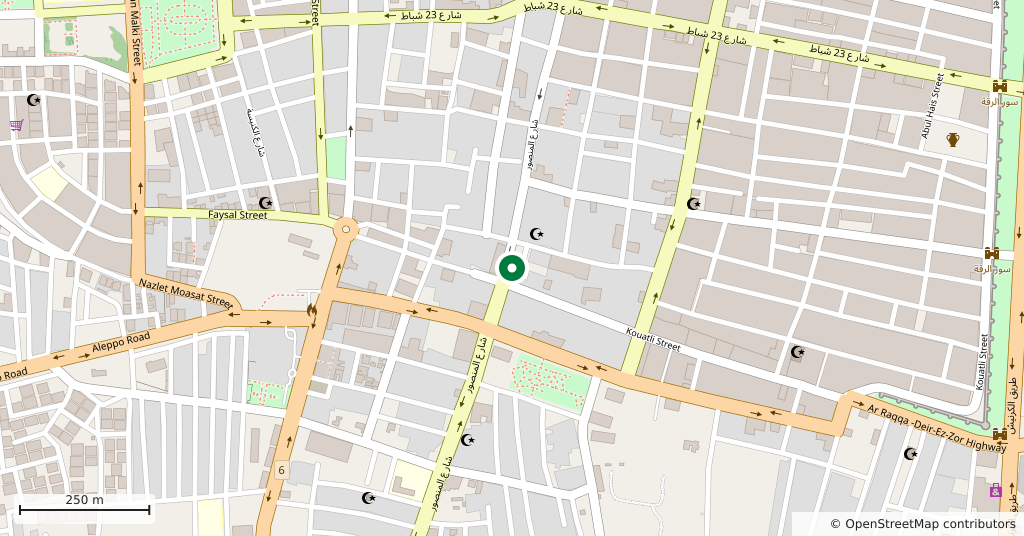
- City centre, near the clock-tower square, Raqqa
The Raqqa Museum opened in 1981 in a building put up in 1861 as an Ottoman government office. It gathered the archaeology of the governorate under one roof. Finds came from the excavations at Tell Sabi Abyad, Tell Bi’a, Tell Chuera and Tell Munbaqa, alongside objects from Roman and Byzantine times, Islamic pieces from the age of Harun al-Rashid, and material from the period of bedouin rule. At its fullest it held some seven thousand objects.
Getting there
In the city centre, near the clock-tower square. It is within walking distance of the three ruins inside the old wall, about a kilometre south-west of the minaret of the Great Mosque.
How long it takes
An hour. The building is not large: the first floor had three sections — ancient, classical and modern art — and the second floor was given to Arab and Islamic art.
What to see
This has to be said plainly: what the museum holds today is the one thing this page cannot verify. Much of the collection was stolen or destroyed during the war. From early 2018 the culture and antiquities committee of the Raqqa Civil Council, working with a civil organisation, began restoring the building and tracing the stolen objects. So the building itself is a record; how much of its contents has come back is something you learn at the door.
What not to miss
The story of the cuneiform tablets taken from here. Before the war a team from Leiden had made silicone moulds of some of the tablets excavated at Tell Sabi Abyad. When the tablets were looted, those moulds became the only surviving evidence of a stretch of 12th-century BC northern Syria. Because the moulds last only about thirty years, Leiden and Delft scanned them with X-ray tomography and produced three-dimensional reconstructions of the tablets. The project won a Europa Nostra award in 2020, and the digital copies are open to anyone. So even where a case in the museum stands empty, the text in it can still be read.
Tips
- Ask whether it is open before you go; the situation is not settled
- The building is itself an Ottoman government office of 1861 — look at the front
- Ask at the door which galleries are open; part of it may be closed
- The Baghdad Gate, Qasr al-Banat and the Great Mosque are all walkable from here
Transparency
- How this was chosen
- Written by hand; opening hours, entry fee and coordinates are kept as data. A field that is not known for certain is marked as variable rather than guessed.
- Facts checked
- September 2026
- Last updated
- September 15, 2026