Qasr al-Banat
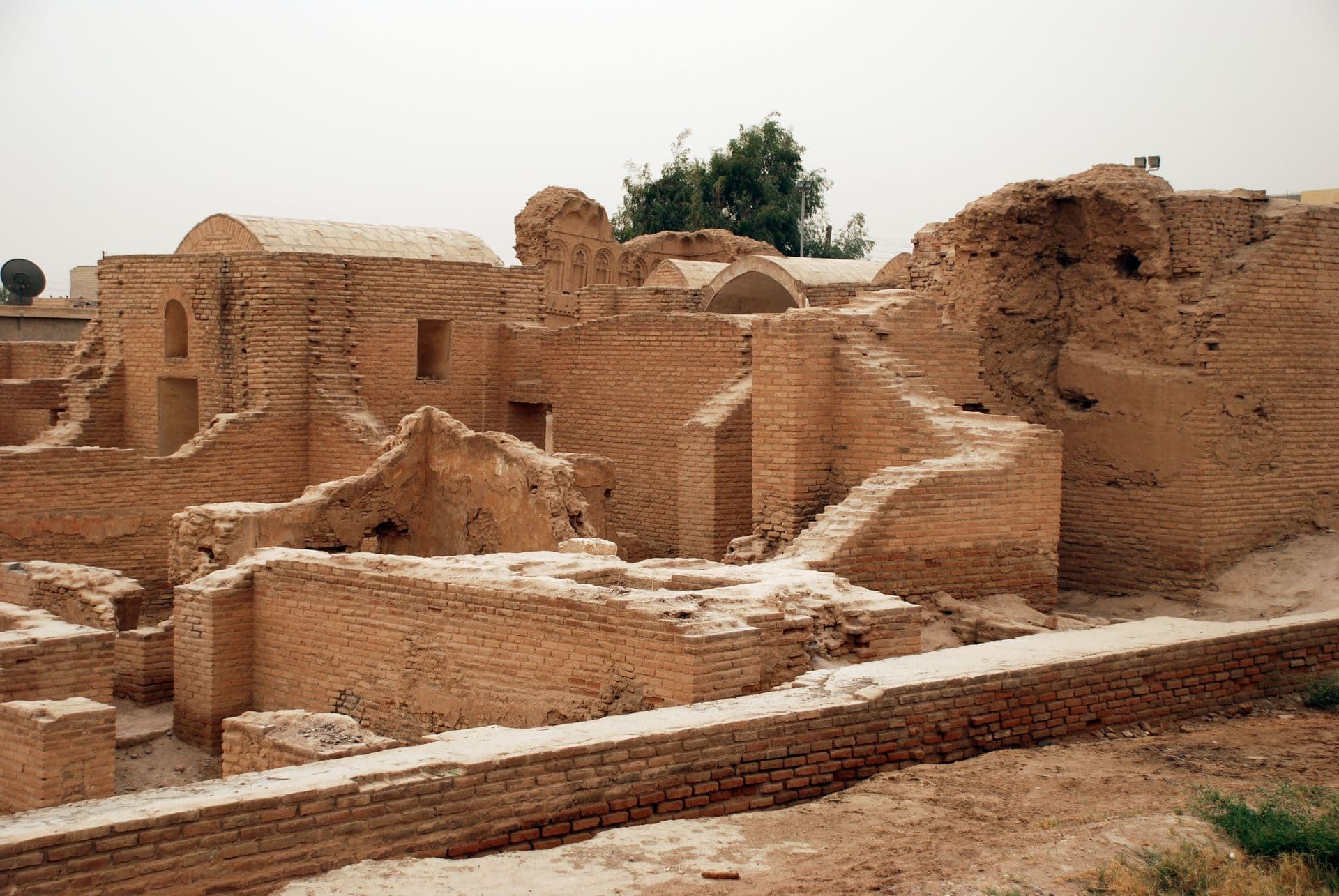
A 12th-century house wedged among apartment blocks in the middle of Raqqa. Its vaulted halls, its plan borrowed from Iran, and one original stucco wall.
- Opening hours
- Fenced and usually closed; visible from every side
- Entry
- Variable — if the gate is open, confirm there
- Duration
- 30 minutes
- Best time
- Morning or late afternoon; raking light gives the brick its texture
- Period
- Zengid — about 1168
- Address
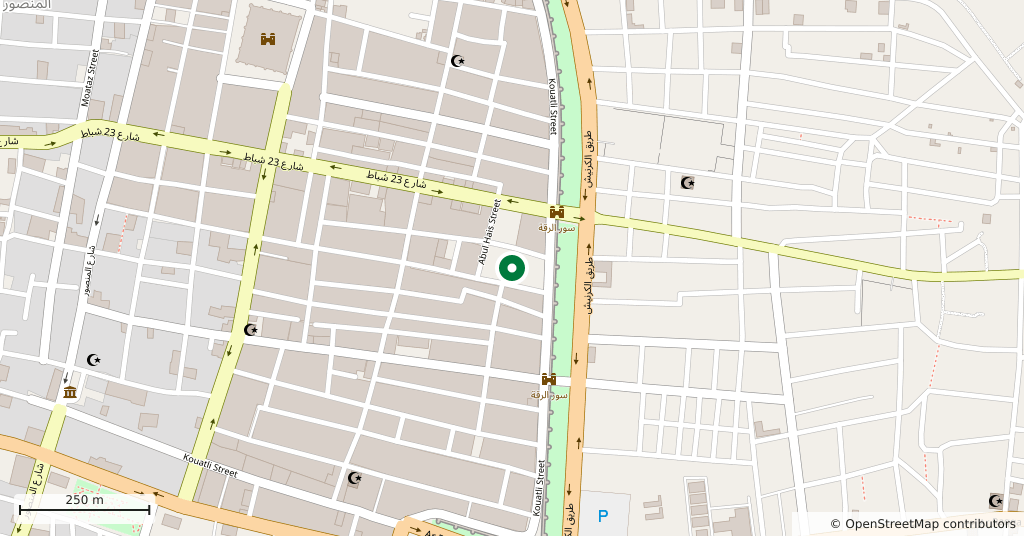
- Inside the al-Rafiqa wall, west of the eastern wall, Raqqa
The name means “palace of the ladies”, but this was not a palace. It was a residence: a 12th-century brick ruin on an open plot in the middle of Raqqa, hemmed in on all sides by new buildings. When the city grew fast in the 1970s the whole historic area was built over, and what was left of Qasr al-Banat was an open space eighty metres wide and two hundred metres long. Inside that space is a plan with few parallels in Syria.
Getting there
In the old walled city, a hundred and fifty metres west of the eastern wall and four hundred metres north of the Baghdad Gate — so you walk here from the gate. The site is fenced and normally closed, but it is visible from every side, and you can read it without going in.
How long it takes
Half an hour. Twenty minutes to walk the perimeter, ten more to sit and look at the brickwork.
What to see
Vaulted halls around a central courtyard. The main hall on the north side fills the entire width of the courtyard and is divided into three aisles; around it are forty-one irregular rooms, laid out with no symmetry. The source of the arrangement is not Syria but Iran. It was very rare in 12th-century Syria, and common at the centre of Iranian mosques, palaces and mansions. A building of Nur ad-Din’s time in Damascus carries a similar form.
What not to miss
Most of the walls and arches you see today are newly fired brick: the site was excavated and rebuilt between 1977 and 1982 under Kassem Toueir for the Syrian Directorate-General of Antiquities. One diagonal segment of wall is original — the piece carrying three layers of stucco, where old muqarnas and stepped arched niches can still be made out. When Sarre and Herzfeld came in 1907, and when Gertrude Bell looked a few years later, that segment was the only thing standing upright on an otherwise flat ruin. The site was damaged between 2012 and 2017, its central fountain broken and the ground looted; in 2026 volunteers cleared part of the debris.
Tips
- If the gate is shut, go round to the north-west side of the fence: the vaults of the main hall show fully from there
- Look for the diagonal segment with the original stucco; the rest is new brick
- The Baghdad Gate is four hundred metres south — put the two into one walk
- The site is ringed by housing; do not shoot from an angle that looks into someone's window
Transparency
- How this was chosen
- Written by hand; opening hours, entry fee and coordinates are kept as data. A field that is not known for certain is marked as variable rather than guessed.
- Facts checked
- September 2026
- Last updated
- September 15, 2026