The Great Mosque of Raqqa
A first in mosque architecture: the earliest mosque built from scratch to one coherent plan. Its brick minaret and a row of eleven arches still stand in Raqqa.
- Opening hours
- Variable — the site is fenced; ask in Raqqa before you go
- Entry
- Variable — confirm at the entrance
- Duration
- 30 minutes
- Best time
- Morning, when light catches the north-eastern face of the minaret
- Period
- Abbasid — Zengid restoration in 1165
- Address
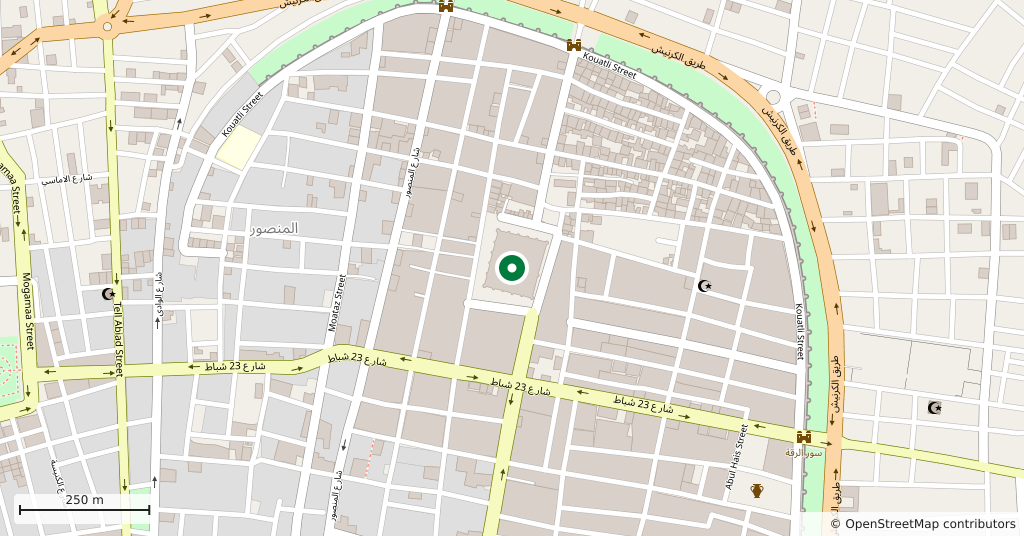
- Inside the al-Rafiqa wall, north of the old city, Raqqa
What matters about this mosque is not the stone left of it but its plan. It was built in 772 at the centre of al-Rafiqa, the city the caliph al-Mansur had just founded, and it counts in architectural history as the first mosque built from scratch to a single coherent plan. Earlier mosques were either conversions of older buildings — the Umayyad Mosque in Damascus, for one — or very rudimentary layouts like the first mosque at Baghdad. The plan here set the pattern for what followed: Harun al-Rashid, living in Raqqa, knew this building, and in 808 he had the Baghdad mosque rebuilt along the same lines. Traces of it run on into the Great Mosque of Samarra and the Mosque of Ibn Tulun in Cairo.
Getting there
In the northern half of the old walled city, about a kilometre north-west of the Baghdad Gate. Everything around it is new housing; the site is fenced and whether the gate is open changes from day to day.
How long it takes
Half an hour. Two things are standing, and the rest is a trace in the ground.
What to see
The mosque is rectangular, 108 metres by 92 metres. The outer walls are mud brick with semicircular buttress towers at the corners. The first thing standing today is the minaret, 25 metres of kiln-fired brick. The second is the row of arches on the front of the prayer hall: eleven of them, left from Nur ad-Din Zengi’s restoration of 1165. The prayer hall had three arcades carried on cylindrical piers, and double arcades ran along the other three sides of the courtyard. Traces of stucco decoration survive on the walls.
What not to miss
The courtyard itself. During the war, families in the city who could not reach a cemetery buried their dead in the mosque’s courtyard, so the courtyard is now a graveyard. There used to be a small shrine at the centre of the site as well — an Ottoman structure of 1836 over a grave attributed to Wabisa ibn Ma’bad, a companion of Muhammad. Satellite imagery shows that shrine bulldozed between late 2013 and early 2014. In June 2017 shelling also struck the ground around the mosque.
Tips
- If the site is closed the minaret is still visible from the street: it is the tallest old structure inside the wall
- The courtyard was used for burials; walk with that in mind
- The ground is uneven and rubble has not been cleared; wear closed shoes
- Qasr al-Banat is about a kilometre's walk from here and fits into the same morning
Transparency
- How this was chosen
- Written by hand; opening hours, entry fee and coordinates are kept as data. A field that is not known for certain is marked as variable rather than guessed.
- Facts checked
- September 2026
- Last updated
- September 15, 2026