Battle of al-Mazraa Memorial
The 1970 memorial on the plain 12 kilometres north-west of Suwayda where a French column was routed on 2-3 August 1925, and the story of the battle behind it.
- Opening hours
- Open ground, all day; current access not verified
- Entry
- No known ticket office
- Duration
- 30 minutes
- Best time
- Spring, when the plain is green and the summer heat has not set in
- Period
- French Mandate
- Address
- Near the Ain al-Mazraa spring, west of the old Suwayda-Izra' road; 12 kilometres north-west of Suwayda
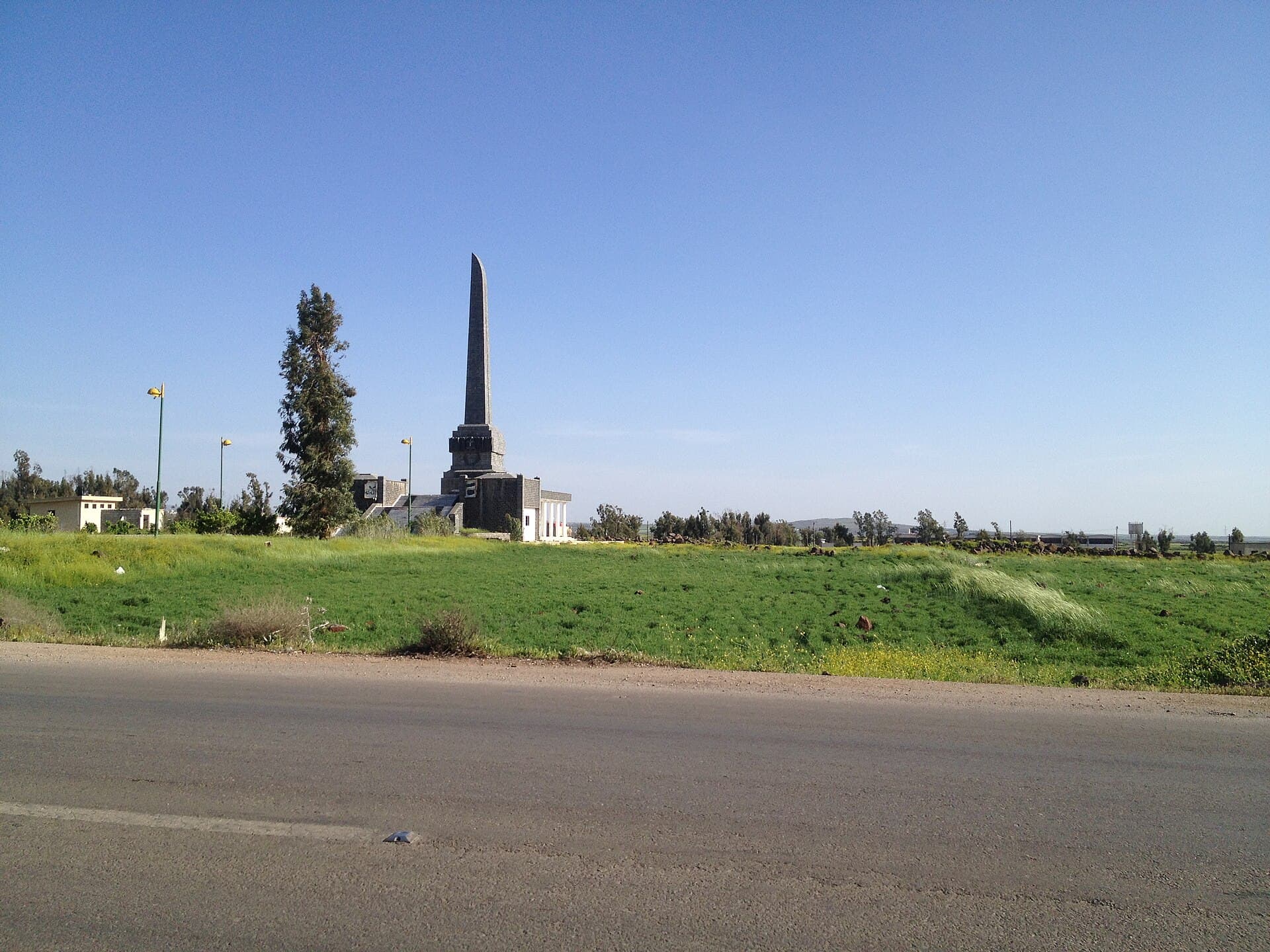
Beside the village of al-Mazraa, 12 kilometres north-west of Suwayda, stands a memorial raised in 1970 to those killed in the battle of 2-3 August 1925. Here Druze and Bedouin horsemen under Sultan Pasha al-Atrash routed the heavily armed column of General Roger Michaud. The victory carried the Great Syrian Revolt beyond the Jabal al-Druze and across most of the French Mandate. The memorial also honours Suleiman al-Aqbani, regarded as the hero of the battle.
Getting there
12 kilometres from Suwayda along the old road to Izra’. The memorial stands west of the road near the Ain al-Mazraa spring and is visible as you arrive from Suwayda: a slender, tall obelisk of dark stone with a low building at its foot.
How long it takes
Half an hour. The memorial grounds and the view over the plain; the open ground where the battle was fought lies all around.
How the battle came about
On 22 July 1925 Sultan al-Atrash’s men had destroyed a French column at al-Kafr. In response, General Michaud prepared a punitive expedition against the Druze from his headquarters in Damascus. By 29 July the rebels had torn up the Damascus-Daraa railway at al-Mismiyya and parts of the road from Izra’ to Suwayda, slowing the advance. At Izra’ a column of about 1000 French soldiers and 2000 Syrian and African colonial troops assembled: three and a half infantry battalions, three cavalry squadrons on the flanks, and armoured cars and artillery at the rear. On 31 July it set off in the midsummer heat.
2-3 August
After a 25-kilometre march the column reached al-Mazraa, at the foot of the Jabal, on 2 August. The ground was flat, open and bare, and every movement could be seen from the slopes. About 500 Druze and Bedouin horsemen attacked, inflicted casualties and were driven back. In the early hours of 3 August a second attack struck the ammunition convoy and forced it back to Izra’. Faced with heat and thirst, Michaud also ordered a withdrawal. Seeing the column pull back, the horsemen attacked again, and the retreat became a rout. The 42nd Battalion of Malagasy colonial infantry, holding the rearguard, was destroyed. Its commander and the column’s second-in-command, Major Jean Aujac, shot himself on the battlefield. By the end, 1029 soldiers had been killed or wounded, and much of the rest of the force had been captured or had deserted.
Aftermath
The rebels captured 2000 rifles with ammunition, several machine guns and an artillery battery. On 14 August prisoners were exchanged at the Hauran village of Umm Walad, and more than 2000 Druze horsemen attended. The French garrison held out in the citadel of Suwayda for a while and left the town on 24 September. Michaud was recalled to France and replaced by General Maurice Gamelin. When news of the victory reached Damascus, nationalists took up the cause, and over the following months revolt spread across most of the Mandate.
Do not miss
The view from beside the memorial across the plain. The sources say Sultan al-Atrash could watch the French column clearly from the slopes of the Jabal, and the flat, treeless ground still shows why every move was visible from above. Read al-Mazraa together with the Battle of al-Kafr Memorial: al-Kafr is where the revolt began, al-Mazraa where it spread.
The village
The village was once called as-Sijn, “the prison”. One story ties the name to an old spring that dried up, another to an old jail. Its present name comes from the Ain al-Mazraa spring, known for the greenery around it, and was made official in memory of the 1925 battle. A stone inscribed in 179-180 has been found in the village. The 2004 census counted 2454 people; most are Druze, with Christian and Sunni Bedouin minorities.
The site today
In July 2025 al-Mazraa was one of the places hit by heavy fighting between Druze armed groups and Bedouin tribes, and government forces entered the town. The present state of the memorial and access to the area could not be verified; this page tells what happened at al-Mazraa and does not say it can be visited today.
Tips
- Look west of the road as you come from Suwayda; the obelisk stands out from a distance
- Pair it with the Battle of al-Kafr Memorial; the first clash of the revolt happened there
- Look across the plain from beside the memorial; the French column was watched from the slopes over this flat ground
- The Ain al-Mazraa spring that gave the village its name is near the memorial; local sources say it has dried up in the drought
Transparency
- How this was chosen
- Written by hand; opening hours, entry fee and coordinates are kept as data. A field that is not known for certain is marked as variable rather than guessed.
- Facts checked
- September 2026
- Last updated
- September 15, 2026