The Roman Theatre at Bosra
A Roman theatre in black basalt with an Ayyubid fortress built around it. How to get in, how long it takes, and what the war has left standing there today.
- Opening hours
- Daylight hours; no fixed timetable could be confirmed, ask at the gate
- Entry
- Variable — confirm at the entrance
- Duration
- 90 minutes
- Best time
- The first hour of the morning; there is no shade on the seating and the basalt heats up after noon
- Period
- Roman — Ayyubid
- Address
- South-western edge of the ancient city, facing the town square, Bosra
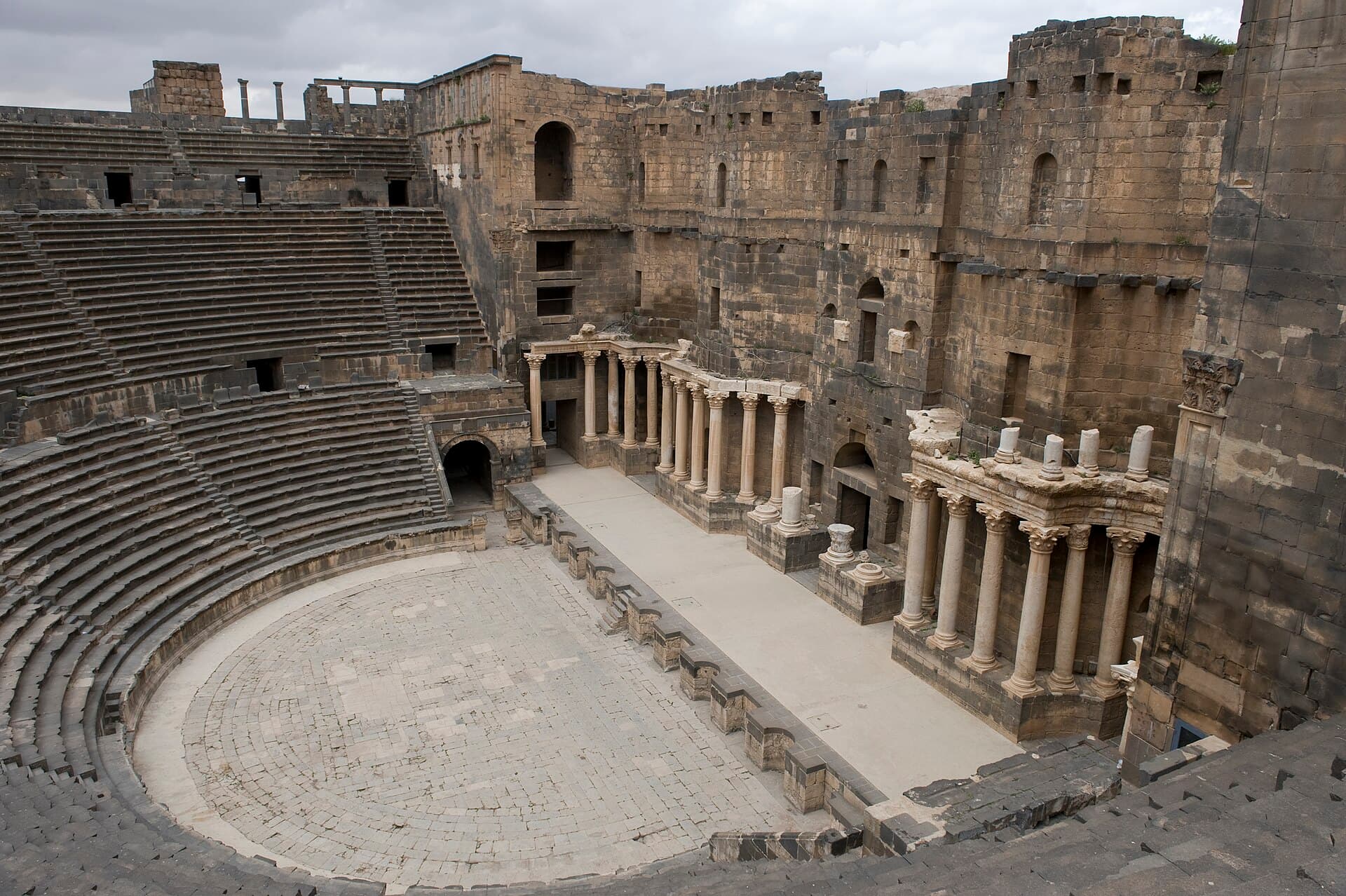
The soundest thing Rome left in Syria, and it survives for an unusual reason: the theatre ended up inside a castle. It was built of black basalt in the 2nd century; over the following centuries its doorways were walled up, first turning it into a stronghold and then into a full Ayyubid fortress. From outside you see a castle. Once you are through the gate and the dark corridors, the seating opens all at once and the scale is startling.
Getting there
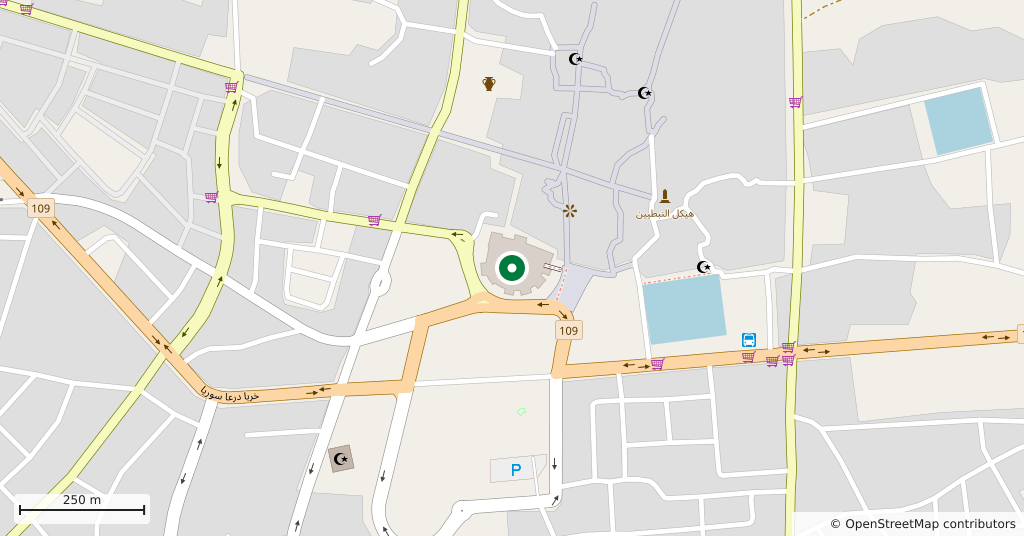
At the south-western edge of the ancient city, facing the main square of the town. You enter through the citadel gate; there is no direct way into the theatre. It is a few minutes’ walk from the square, and the building is visible from anywhere in town.
How long it takes
An hour and a half is realistic: half an hour on the seating, half an hour in the corridors behind the stage wall, the rest on the towers. You can be out in forty minutes, but then you have not seen the castle itself — this is two buildings, not one.
What to see
The seating is 102 metres across and entirely black basalt. Estimates of capacity in the sources run from nine thousand to seventeen thousand; the lowest figure comes from the most recent archaeological survey. The upper gallery stands complete as a covered portico — according to UNESCO the only Roman theatre preserved in that state. The stage wall and the row of columns in front of it are still in place. The accepted frame for the date of construction is the 2nd century, probably under Trajan, though a group of scholars reads the architectural ornament as later and argues for the Severan period at the century’s end.
How the castle grew
The walls around the theatre were not raised in one go. The Umayyads blocked the outer doorways; after 1076 the Seljuks turned two corner stairwells into towers; and from 1202 al-Adil, Saladin’s brother, added eight more. For a while the place was a ruler’s residence: al-Adil’s son al-Salih Ismail lived here between 1218 and 1246. In 1260 it was handed to the Mongols without a fight, and the following year the Mamluk sultan Baybars repaired the defences and installed a garrison. UNESCO places the whole fortification process between 481 and 1251.
What not to miss
Climb the towers. The full half-circle of the theatre only reveals itself from above, and behind it the Hauran plain runs flat to the horizon. The second detail is in the ground: the interior lay buried under fill for centuries, and the excavation between 1946 and 1970 cleared it. Some of the crispness you are looking at is owed to that fill — it kept the seating out of the weather and out of the reach of stone robbers.
Where it stands now
The building was damaged during the war. Heavy damage to the theatre’s western courtyard and to parts of the citadel was reported at the end of 2015, shelling caused partial damage in 2018, and the collection of the museum inside the citadel was damaged and looted. The structure as a whole is standing: in 2025 the theatre hosted an event attended by more than twenty-five thousand people. Clearing and repair have been going on since 2015.
Tips
- You enter through the citadel gate; there is no direct door into the theatre, the corridors come first
- Climb the towers — the half-circle and the plain behind it are only visible from up there
- The corridors behind the stage wall are dark; a phone torch helps
- Ask at the gate whether the museum inside the citadel is open; its collection was damaged in the war
Gallery
Transparency
- How this was chosen
- Written by hand; opening hours, entry fee and coordinates are kept as data. A field that is not known for certain is marked as variable rather than guessed.
- Facts checked
- August 2026
- Last updated
- September 15, 2026