The South Baths of Bosra
Bosra’s best-preserved Roman baths: an 8000-square-metre complex with Nabataean roots, water piped from Birket al-Hajj, and use that ran into Umayyad times.
- Opening hours
- Open-air site; no fixed timetable could be confirmed
- Entry
- Variable — confirm on the spot
- Duration
- 30 minutes
- Best time
- Morning, while the arches of the square hall give shade and the site is still cool
- Period
- Nabataean — Roman — Umayyad
- Address
- South of the main street, east of Bab al-Qandil, Bosra
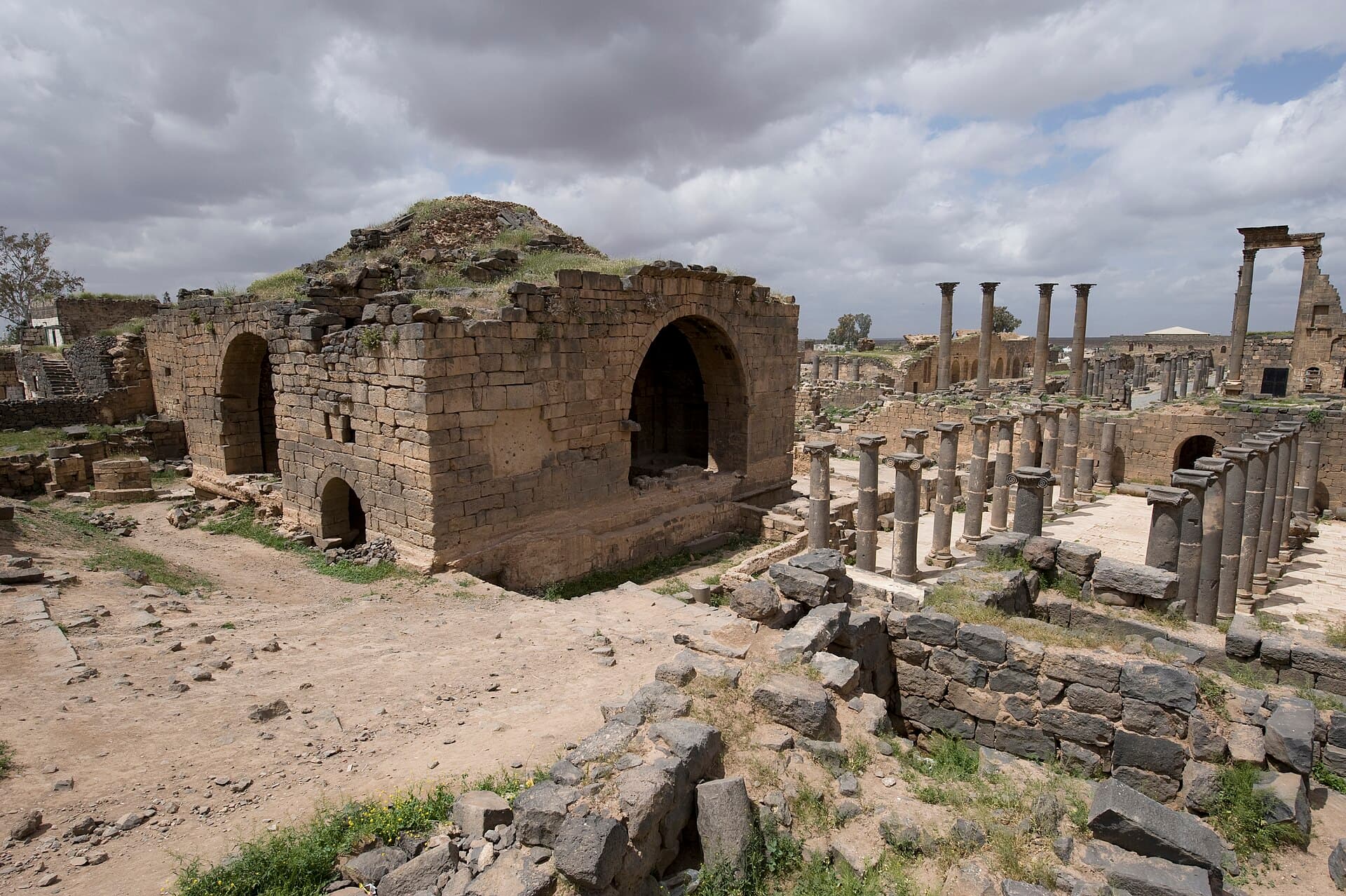
South of the colonnaded street stands a square basalt hall that has lost its dome, with the walls of other rooms spreading out around it. This is the best-preserved bath complex in Bosra. It covers about 8000 square metres and is one of the largest Roman public buildings in the city after the theatre. Its foundations go back to the Nabataeans and it worked as a bath house until the Umayyads, so a single building spans six centuries of the city’s life.
Where it is and how to get there
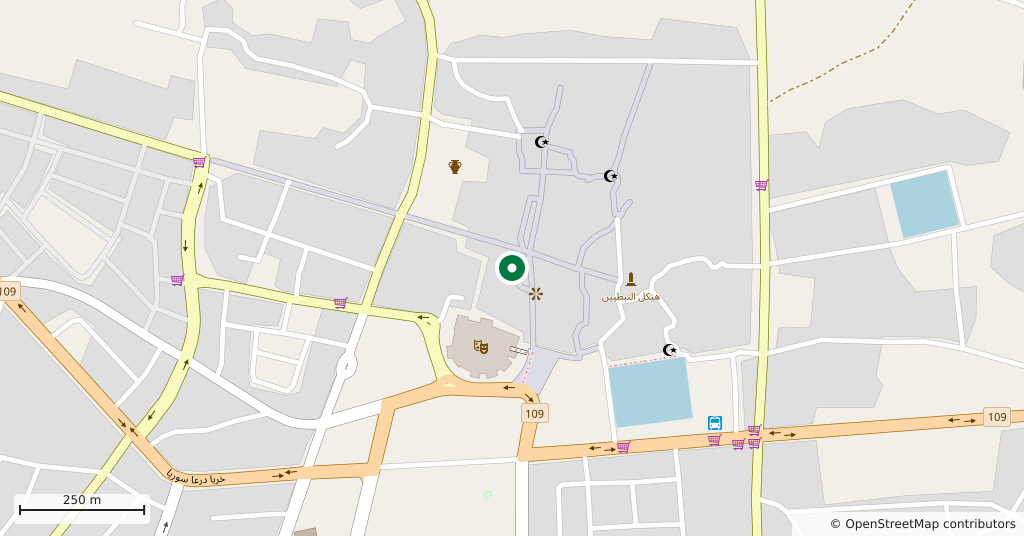
South of the junction where the main east-west street meets the north-south street that runs down to the camp. Walk north from the theatre towards Bab al-Qandil, and the baths are on your right, to the east. The Central Baths are across the street.
What to see
The first thing you meet is the square hall, with arched openings on all four sides. The hot rooms on the west were uncovered in recent excavations. The load-bearing structures and the water installations still in place let you follow how the building grew: cold, warm and hot sections, halls and palaestras, the exercise courts of a Roman bath. According to Butler, a channel brought water to the baths from Birket al-Hajj in the south-east of the city.
How many phases
Before the baths, there were Hellenistic or Nabataean houses in the western part. The Nabataean phase belongs to the late 1st and early 2nd century: a wall under the column base of the west palaestra is dated by Nabataean pottery. Roof tiles like those in the eastern quarter, and fragments of the small piers that held up a heated floor, suggest the building was already a bath at that point.
The first monumental Roman building dates from the second half of the 2nd century. It grew with added halls and palaestras, and it was abandoned as a bath house in the Umayyad period.
What not to miss
Cross to the east side of the baths. A residential quarter excavated in the 1990s lies there: a Byzantine church with a temple of Nabataean origin beneath it, an Umayyad house with its stables, and the “new praetorium”, the governor’s residence known from an inscription dated 490. The baths make sense when you see them with this neighbourhood.
Current state
A 2007 source noted that some rooms could not be visited for safety reasons. Which parts are open today could not be confirmed, and there may be loose stone at the foot of the walls.
Tips
- Look at the hot rooms on the west side; the water installations are still in place
- Cross to the residential quarter on the east; the church, the Umayyad house and the governor's residence are together there
- Do not enter rooms that are closed or fenced off; some sections were shut for safety reasons
Transparency
- How this was chosen
- Written by hand; opening hours, entry fee and coordinates are kept as data. A field that is not known for certain is marked as variable rather than guessed.
- Facts checked
- September 2026
- Last updated
- September 15, 2026