Burqush
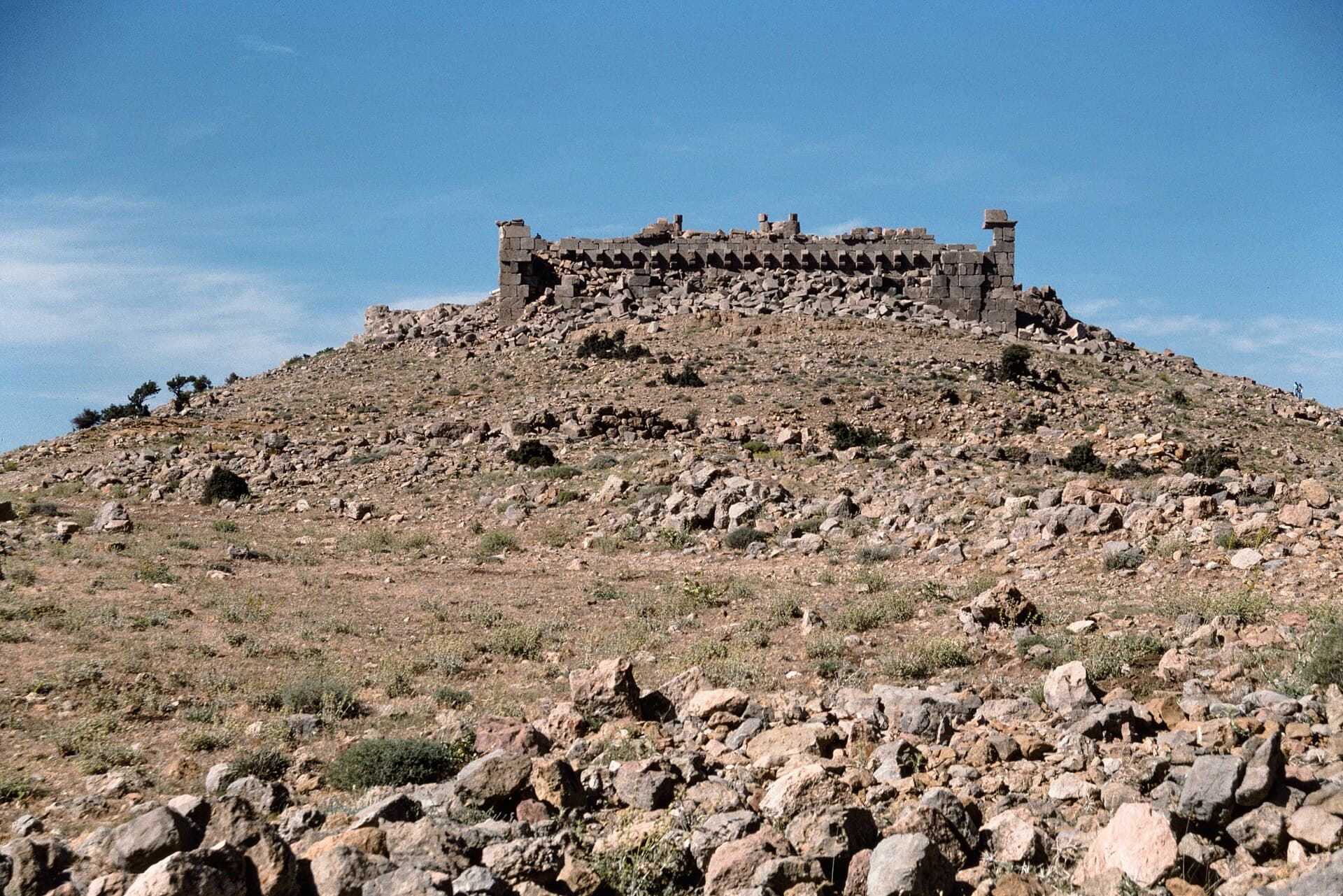
A hilltop 30 kilometres west of Damascus at 1580 metres: a 6th-century basilica raised on a Roman temple podium, with rock-cut rooms and tombs all around it.
- Opening hours
- Open site; entry depends on permission and usually a military escort
- Entry
- Free; permission and transport cost extra
- Duration
- 90 minutes
- Best time
- Spring, when the air at 1580 metres is still cool and the plain reads clearly below
- Period
- Roman — Byzantine
- Address
- Qatana countryside, flank of Mount Hermon, 30 kilometres west of Damascus
The site sits on a ridge at 1580 metres, looking down over the plain of Damascus. The hill is not natural: it was cut back to make a two-level platform. On top are the remains of a 6th-century Byzantine basilica, and the podium the basilica stands on belongs to an older Roman temple. Under the temple, in turn, is thought to lie a still older structure that served secular purposes for centuries. The place was probably called Barkousa in antiquity, and in the 6th century it was renamed Justinianopolis after the emperor Justinian.
Getting there
It is 30 kilometres west of Damascus, on the flanks of Mount Hermon in the countryside of Qatana. From the main road it is a ten-minute walk up a steep track. The area lies close to the Lebanese and Golan boundaries and is militarily sensitive: a visit needs permission, and usually a military escort. Do not set out alone. Confirm the situation with a local guide before you leave Damascus; there are days when permission is not given.
How long it takes
An hour and a half on the site is enough. The road and the paperwork take many times that, so plan a full day.
What to see
From a distance the basilica podium reads like a rampart: massive blocks stacked along the crest. Inside, some of the columns that divided the aisles are still standing, and a few of the capitals are composite. There is the trace of a portico on the east wall. One doorway keeps a carved lintel, the best-preserved stonework on the site. The basement was cut straight out of bedrock, and the workmanship is startlingly neat. Rock-cut rooms, tombs and quarries lie scattered around, along with the remains of two Roman temples counted among the temples of Mount Hermon.
What most people miss
Count the capitals. In 1903 the German mission on its way to Baalbek recorded twelve of them here. In the survey Gunnar Brands of the University of Halle-Wittenberg carried out in 1999, only eight were still in place; three had fallen nearby, one had been reused in medieval farming, and the twelfth lay buried under rubble. That count is the most concrete way to read the site.
Nearby
Wadi al-Qarn, the valley next to the hill, is on BirdLife International’s list of Important Bird Areas and is one of the significant breeding grounds for wild birds in the Middle East. On the slopes you meet herds of goats and camels. From the top the plain of Damascus and the hill country around it are visible whole; the view is as much of a reason as the ruins.
Tips
- Check the permission situation before you set out; this is a border zone and an escort may be required
- From the main road it is a ten-minute walk up a steep track; wear shoes with a firm sole
- Look for the carved door lintel, the best-preserved stonework on the site
- Count the capitals; how many are left in place is the site's own story
Transparency
- How this was chosen
- Written by hand; opening hours, entry fee and coordinates are kept as data. A field that is not known for certain is marked as variable rather than guessed.
- Facts checked
- September 2026
- Last updated
- September 15, 2026