The Convent of Saint Thecla, Maaloula
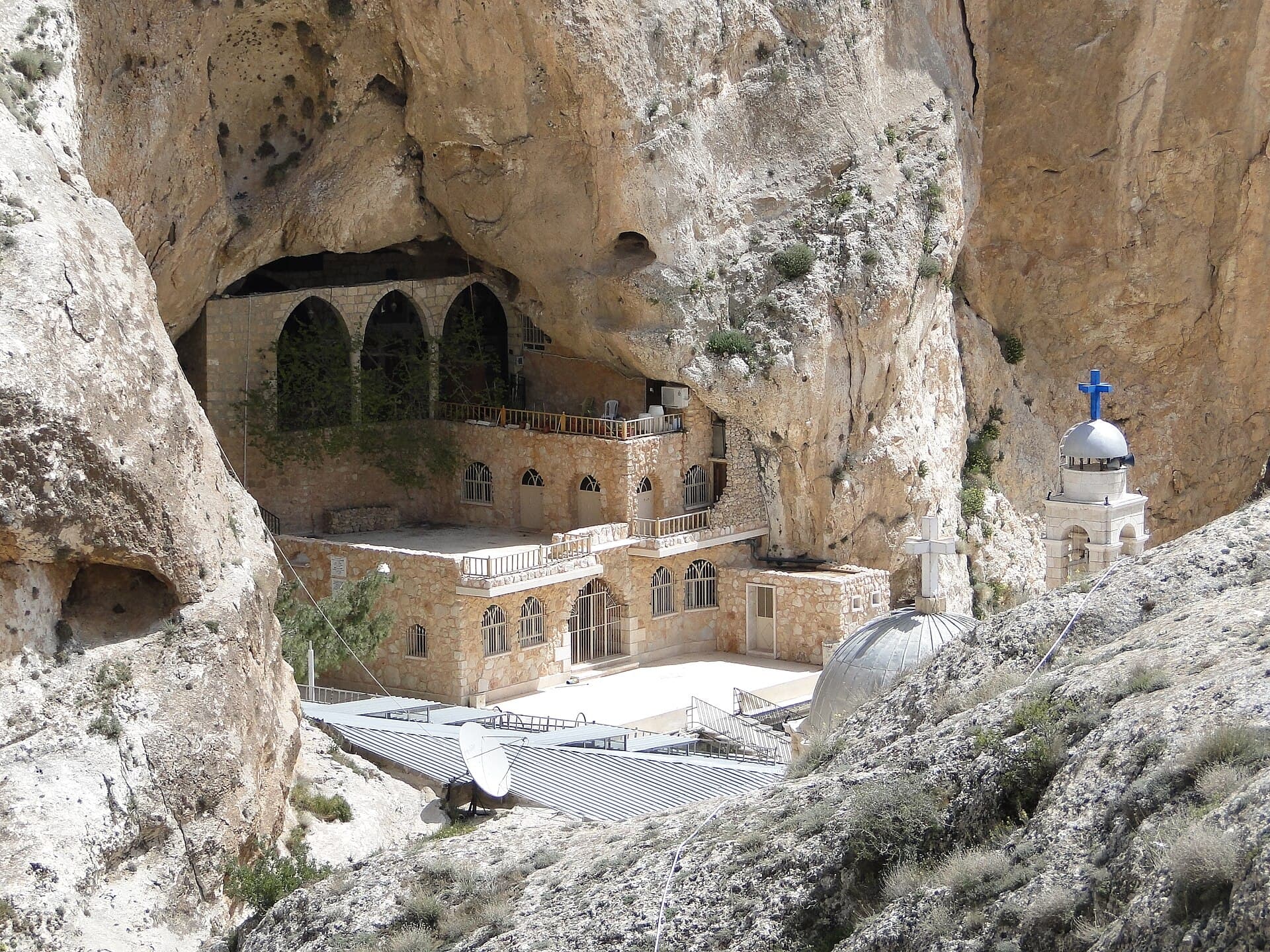
A Greek Orthodox convent at the foot of the cliff in Maaloula, built against the cave where Saint Thecla is said to have lived. A holy spring and 18th-century icons.
- Opening hours
- Open in the daytime; current hours unconfirmed, check at the gate
- Entry
- Varies — check at the gate
- Duration
- 60 minutes
- Best time
- A morning outside the feast days; thousands come on 14 and 24 September
- Period
- Early Christian cave; present buildings 1756-1959
- Address
- Maaloula, 50 km north of Damascus, Rif Dimashq
A convent of nuns at the foot of the cliff that splits Maaloula in two, under the direct authority of the Greek Orthodox Patriarchate of Antioch. The buildings are not the reason people come. The cave behind them is. Tradition holds that Thecla, a disciple of Saint Paul, spent her life there and is buried there. The cave also has a spring held to be holy, and Muslims come to it with vows as well as Christians.
The story behind it
Thecla is running from soldiers sent by her pagan father when the rock blocks her way. She prays. The rock splits and she passes through. The narrow cleft in Maaloula, the Fajj gorge, is tied to this story. She lives out the rest of her life in a cave inside the rock. The spring water is credited with curing paralysis, rheumatism and infertility, and Muslim women who come with vows are mentioned in the sources too.
Getting there
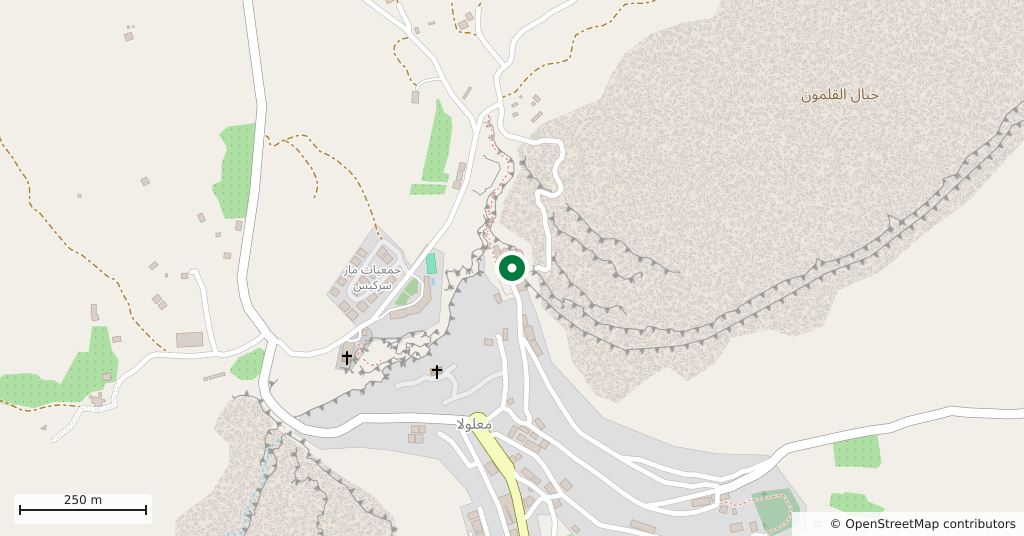
The convent is inside Maaloula, in the lower part of the village right at the base of the cliff. From Damascus to Maaloula is a little over an hour by car. The Mar Sarkis monastery above the village is close to 400 metres away in a straight line; the gorge between them links the two, and both fit into one visit.
How long it takes
An hour, for the courtyard, the churches, the stair to the cave and the roof. On 14 September, the Feast of the Cross, and on 24 September, Saint Thecla’s day, thousands of people come and a visit takes longer.
What is there
The present buildings went up in layers. The chronicle of Mikhail al-Burayk records that the churches of Saint Thecla and John the Baptist were rebuilt in 1756. The Russian consul Uspensky counted only four monks here in 1840. The cave church was built in 1906 on the remains of an older church. Work on the convent building began in 1935, and its second floor was added in 1959. The guesthouse dates from 1934, and a building from 1888 was restored as the patriarch’s residence.
The oldest icons are in the church of John the Baptist. Three 18th-century icons of Patriarch Sylvester show Christ with John the Baptist, the Virgin with Thecla, and the Annunciation. The convent also has a 19th-century iconostasis, the screen of icons in front of the altar, and four icons by Mikhail Mhanna al-Qudsi of the Jerusalem school.
What most people miss
The stair at the top of the main building. It leads straight into the cave, where the spring and Thecla’s tomb are. On the way back, go up to the roof: from there you can pick out, one by one, the hermits’ cells cut into the surrounding rock.
Recent history
On 3 December 2013 the Nusra Front took 12 nuns from the convent hostage. They were held in Yabroud and released in an exchange on 9 March 2014. The convent was repaired, the nuns came back in 2018 and the doors opened to visitors again. Visiting hours for 2025 and 2026 could not be confirmed.
Tips
- The cave is reached by the stair at the top of the main building, and the spring is there
- Covered shoulders and knees are expected; nuns live in this convent
- From the roof, look for the hermits' cells cut into the rock around it
- The Mar Sarkis monastery is close to 400 metres away; both fit into one visit
Transparency
- How this was chosen
- Written by hand; opening hours, entry fee and coordinates are kept as data. A field that is not known for certain is marked as variable rather than guessed.
- Facts checked
- September 2026
- Last updated
- September 15, 2026