Cyrrhus (Nebi Huri)
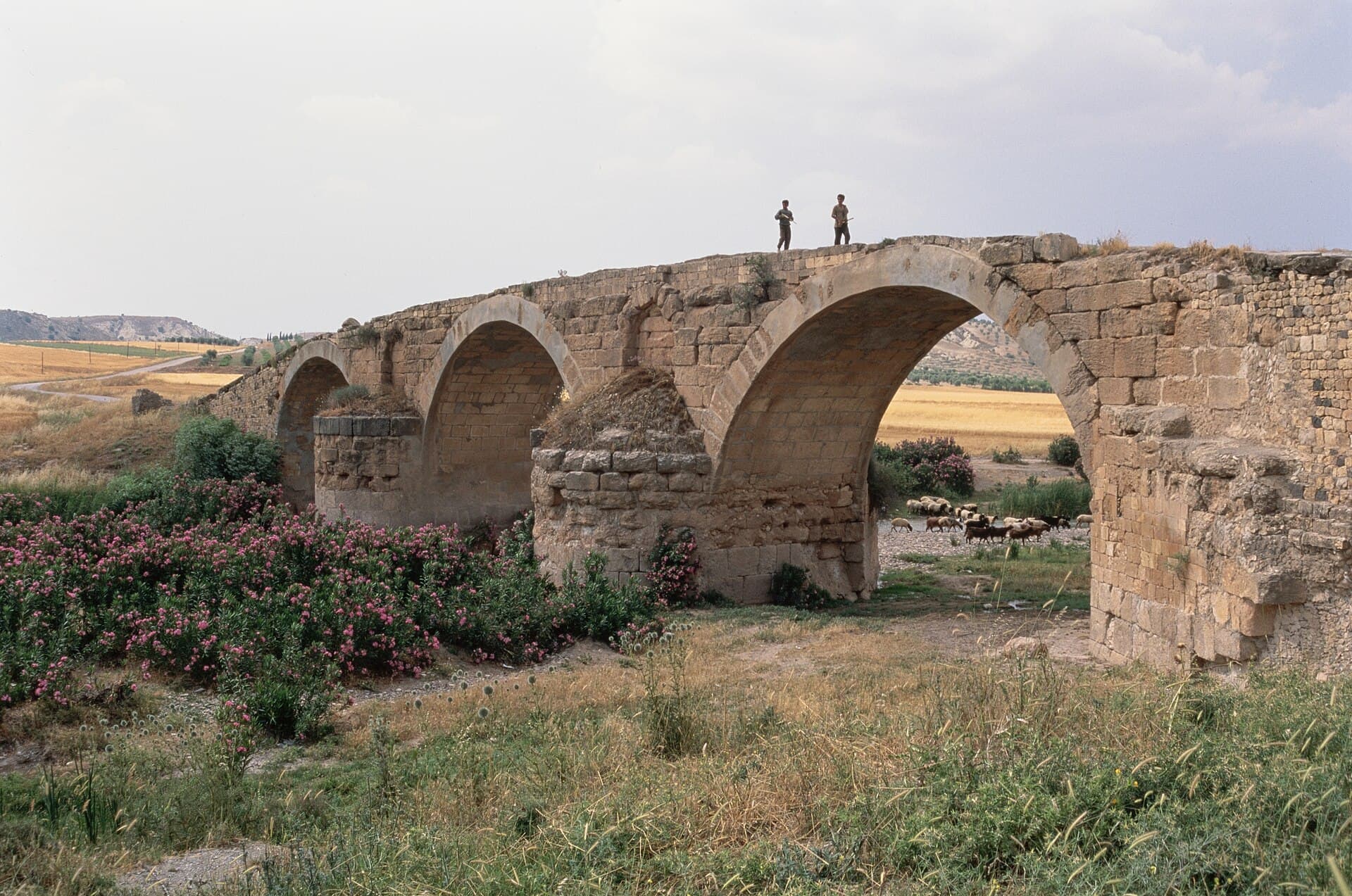
A Roman city north of Aleppo: two bridges that still carry traffic, a theatre outside the walls, and a hexagonal tomb tower that survived as a shrine.
- Opening hours
- Open site, daylight hours
- Entry
- Variable — confirm at the entrance
- Duration
- 120 minutes
- Best time
- Spring, when the plain is green and oleander flowers by the bridge
- Period
- Hellenistic — Roman — Byzantine
- Address
- Nebi Huri, Afrin area, 70 km north-west of Aleppo
Nebi Huri is what remains of Cyrrhus, founded around 300 BC by Seleucus Nicator, one of Alexander’s generals. It was a Roman administrative and garrison centre on the road between Antioch and the Euphrates crossing at Zeugma, and it minted its own coinage. Its Arabic name comes from the hexagonal Roman tomb tower south of the city, later converted into the shrine of Nabi Huri.
Getting there
70 km north-west of Aleppo and 20 km west of Azaz, close to the Turkish border. Allow about two hours by road from Aleppo. The approach road crosses one of the bridges, so the first Roman structure you meet is the one you drive over.
What to see
Two Roman bridges are still standing and still in use, which is true of very few structures in Syria. The city was laid out on a Hellenistic grid with a colonnaded main street through the middle, and that plan survived into the Islamic period. The theatre stands outside the walls with much of its seating exposed. On the hill behind it is a sixth-century Byzantine citadel, almost entirely unexcavated. The foundations of a basilica and stretches of the city wall can also be traced.
What not to miss
The hexagonal tomb tower. It stands about 1 km south of the main site, a single Roman funerary monument under a pyramidal roof; it survived because it was turned into a Muslim shrine, and it gave the site its modern name. Most visitors see the bridges and the theatre and leave without walking to it.
History and the present
The city was attacked by the Sasanians in the Roman period, refortified in the sixth century under Justinian, and passed to the Arabs in 637, after which it was known as Qorosh. Nur ad-Din Zangi took it in 1150. Travellers of the 13th and 14th centuries describe it as both large and largely ruined. Its best-known bishop was Theodoret, who lived here in the fifth century and wrote that his small diocese held 800 churches. A joint Lebanese and Syrian mission has excavated the site. After 2018 it suffered heavy illegal digging and looting, and the open pits and spoil heaps are still visible.
Tips
- The hexagonal tomb tower is 1 km south of the main site; do not stop at the bridges
- Climb the hill behind the theatre for the unexcavated Byzantine citadel
- There are open looting pits across the site; keep away from the edges
- There is almost no shade; bring water and a hat in summer
Transparency
- How this was chosen
- Written by hand; opening hours, entry fee and coordinates are kept as data. A field that is not known for certain is marked as variable rather than guessed.
- Facts checked
- August 2026
- Last updated
- September 15, 2026