The Grand Serail of Damascus
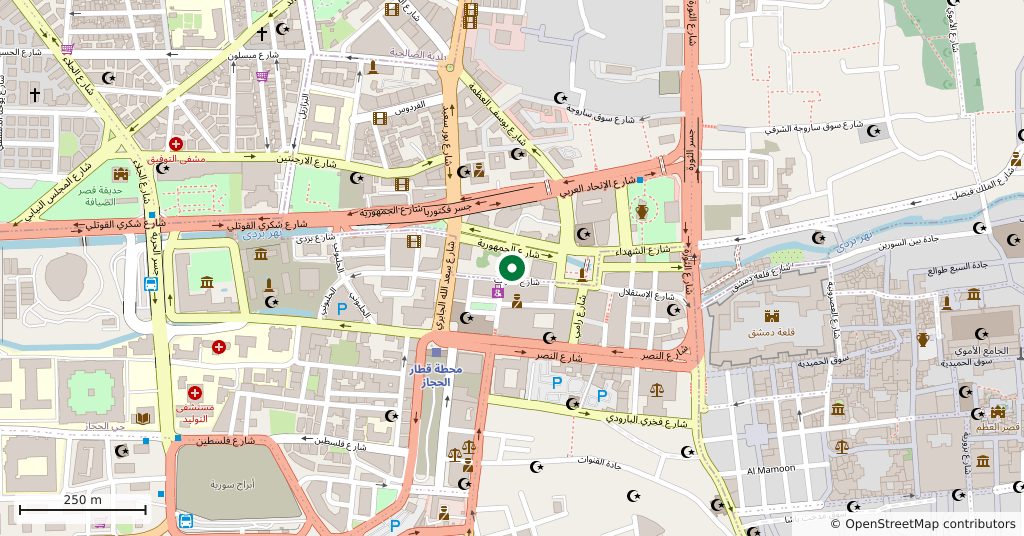
The Grand Serail on the south side of Marjeh Square opened in 1900 as the governor’s seat. King Faysal and the French Mandate both ruled Damascus from it.
- Opening hours
- In official use; the interior is closed to visitors, the façade is there at any hour
- Entry
- Free from the street; no visitor entry to the building
- Duration
- 15 minutes
- Best time
- Late afternoon, when the square fills and the light comes across the front
- Period
- Late Ottoman
- Address
- South side of Marjeh Square, on the Barada, Damascus
The large stone building beside Marjeh Square, on the south bank of the Barada, is the answer to the question of who ran Damascus after 1900. It went up over the old municipal garden while Husayn Nazim Pasha was governor, and the name Grand Serail stuck to it. A European plan, a pyramidal roof. The interior is still in official use and closed to visitors; the front that makes the square a square is in full view from the street.
Getting there
On the southern edge of Marjeh Square, across the Barada. Come out of the Al-Hamidiyah Souq onto An-Nasr Street and walk west; the square delivers you here by itself. The Al-Abed Building stands on the eastern face of the same square, some two hundred metres away, and the courthouse is five minutes to the east.
Can you go inside
No. The building has been in unbroken state use since independence: as ministries left, other departments took their rooms, and in the end it went to the Ministry of the Interior. In 2011 it was transferred to the Ministry of Tourism to be assessed as a hotel, but it never became one. In April 2013 a car bomb damaged it. Watching the façade from the pavement is the only form of visit available.
What the façade shows
This belongs to the generation of buildings through which European architecture reached Damascus: even rows of windows, a classical cornice, a pyramidal roof rising at the centre. The front once carried the cipher of Sultan Abdulhamid II; it was taken down after independence and an empty panel was left in its place. That blank is the most talkative detail on the building.
What happened here
On 26 September 1918, when the Ottoman garrison pulled out of the city, Emir Muhammad Said al-Jazairi walked in and declared himself governor of Damascus. On 1 October Faysal arrived with the allied army. Through King Faysal’s reign and the whole French Mandate this was the seat of government. Ministries began to move out from 1949, foreign affairs first; by the middle of the 1960s the prime minister’s office had gone too.
Do not miss
The spot where the cipher was cut out of the façade, and the pyramid of the roof as it reads from the Barada side. Almost everyone photographing on the square turns towards the telegraph column, not the building behind them.
Tips
- Look from the footbridge over the Barada; the whole front reads from there
- Photograph from the pavement, not the central island — the square carries traffic
- The Al-Abed Building and the telegraph column are on the same square; all three in one stop
Transparency
- How this was chosen
- Written by hand; opening hours, entry fee and coordinates are kept as data. A field that is not known for certain is marked as variable rather than guessed.
- Facts checked
- September 2026
- Last updated
- September 15, 2026