The Palace of Justice, Damascus
Across from the Al-Hamidiyah Souq stands the building that has housed whoever ran Damascus since 1554: Ottoman governors, French commissioners, now courts.
- Opening hours
- A working courthouse; the interior is closed to visitors, the façade is there at any hour
- Entry
- Free from the street; entry to the building only on court business
- Duration
- 15 minutes
- Best time
- Early morning, while the street is still empty
- Period
- Ottoman — French Mandate — Republic
- Address
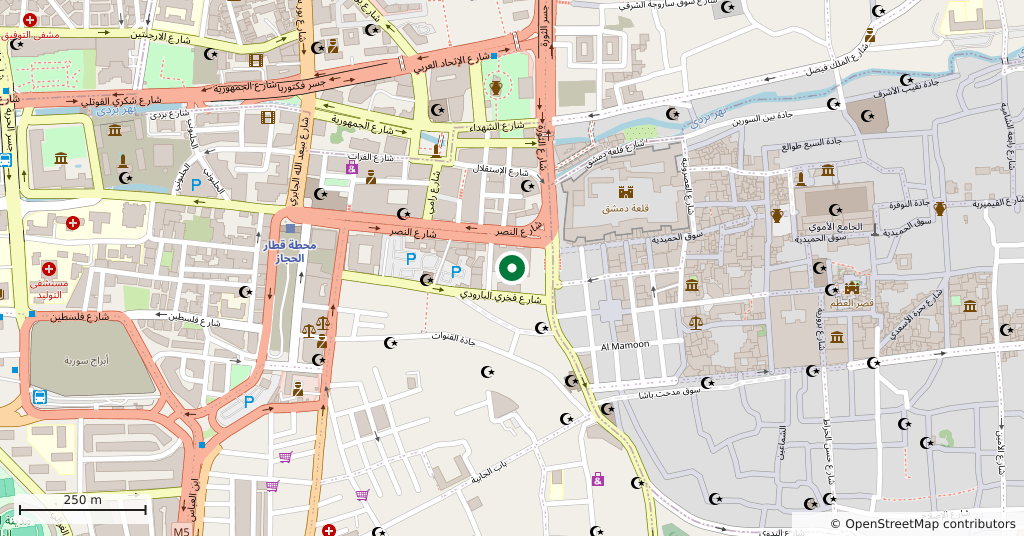
- An-Nasr Street, opposite the Al-Hamidiyah Souq, Damascus
Cross the street from the western end of the Al-Hamidiyah Souq and the long stone front opposite you belongs to a building through which four different administrations of Damascus passed. In 1554 it became the official residence of the Ottoman governor. Under the French Mandate it held the High Commission. Today the sharia and civil courts sit here. The inside is not open to visitors. What there is to see is the façade, and the continuity it records.
Getting there
On An-Nasr Street, directly across from the Al-Hamidiyah Souq. Leave the souq, turn to the street, and it is over your right shoulder. Marjeh Square is five minutes on foot, the citadel about the same the other way. The ground it stands on was called the Ahsasiyah quarter, then the Darwishiyah quarter; those names have given way to the street.
Can you go inside
No. This is a working courthouse: hearing rooms, clerks’ offices, lawyers, people with business to settle. There is a security check at the door and no visitor tour. The Ministry of Justice itself moved out to Mezzeh; the courts stayed. Looking from outside is fine. Standing about at the gate is not.
What the façade shows
The front you see was built after 1831. That year Ibrahim Pasha entered Damascus with the Egyptian campaign, lived here, and had the south wing burnt. The repair that followed gave the building a three-faceted main entrance shaped like a mihrab under muqarnas — the tiered stone corbelling of Islamic building — and pointed-arch windows resting on columns. The door looks lifted from a mosque, though no mosque ever stood behind it. Counting the arched windows from left to right is the quickest way to read the rhythm of the front.
Who used the building
It became the governor’s residence in 1554, under Shamsi Pasha, and was called Dar al-Saada; in 1573 the name changed to Saray al-Hukuma. In 1850 it was made headquarters of the Fifth Army and known as Dar al-Mushiriyah. In 1898 Kaiser Wilhelm and his wife were received here. The French Mandate turned it into the High Commission, and after 1929 the registry and passport offices moved in. It burnt in 1945, was repaired under the government of Shukri al-Quwatli, and then became the courthouse. In March 2017 a suicide attack struck its gate.
Do not miss
The band of inscription above the main arch, and the run of muqarnas directly over it. The crowd leaving the souq walks off with its back to the building. That band is the one surface here that shows how a public building in Damascus described itself.
Tips
- Come out at the west end of the souq and cross; the building is straight ahead
- Do not try the door; photograph it from the pavement
- Marjeh Square is five minutes away: the Al-Abed Building and the Grand Serail are on the same walk
Transparency
- How this was chosen
- Written by hand; opening hours, entry fee and coordinates are kept as data. A field that is not known for certain is marked as variable rather than guessed.
- Facts checked
- September 2026
- Last updated
- September 15, 2026