The Temple at Dumeir
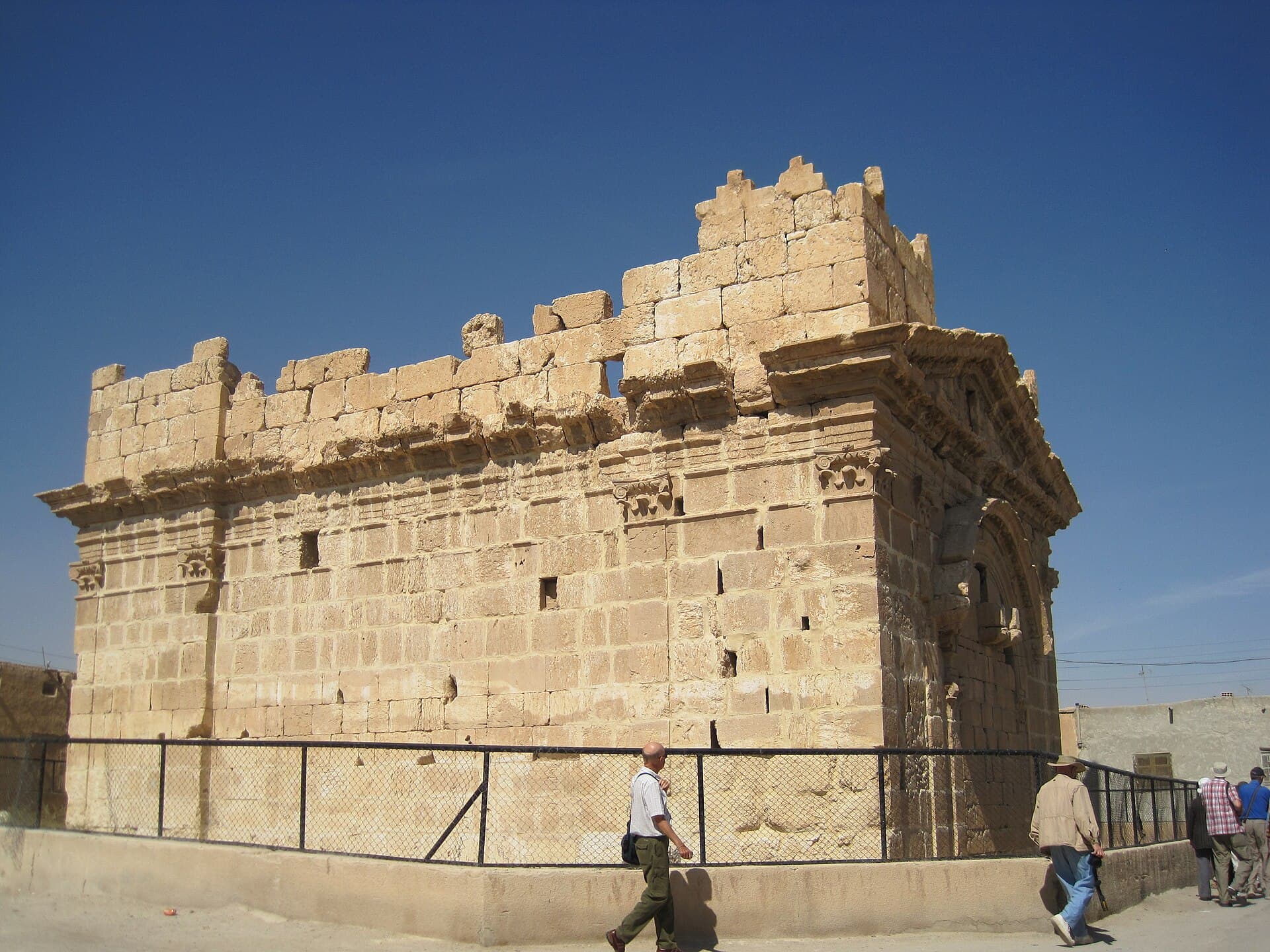
In the middle of a town on the desert edge north-east of Damascus stands a temple dedicated to Zeus Hypsistos in 245. All four of its walls are still up.
- Opening hours
- Outside freely in daylight; ask in the town to go in
- Entry
- Variable — confirm on arrival
- Duration
- 30 minutes
- Best time
- Morning; the stone is pale and midday sun flattens the carving
- Period
- Nabataean — Roman — Arab-period fortification
- Address
- Old centre of Dumeir town, 45 km north-east of Damascus
The road out of Damascus towards Baghdad passes through Dumeir before it enters the steppe. In the old centre of the town, among the houses, stands a building of dressed stone with four walls: a temple dedicated in 245, under the emperor Philip the Arab, to Zeus Hypsistos. Its form is unusual, and researchers explain that with a question — this may not have begun as a temple at all. It may have been built as a public fountain or a staging post on the road, and only ended up as a temple.
Getting there
45 kilometres north-east of Damascus. Minibuses following the eastern road out of the city call at the town; about an hour by car. The temple is inside the town and cannot be seen from the highway, so go down to the centre and ask.
How long it takes
Half an hour. It is a single volume; walking round it and looking at the doorway arch and the corner pilasters fills that time.
What to see
All four walls stand, finished at the top with a stepped crest. The real work is on the great arched doorway in the east face: the arch and its jambs are carved from top to bottom, and Corinthian capitals sit at the corners. The building is of sand-coloured limestone and its body rises half a storey above the houses around it; a wire fence runs round it. You will see that the arch in the rear wall has been blocked with stone — that is not Roman but Arab-period work, when the building was closed up for defence and turned into a small fort.
What not to miss
Three centuries before this temple, another sanctuary stood here. An altar dedicated to Baalshamin and dated to 94 was found at Dumeir, and is now in Paris, in the Institut du Monde Arabe. Its presence points to a Nabataean temple on the spot: the Roman building did not go up on empty ground but on ground already held sacred. A second detail: in Byzantine times the Ghassanid phylarch al-Mundhir III had a tower built here, and its Greek inscription names him while giving thanks to God and to Saint Julian.
What remains
The building has been through a long process of research and reconstruction, and what stands now is the result of that work. The ground around it is laid out and fenced and the door is usually locked; you have to ask in the town to get inside. Walking round the outside is free, and most of what there is to see is on the outside anyway. There was once a monastery called Dayr al-Matirun 3 kilometres east of the town — the name comes from the Greek martyrion — and today there is nothing to do but ask where it stood.
Tips
- Give the arched east doorway some time — all the carving on the building is there
- Look for the arch blocked with stone in the rear wall; that is the Arab-period fort
- If you want to go inside, ask in the town who holds the key
- It is a half-day trip out of Damascus; there is little shade or water, so carry some
Transparency
- How this was chosen
- Written by hand; opening hours, entry fee and coordinates are kept as data. A field that is not known for certain is marked as variable rather than guessed.
- Facts checked
- September 2026
- Last updated
- September 15, 2026