Ebla
A tell 55 km southwest of Aleppo. The burnt archive of Palace G gave up thousands of cuneiform tablets from the 3rd millennium BC, now in Aleppo and Idlib.
- Opening hours
- Open ground; the keeper's presence varies — confirm on site
- Entry
- Variable — confirm on site
- Duration
- 90 minutes
- Best time
- A spring morning; there is no shade on the mound
- Period
- Early Bronze Age
- Address
- Tell Mardikh, near Saraqib on the Aleppo–Damascus road, Idlib governorate
A tell in Idlib governorate, 55 km southwest of Aleppo: Tell Mardikh. Under it lies one of the largest Syrian cities of the 3rd millennium BC, a place known until 1968 only from the records of other cities. What made Ebla famous is not its architecture but an archive that a palace preserved while burning.
Getting there
Beside the Aleppo–Damascus road, next to the village of Mardikh near Saraqib. The tell rises alone out of the plain; it is visible from the road and signposted. You can reach it by public transport, but the last stretch is on foot.
What to see
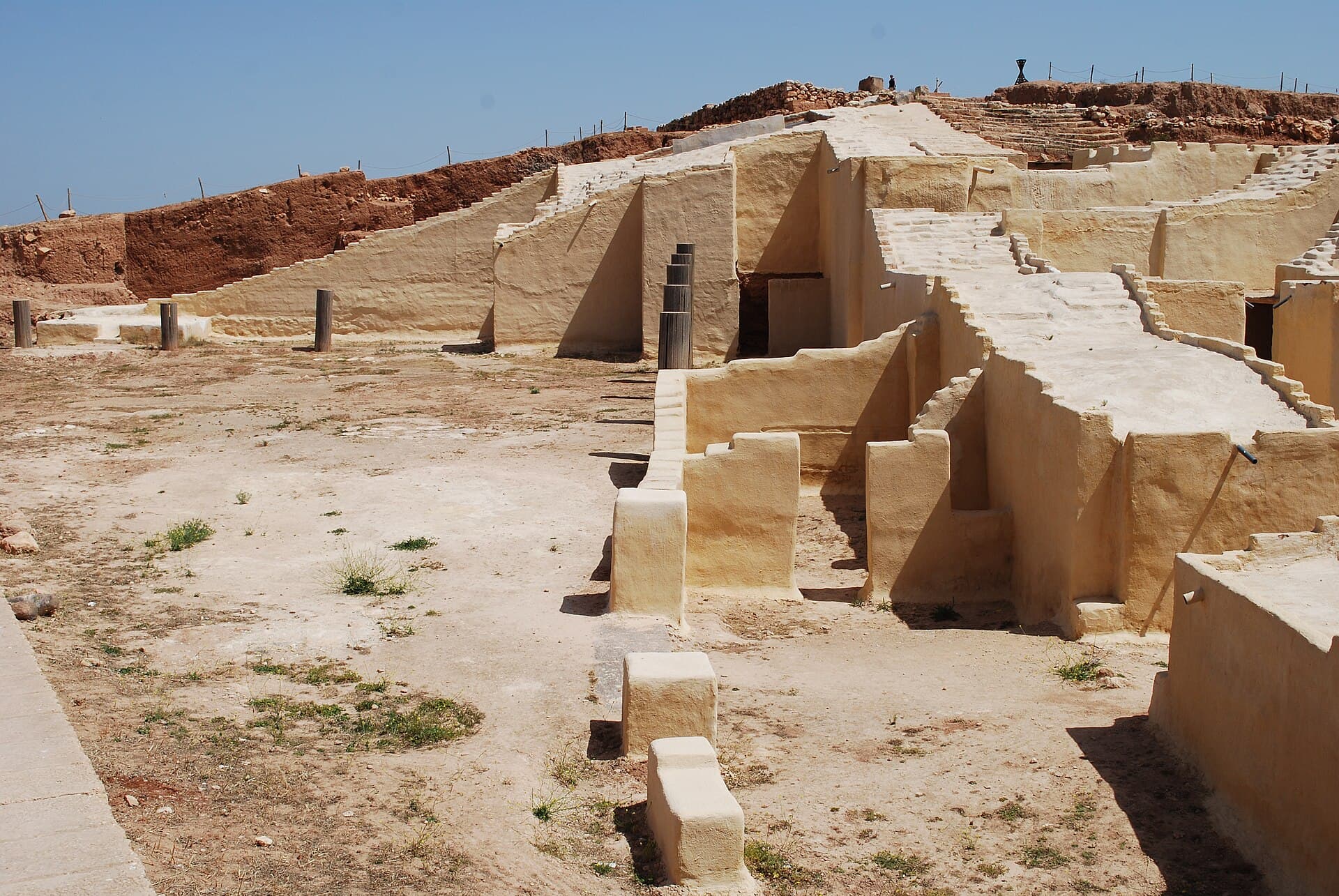
The city consisted of a lower town and an acropolis in the centre, and covered 56 hectares. It was ringed by a mud-brick wall and divided into four quarters, each with its own gate in that wall. What is visible on the mound today is excavated walling, the palace’s ceremonial staircase and temple foundations; the rest is still under earth. Most of Ebla has never been dug.
What the tablets say
In 1964 an Italian team from Rome began digging under Paolo Matthiae. In 1974 the archive was found in Palace G on the acropolis, in two small rooms off the audience hall: some 1800 complete tablets and 4700 fragments. The tablets stood ranged on wooden shelves; the fire that destroyed the palace collapsed the shelving and fired the clay at the same time, so both the texts and their shelf order survived. The fire saved them.
The texts date between 2500 and 2250 BC. They are written in two languages: Sumerian, and a Semitic language unknown until then, now called Eblaite. Among them are word lists setting Sumerian against Eblaite — reckoned the oldest known dictionaries. The tablets are held today in the museums of Aleppo, Damascus and Idlib.
The state of the site
The mound was damaged during the war years. Satellite imagery showed military trenching and illegal digging on the acropolis in 2017, and the number of pits grew in the years after. Some of the disturbance you see on the surface, then, is not the work of excavation but of recent years.
What most people miss
The ceremonial staircase of Palace G. The archive rooms opened off the audience court right beside it, so standing at the foot of those steps puts you a few paces from where the tablets came out. Most visitors climb to the top of the mound for the view and pass this corner without picking it out.
Tips
- There is no shade and no water on the mound; take a hat and water
- Find the ceremonial staircase of Palace G; the archive rooms were beside it
- You cannot see the tablets here — they are in the Aleppo and Idlib museums
- The ground is pitted with dug holes; keep off the edges and stay on the paths
Transparency
- How this was chosen
- Written by hand; opening hours, entry fee and coordinates are kept as data. A field that is not known for certain is marked as variable rather than guessed.
- Facts checked
- August 2026
- Last updated
- September 15, 2026