The Elfrange Synagogue in the Jewish Quarter of Damascus
The synagogue in the Jewish quarter of old Damascus. Named after Sephardi arrivals, it is the last synagogue in Syria still used for worship; entry by permission.
- Opening hours
- Not open to regular visits; the door is locked and permission comes from the community or the quarter
- Entry
- No entry fee; visits by permission
- Duration
- 20 minutes
- Best time
- Morning, while the lanes of the quarter are still empty
- Period
- Ottoman — second half of the 19th century
- Address
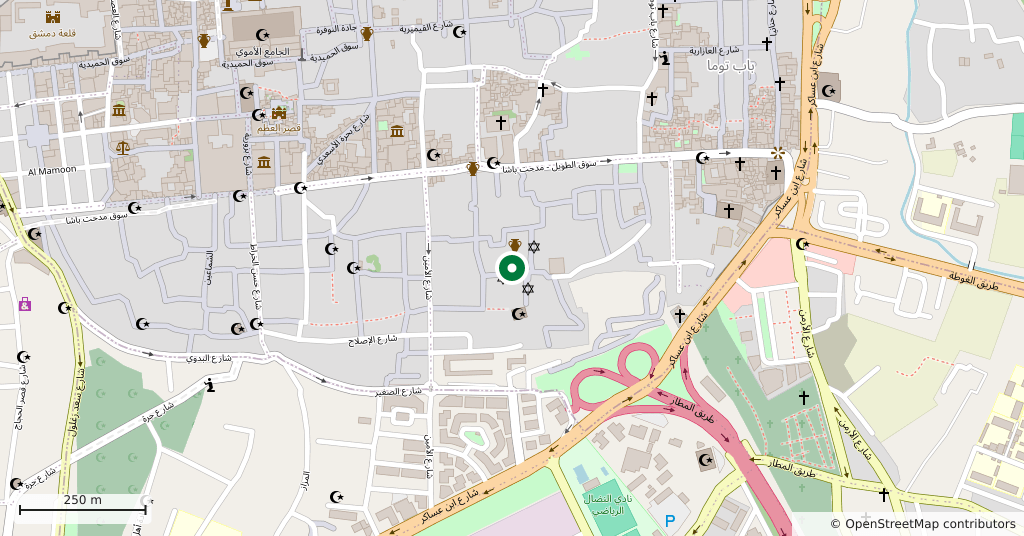
- Al-Fannanin cul-de-sac, Jewish Quarter, Old City, Damascus
In the Jewish quarter of old Damascus, on the east side of the al-Fannanin cul-de-sac between the Liniado and Farhi-Muallim mansions, there is a door. From the street there is almost no religious sign on it, and it is hard to tell apart from the other doors of the quarter. Behind it stands the Elfrange Synagogue, the last synagogue in Syria still used for worship.
Getting there
The quarter lies south of Straight Street, within walking distance of Bab Sharqi. The lanes are narrow and cut by dead ends; once you are in the al-Fannanin cul-de-sac, watch the east side. The door will be locked. The building is not open to regular visits, so seeing the inside needs permission from the community or from a neighbour.
What to see
The present building went up in the second half of the 19th century. The plan is rectangular, the hall has three aisles, and round arches rest on cylindrical stone columns. Its doors, its floor and its bimah, the reading platform, were designed by Maurice Nseiri, a Jewish craftsman from the quarter who later emigrated to the United States. The gap between inside and outside is the most concrete thing about this building: craftsmanship within, almost no sign without. That was the rule across the quarter.
The Sephardi beginning
The oral tradition of the Damascus Jews holds that the synagogue was founded at the end of the 15th century by Sephardim fleeing the Reconquista, and that the service was held in Ladino. The name comes from the same story: firenj means Frank, that is, someone from the west. The building you see is not that first structure, but the site is the same and the name did not change.
Today
The community thinned out after the pogroms of 1949 and the exit permission granted under Hafez al-Assad. By 2020 twelve elderly Jews remained in the city, and it was they who repaired the synagogue in 2019. In February 2025 Rabbi Yusuf Hamra and his son Henry came here with a delegation, the first such visit since the closure. The building is not a sealed monument; the use is rare but it continues.
Tips
- The door is on the east side of the cul-de-sac and carries no religious sign; without the address it is hard to find
- Seeing the inside needs permission; ask in the quarter rather than trying the door
- The Menarsha Synagogue is ninety metres north; the two make one walk
- Do not photograph during a service
Transparency
- How this was chosen
- Written by hand; opening hours, entry fee and coordinates are kept as data. A field that is not known for certain is marked as variable rather than guessed.
- Facts checked
- September 2026
- Last updated
- September 15, 2026