The Latin Monastery: where the 1860 massacre reached in Damascus
The Franciscan monastery two hundred metres south of Bab Touma. It remembers the 11 people killed here in 1860, and the graves lie beside the side altar.
- Opening hours
- Open at service times; outside them, ask the attendant at the gate
- Entry
- Free
- Duration
- 30 minutes
- Best time
- 10 July, the feast day, or Sunday morning during the liturgy
- Period
- Ottoman — on this site for centuries
- Address
- Corner of Deir Street and Bab Touma Street, Old City, Damascus
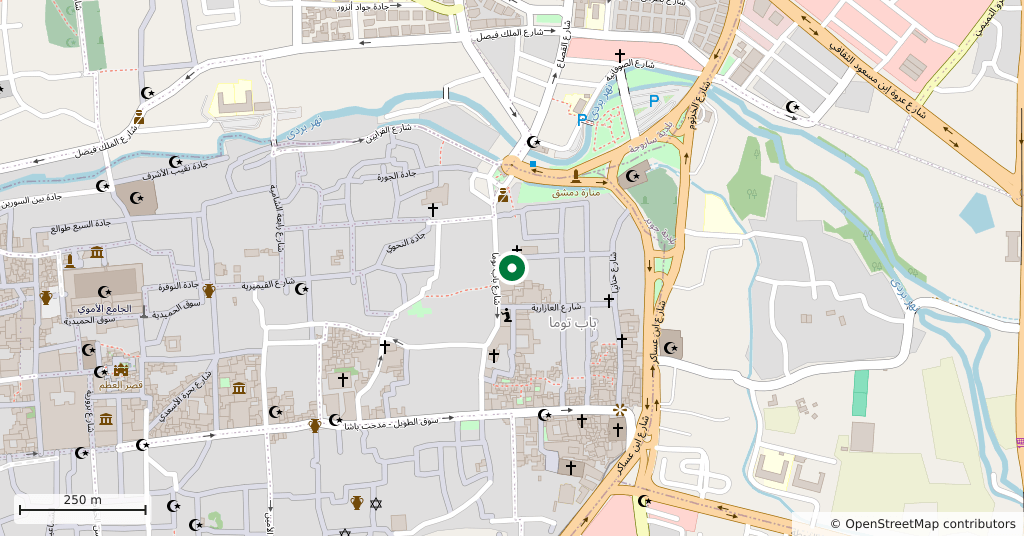
At the corner of Deir Street and Bab Touma Street, two hundred metres south of the gate, stands a monastery behind high walls. People in Damascus call it al-Dayr al-Kabir, the Great Monastery; the name Latin Monastery points at the same place. Run by the Franciscans, it is the one address in the old city that says exactly where the 1860 massacre reached. The Maronite Cathedral of Saint Anthony faces it across the street.
Getting there
Walk south from the Bab Touma gate. The monastery door is at the corner where Deir Street begins, and it is the largest door on that street; you can walk past the other churches of the quarter, but not this one. The door leads into a courtyard and the courtyard into the church.
What to see
The monastery is a church, a courtyard, and the wings where the friars live. An 1844 geography handbook lists it as one of the three Catholic monasteries of Damascus: eight Spanish friars lived inside, and the other two were the Lazarist and Capuchin houses. Beside the side altar of the church there are graves, and they belong to the night described below.
What happened here in 1860
On 9 July 1860, during the massacre in the Christian quarter, families from the surrounding lanes took refuge in this monastery. Militia entered it and 11 people were killed: Engelbert Kolland, a friar from Tyrol, seven Spanish friars, and the three Massabki brothers, Maronites who refused to renounce their faith, Francis, Abdel Mooti and Raphael. The 11 were beatified by Pope Pius XI on 10 October 1926 and their feast was set for 10 July. The Massabki brothers were canonised by Pope Francis on 20 October 2024, becoming the first Maronite laymen declared saints of the Roman Catholic Church. The graves of Kolland and the seven Spanish friars are beside the side altar of the church, and the Massabki brothers are named in the same list.
What not to miss
The graves beside the side altar. Most visitors cross the courtyard, enter the church, look at the main altar and never turn aside. One more thing worth knowing: the Franciscans serve the Roman Catholics of Damascus, yet most of the people who come to this church belong to other churches. The quarter remembers this monastery by 1860, not by denomination.
Tips
- The door is at the corner where Deir Street begins and it is the largest on the street
- The graves are beside the side altar; do not look at the main altar and turn back
- The Maronite Cathedral of Saint Anthony stands opposite on the same street; count the two as one stop
- Do not photograph during the service; ask afterwards
Transparency
- How this was chosen
- Written by hand; opening hours, entry fee and coordinates are kept as data. A field that is not known for certain is marked as variable rather than guessed.
- Facts checked
- September 2026
- Last updated
- September 15, 2026