The Hanabila Mosque
The first Ayyubid mosque in Damascus, in Salihiyya. Founded in 1201 by a family of scholars from Jerusalem and read as a small copy of the Umayyad Mosque.
- Opening hours
- Open around prayer times
- Entry
- Free
- Duration
- 30 minutes
- Best time
- Morning, while the courtyard is empty
- Period
- Ayyubid
- Address
- Salihiyya, lower slope of Qasiyun, Damascus
The oldest stone in Salihiyya, on the lower slope of Mount Qasiyun. Abu Umar Muhammad ibn Ahmad ibn Qudama al-Maqdisi began building it in 1201. He was a Hanbali scholar, and his family had moved from Jerusalem to Damascus in 1155. The emir of Irbil, Muzaffar al-Din Gokburi, paid for much of the work, which is why the mosque is also called al-Muzaffari. It was in use by 1207. The minaret was finished in 1209. It is among the oldest large mosques in Damascus after the Umayyad Mosque, and the first the Ayyubids built in the city.
Getting there
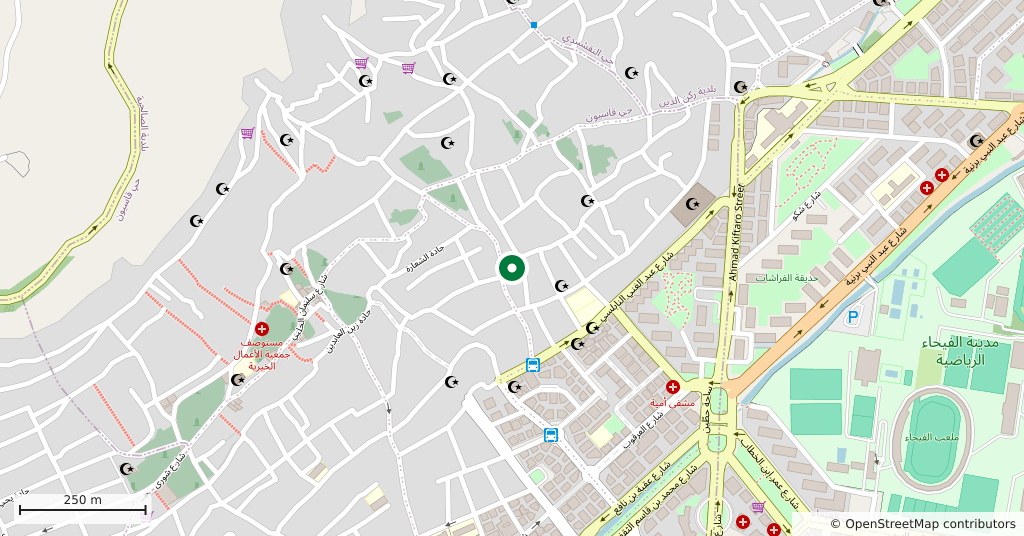
Inside the Salihiyya market street, a few hundred metres north-east of the Ibn Arabi Mosque. Follow the road that climbs north from the old city towards Qasiyun; once you are in Salihiyya you may have to ask, because the mosque has no street front and is entered through a narrow gap.
What to see
The plan is read as a reduced version of the Umayyad Mosque: a courtyard, a fountain in the middle of it, a prayer hall along the qibla side. Two iwans face each other across the courtyard, each carried on five old arches. There is little ornament. The stone is plain and the proportions are broad. Coming here after the Ottoman mosques of Damascus shows the difference between the two periods at a glance.
The mosque that made the quarter
When the Maqdisi family arrived from Jerusalem they settled not inside the Damascus walls but on the empty slope to the north. The quarter they founded was called Salihiyya, the place of the righteous, and the mosque became its centre. The two other names of the building say the same thing: the Mountain Mosque, and the Mosque of the Righteous.
Don’t miss
Look at the rows of arches in the courtyard — the stones are older than the mosque, reused from earlier buildings. And look at the minaret: its shaft, dated 1209, is one of the few Ayyubid minarets left in the city.
Tips
- The mosque has no street front; the way in is through a narrow gap
- It fits into the same walk as the Ibn Arabi Mosque, a few hundred metres away
- Look closely at the reused arch stones in the courtyard
Transparency
- How this was chosen
- Written by hand; opening hours, entry fee and coordinates are kept as data. A field that is not known for certain is marked as variable rather than guessed.
- Facts checked
- September 2026
- Last updated
- September 15, 2026