The Jaqmaqiyya Madrasa and Calligraphy Museum
A Mamluk madrasa facing the north gate of the Umayyad Mosque, now the Museum of Arabic Calligraphy, with a roofed courtyard and its founder’s tomb niche.
- Opening hours
- Variable — check at the door
- Entry
- Variable — check at the door
- Duration
- 45 minutes
- Best time
- Late morning, when light from the courtyard dome falls on the cases
- Period
- Mamluk, the sultanate that ruled Syria and Egypt from the 13th century
- Address
- Opposite the north gate of the Umayyad Mosque, Old City, Damascus
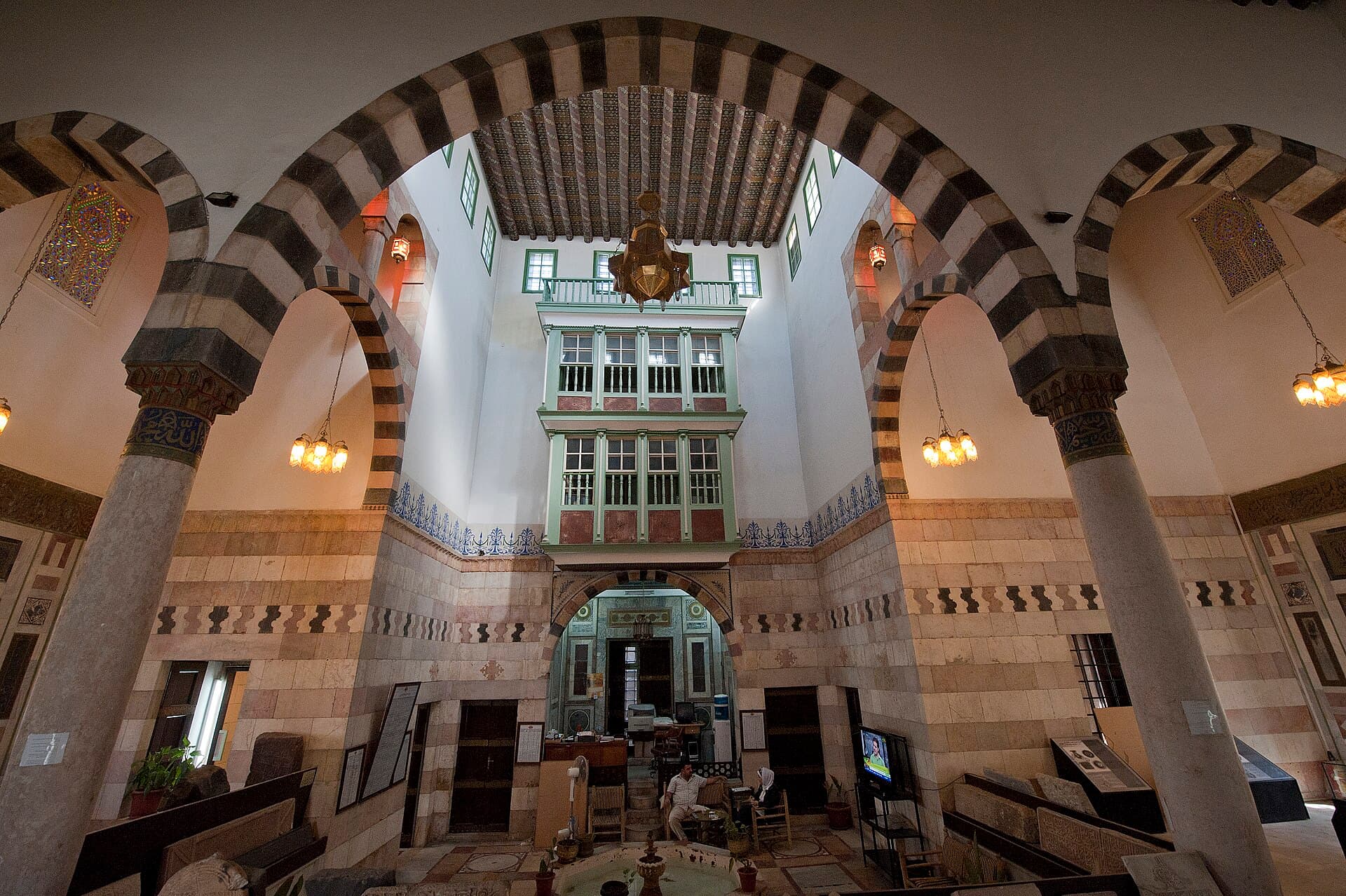
Step out of the north gate of the Umayyad Mosque, look across, and the banded black and white stone facade in front of you is this building. It is a Mamluk madrasa, and it now holds the Museum of Arabic Calligraphy. It stands opposite the busiest point in Damascus and most visitors walk straight past the door, which is a shame: the courtyard is the nearest place to get out of the noise of the great mosque.
Getting there
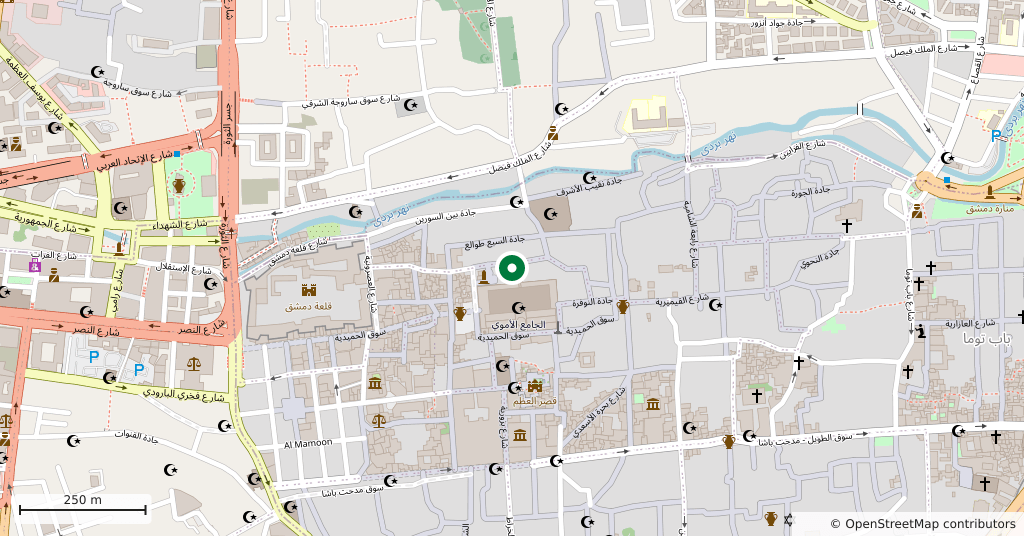
On the lane facing the north gate of the Umayyad Mosque, thirty seconds from the mosque door. From the eastern end of the Al-Hamidiyah Souq, five minutes around the mosque. The entrance is at street level and narrow, so looking for the courses of black and white stone is faster than looking for a sign.
How long it takes
Three quarters of an hour. The museum is small, but the panels in the cases reward reading, and if the shapes of the script interest you at all, you will stay longer.
What to see
The outer walls are built in ablaq, alternating courses of white and black stone, the signature of Damascene masonry. On the north facade is a tall hood of finely cut stone that survives from the building’s earliest layer. The inner courtyard breaks with Damascene habit by being roofed: not an open arcaded court but a domed one. This was a Mamluk answer that departed from the arcaded plan of the Umayyad Mosque, and the madrasa counts as one of its best examples. Ablaq arches ring the court, wooden latticed windows sit above them, and a small basin marks the centre. The cases hold calligraphic panels, inscriptions and writing sets.
Beneath the building lies an older one: a school for orphans founded in 1361, completed and turned into a khanqah, a Sufi lodge, in 1367. It was destroyed when Timur took Damascus in 1401, and its carved fragments were reused in the new building. Sayf al-Din Jaqmaq al-Arghunshawi, governor of Damascus, extended what remained southwards by adding a tomb chamber, brought the orphans’ school back, and opened windows in the north facade. Jaqmaq died in 1421. The madrasa was damaged by shelling in the middle of the last century and repaired afterwards.
What most people miss
The muqarnas niche of coloured stone on the east facade. The founder himself is buried there, and the niche is visible from the street, yet almost nobody who visits the museum steps back outside to look at it. On the way out, turn right, walk ten paces and look up.
Tips
- Put it in the same half day as the Umayyad Mosque; the two doors face each other
- Most labels are in Arabic only, so come prepared
- The roofed courtyard stays cool at midday in summer and makes a good pause
Transparency
- How this was chosen
- Written by hand; opening hours, entry fee and coordinates are kept as data. A field that is not known for certain is marked as variable rather than guessed.
- Facts checked
- September 2026
- Last updated
- September 15, 2026