The Lala Mustafa Pasha Mosque
A working mosque on Baghdad Street in the Saruja quarter of Damascus. It carries an Ottoman governor’s name, but the building is far newer than his mosque.
- Opening hours
- Daylight hours, outside prayer times
- Entry
- Free
- Duration
- 15 minutes
- Best time
- After midday prayers, once the street quietens
- Period
- Ottoman endowment; the present building dates from 1936
- Address
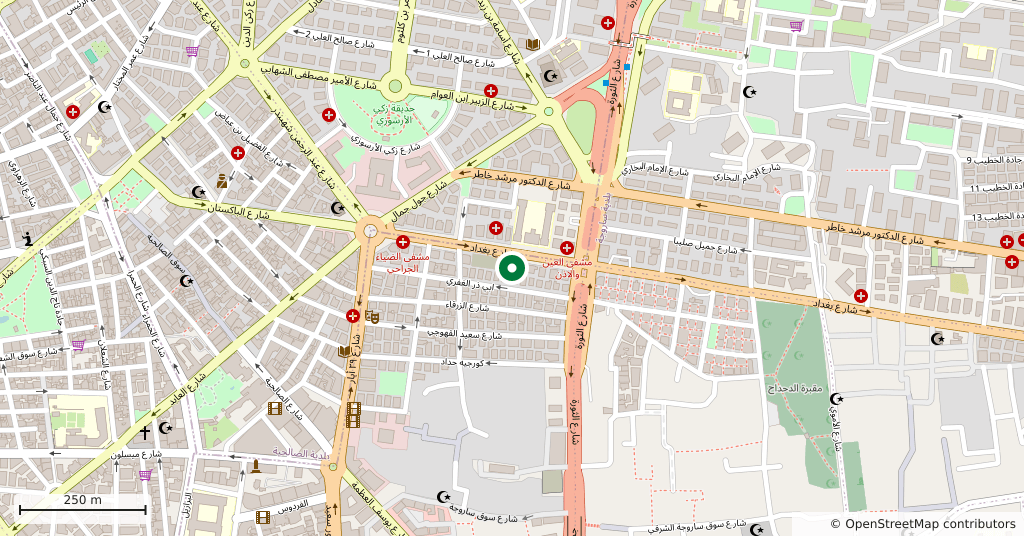
- Baghdad Street, Ayn al-Kirsh, Suq Saruja, Damascus
A mosque north of the walls, on Baghdad Street in the Ayn al-Kirsh part of Suq Saruja. It takes its name from Lala Mustafa Pasha, an Ottoman governor of Damascus, and it is in use today, with its own imam. The building on the street, though, went up some four hundred years after the mosque whose name it carries.
Which building you are looking at
In the year he took the governorship of Damascus — 971 of the Hijri calendar, that is 1563 — Lala Mustafa Pasha founded a mosque. The inscription above its door read 972. That mosque did not stand on this site: it was inside the Mardam Bek garden, next to the spring called Ayn al-Basha, on the line of the Khan al-Pasha market. It was then demolished when Souq al-Hal, the wholesale produce market, was laid out. The descendants of Lala Mustafa Pasha, the Mardam Bek family, built a replacement — this time on Baghdad Street, in 1355 of the Hijri calendar, or 1936. That is the mosque you see.
What the demolished mosque looked like
The German scholars Wulzinger and Watzinger saw the old mosque in place before 1918 and recorded it. It had two storeys: the prayer hall stood above storerooms and rested on eight arches carried by ten stone columns; the roof was timber, the portico had marble columns, and carved script ran above the stone mihrab. What they found was not in good condition either. Their note is blunt: after long neglect the building had ended up serving as a stable.
How long it takes
Fifteen minutes, and the reason to come is not the architecture. You stop here as part of a walk through Saruja, at a place that shows how an Ottoman endowment in Damascus moved address and ended up in a new building. Looking for the 16th century on this facade is wasted effort.
Tips
- Do not look for Ottoman work on the facade; the building you see dates from 1936
- The old mosque was demolished not here but on the ground taken for Souq al-Hal — keep the two apart
- The Suq Saruja market and the Aqsab Mosque are both a short walk away; carry the walk on from there
Transparency
- How this was chosen
- Written by hand; opening hours, entry fee and coordinates are kept as data. A field that is not known for certain is marked as variable rather than guessed.
- Facts checked
- September 2026
- Last updated
- September 15, 2026