The Mosque of Fatima in Bosra
A small Ayyubid mosque beside Bosra’s cathedral, with a minaret dated 1306: a basalt-slab roof in the Hauran manner, a two-phase plan and reused stones.
- Opening hours
- Variable; whether it is open for prayer could not be confirmed
- Entry
- Free
- Duration
- 20 minutes
- Best time
- Morning, when the east face of the minaret catches the light and the lane is quiet
- Period
- Ayyubid — Mamluk
- Address
- North of the cathedral, north-east of the medieval town, Bosra
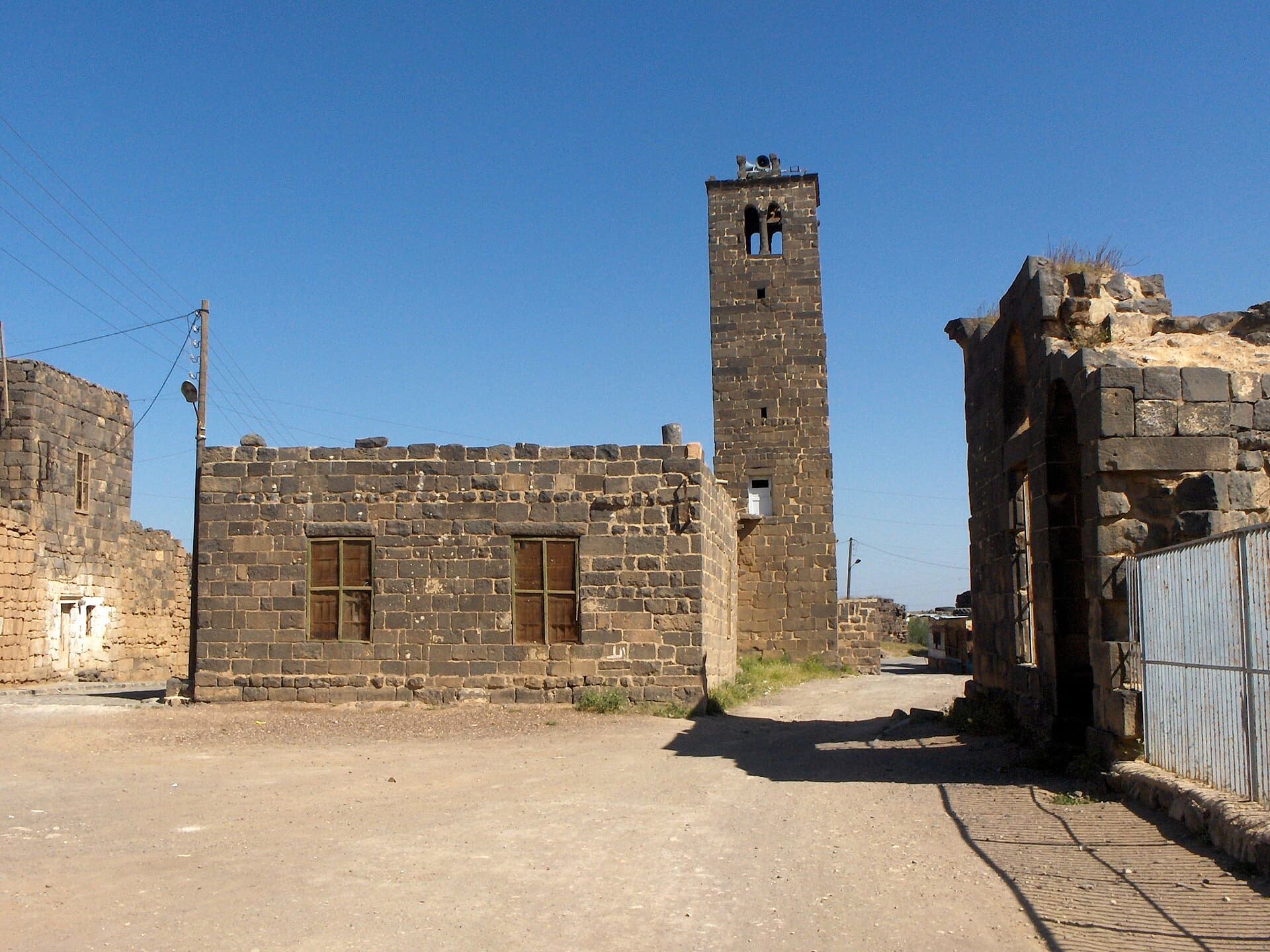
Bosra’s third surviving historic mosque stands right next to the cathedral: a low basalt box with a square minaret rising at one corner. The hall was built in the first half of the 13th century under the Ayyubids, the dynasty founded by Saladin; the minaret was added in 1306 under the Mamluks. It is smaller and plainer than the Al-Omari Mosque, but it shows the Hauran technique of roofing in stone more clearly than any other building in town.
Where it is and how to get there
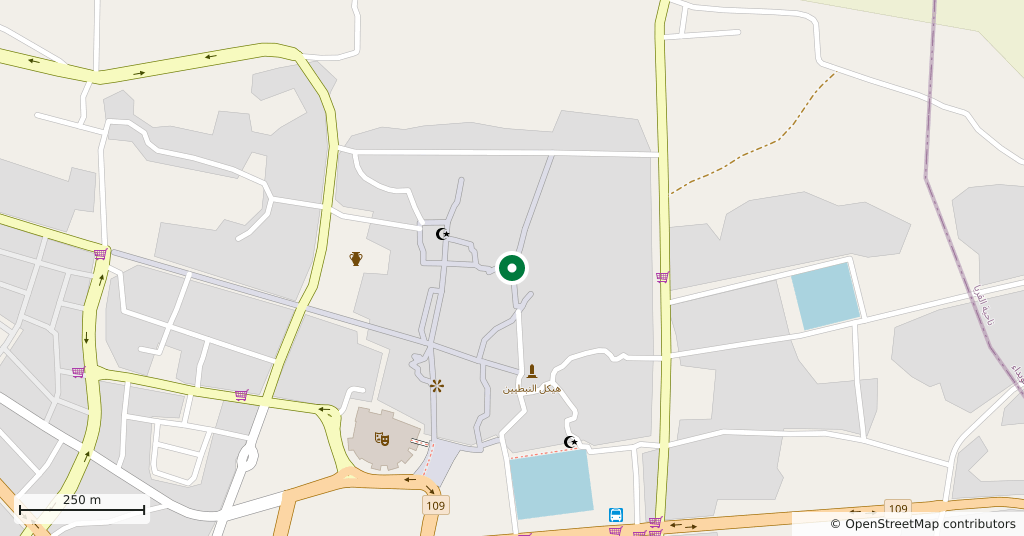
In the north-east of the medieval town, beside the Church of Saints Sergius, Bacchus and Leontius — the Cathedral of Bosra — about 50 metres north of it. Once you have found the cathedral, the minaret is already in view. The Nabataean Arch and the Basilica of Bahira are a few minutes’ walk away.
What to see
The plan is a rectangle, 21 metres by 11, oriented north-south. It is built in the Hauran manner: transverse arches carry flat slabs of basalt. Timber was scarce in this region, and this was how you roofed a room in stone.
Look closely at the long walls. Vertical joints and the larger windows of the southern part reveal two phases. The original building was almost square, a single hall with three arches. Four more bays were added to the south in the early 20th century. At that time it was the only mosque still in use in Bosra — a measure of how empty the town had become at the end of the Ottoman period.
The minaret and its inscriptions
On the north facade, the builder’s name and the date have been chiselled out of the inscription. The careful cursive script that remains still places the building in the Ayyubid period, the first half of the 13th century.
The minaret was built separately and stands at the north-east corner. Its inscription names the builder, Ayyub ibn Majd al-Din Isa al-Najrani, and the Mamluk sultan al-Nasir Muhammad, with the date 705 of the Hijri calendar, which is 1306. Its form copies the minaret of the Al-Omari Mosque, about 90 years older, and it survives intact to a height of 18 metres. It is the only building in Bosra that shows the town kept its importance after the Mongol invasion of 1260.
What not to miss
Look for the reused stones in the walls: a Nabataean Doric frieze and capitals, a Byzantine colonnette, and a Kufic inscription dated between 1147 and 1150. A thousand years of Bosra sit side by side in this small mosque.
The name and its current state
The name “Fatima” is recorded only from the 19th century; the building’s original name is unknown. Whether the mosque is open for prayer today could not be confirmed. If the door is shut, the minaret and facade can still be seen from outside.
Tips
- Find the vertical joint in the long walls; that is where the old hall meets the 20th-century extension
- Look for the Nabataean frieze and the Byzantine colonnette set into the walls
- The cathedral is 50 metres to the south; see both in one stop
Transparency
- How this was chosen
- Written by hand; opening hours, entry fee and coordinates are kept as data. A field that is not known for certain is marked as variable rather than guessed.
- Facts checked
- September 2026
- Last updated
- September 15, 2026