Muhajreen Palace, Damascus
Built on the slope of Qasioun between 1902 and 1905 for an Ottoman governor. Cemal Pasha, King Faysal and Syria’s first president each lived here in turn.
- Opening hours
- In official use; closed to visitors, seen from outside
- Entry
- No visitor entry
- Duration
- 15 minutes
- Best time
- Afternoon, when the slope takes light across it
- Period
- Late Ottoman
- Address
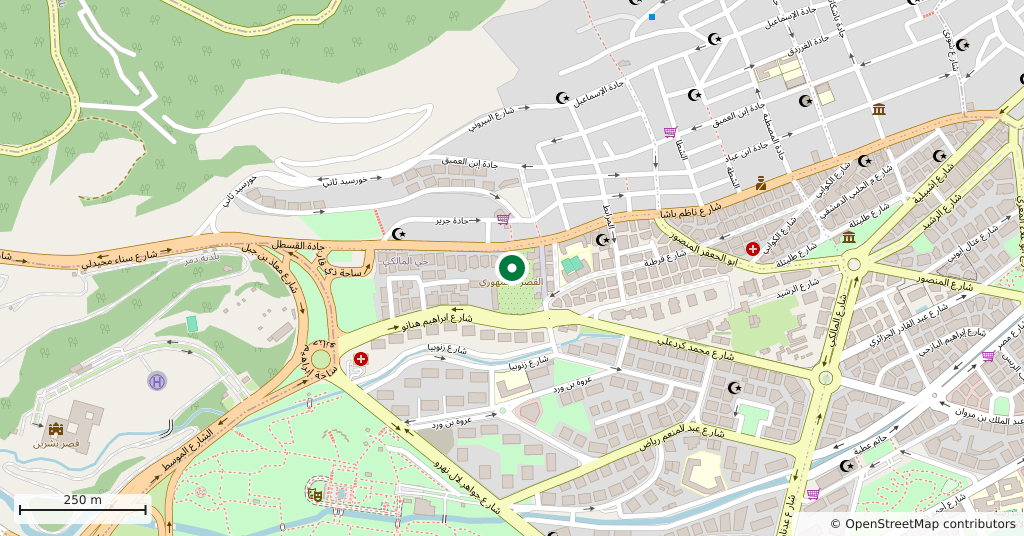
- Nazim Pasha Street, Muhajreen quarter, lower Qasioun, Damascus
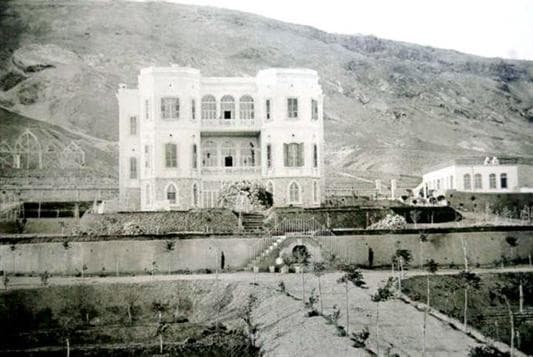
A palace of two floors and a service basement on the lower slope of Qasioun, in the Muhajreen quarter. It stands above a wide garden laid out on three terraces, and it has done the same job since the day it was finished: it houses whoever holds power in Damascus. It is in state use today and closed to visitors; you see it from the garden wall and the gate.
Getting there
The way up runs west from Marjeh and Salihiyah towards Nazim Pasha Street. This is not a walk from the old city — you need a car. The quarter sits on the Qasioun slope, so the road climbs the whole way, and the palace garden stays above the street.
Can you go inside
No. The building served for a long time as a state guest house and has stayed in official use; there has never been a visitor tour. In December 2024, after the fall of Damascus, it was looted. Its present condition and any access arrangement vary, so ask before making the trip to the gate.
Who built it and who designed it
When Husayn Nazim Pasha took office as governor in 1898 he refused to live in the mansions of the old city. He bought land from Shafiq al-Muayyad al-Azm and had a palace built for himself, finished between 1902 and 1905. On the architect the sources part company: an English source gives the design to the Spanish architect Fernando de Aranda, an Arabic source to the Egyptian engineer Khurshid Wahba. Naming both is the honest course; picking one would invent a certainty nobody has. When his term ended, Nazim Pasha is said to have sold the palace to Khurshid Wahba for 5000 gold.
Who lived here
In the First World War it was Cemal Pasha’s official residence and the headquarters of the Ottoman army, and between 1915 and 1918 it also served as a military hospital. King Faysal, crowned in March 1920, lived here until he left the city after the defeat at Maysalun. It then became the embassy of the Kingdom of Iraq. Between 1932 and 1936 it was the residence of Muhammad Ali al-Abid, the first elected president; the tram line was run up to the quarter in those years. A thorough restoration was carried out in 2009-2010.
Do not miss
The three terraces of the garden. The palace does not sit on the slope so much as step the slope and sit on top of it, and in old photographs the stairs and retaining walls read before the building does. From the street the lines of those walls are still legible.
Tips
- Not walkable from the old city; take a car, the road climbs all the way
- Look from the street rather than standing at the gate; the garden terrace shows from there
- The Qasioun viewpoints are on the same slope, so one trip covers both
Transparency
- How this was chosen
- Written by hand; opening hours, entry fee and coordinates are kept as data. A field that is not known for certain is marked as variable rather than guessed.
- Facts checked
- September 2026
- Last updated
- September 15, 2026