The Temple of Mushannaf (Nela)
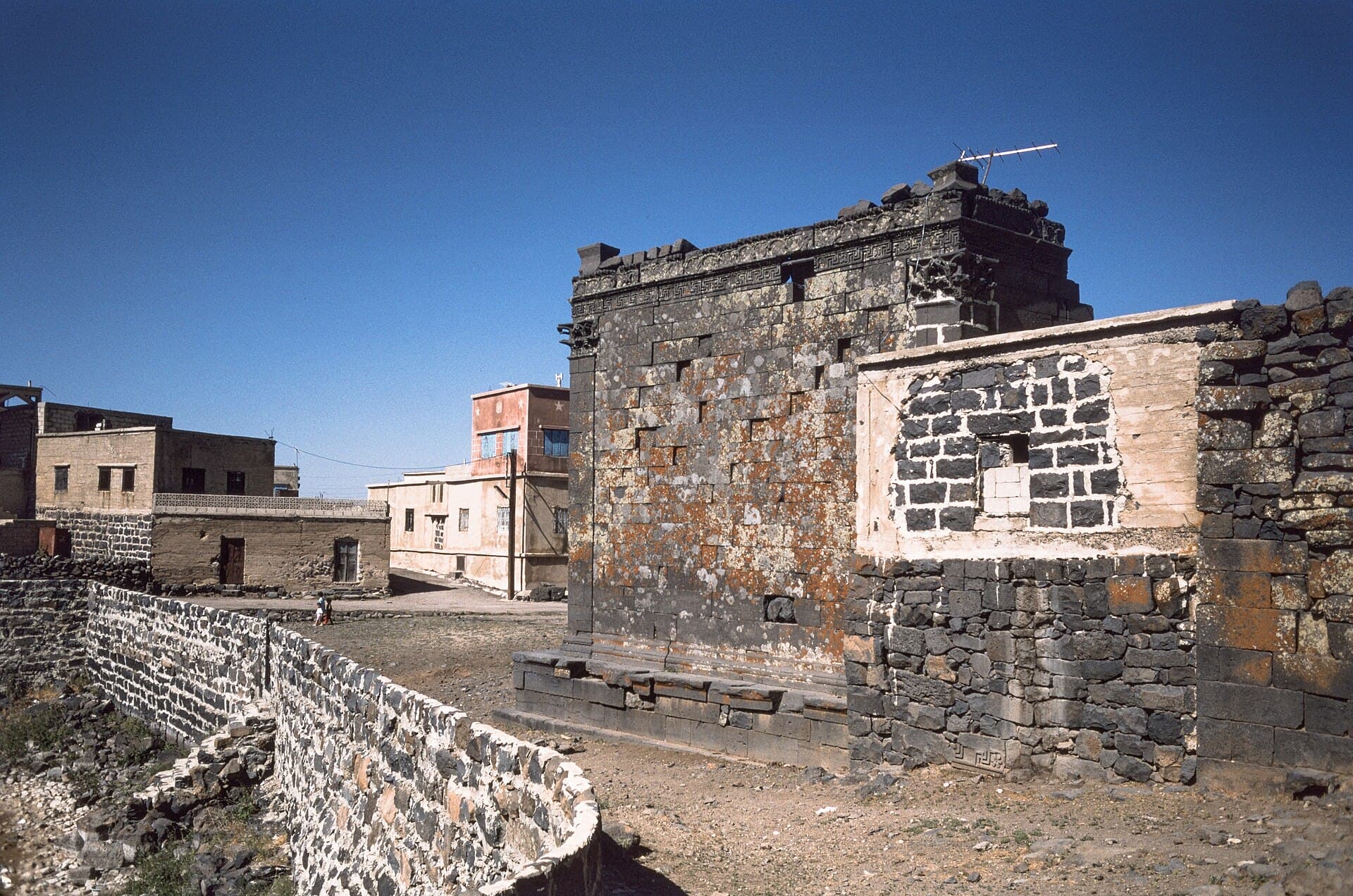
A basalt Roman temple to Zeus and Athena, standing among the houses of a village north-east of Suwayda. One of the best preserved in the whole Hauran.
- Opening hours
- Open site, daylight hours
- Entry
- Free
- Duration
- 40 minutes
- Best time
- Morning; basalt swallows contrast in the middle of the day
- Period
- Roman
- Address
- Al-Mushannaf village, north-east of Suwayda
A Roman temple standing in the village of al-Mushannaf, north-east of Suwayda. The ancient name of the place was Nela, a settlement of the Roman province of Syria on its border with Arabia Petraea. The village today is Druze; families settled here between 1856 and 1858, and the houses grew up around the ancient building.
Getting there
North-east from Suwayda, on the road that branches off towards Qanawat. The temple stands in the middle of the village among the houses. There is no fenced excavation area and no ticket office; you walk to it off the street.
What to see
A prostyle temple on a podium. The podium measures roughly 13 metres by 10. Its entrance faces north, and steps lead up from the courtyard into the inner room. The whole building is local black basalt, laid without mortar, stone resting on stone. Four walls enclose the rectangular precinct, which looked out on an artificial pool on its south side and had colonnades on the others.
What remains
The frieze band along the wall head and the capitals are still in place. Meander, egg-and-dart and acanthus have kept their edges in the basalt, which limestone would not have done. Howard Crosby Butler dug the building in the early 1900s, then Clarence Ward did so again; the Syrian state later carried out a partial restoration.
What not to miss
The votive inscription thought to come from the lintel of the precinct gateway. The text says a local religious association raised the structure for the safety and safe return of “King Agrippa”, in fulfilment of a vow to Zeus and to ancestral Athena. Which Agrippa is disputed. Waddington read him as Agrippa I, which would date the inscription to 41; Mazzilli argues that Agrippa II remains possible. The stone keeps the question rather than answering it.
Tips
- Look closely at the frieze band; meander and acanthus are still sharp in basalt
- Check the south side of the precinct, the pool can be read in the ground
- You are inside a village, mind the privacy of the houses facing the courtyard
Transparency
- How this was chosen
- Written by hand; opening hours, entry fee and coordinates are kept as data. A field that is not known for certain is marked as variable rather than guessed.
- Facts checked
- September 2026
- Last updated
- September 15, 2026